The work permit that renewed itself is gone, and the rule is now final
DHS finalized the end of the 540-day automatic EAD extension on October 14, 2026. Which renewals are covered, which are not, and how to avoid a lapse.
On October 14, 2026, the Department of Homeland Security published a final rule that ends the automatic extension of employment authorization documents — the grace period that let people who filed a timely work-permit renewal keep working while USCIS processed it. The rule takes effect the same day it was published.
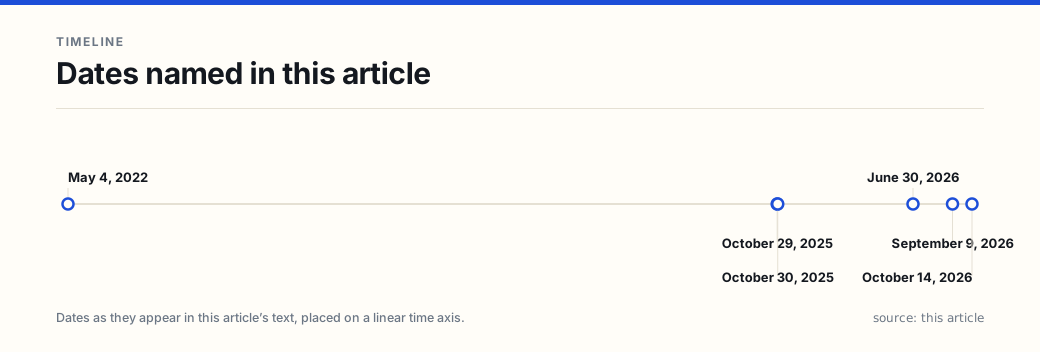
If that were all, it would be a one-line story. What makes it worth reading is that the change actually took effect almost a year earlier, on October 30, 2025, when DHS issued it as an interim final rule. The document published this month does not change a single word of the operative text. Its own summary says it “adopts as final, without change, the amendments to 8 CFR 274a.13(d) and (e)” from the 2025 rule. Anyone who filed a renewal in the last twelve months has already been living under it.
So the honest headline is not “DHS just ended this.” It is: the emergency version is now the permanent version, the last legal route to challenge it through ordinary notice-and-comment has closed, and the readers who are affected are the ones whose renewal is pending right now.
The short version
| Status | A final rule, published and effective October 14, 2026 |
| What it does | Ends the automatic extension of an EAD for renewal applications filed on or after October 30, 2025 |
| What it changes from the 2025 rule | Nothing. It reaffirms the interim final rule as written |
| Who keeps the old grace period | Renewals USCIS actually received on or before October 29, 2025 |
| Who does not | Everyone whose renewal arrived from October 30, 2025 onward |
| The practical consequence | If your renewal is still pending when your card expires, you may have to stop working until it is approved |
| Filing window | USCIS generally recommends not filing more than 180 days early — but does not prohibit filing sooner |
| Litigation | A September 2026 injunction covers seven named plaintiffs, not the public |
What actually changed, and what did not
The rule amends one section, 8 CFR 274a.13, and it splits it in two by date.
Paragraph (d) is now headed “Renewal application filed before October 30, 2025.” For the renewals it still covers, that paragraph does what the old rule did: a renewal that was pending on May 4, 2022, or properly filed on or after that date, gets an automatic extension of up to 540 days, provided it met the conditions in (d)(1)(i) through (iii) — the application arrived before the card’s printed expiration date, it was based on the same employment authorization category, and the applicant’s class of eligibility continues notwithstanding the card’s expiration.
Paragraph (e), “Renewal application filed on or after October 30, 2025,” is the new regime. It says in plain terms that the validity period of an expiring EAD “will not be automatically extended by a request for renewal.”
Read those two headings together and the dividing line is not when your card expires. It is when your paperwork arrived. The final rule is explicit that an application counts as filed before the cutoff only if USCIS “actually received the properly signed application, with required fees, on or before October 29, 2025.” An application mailed in time but delivered on October 30, 2025 does not qualify. That is a narrow, dateable line, and for the many readers who filed after it, it settles the question.
Two outcomes that look alike and are not
This is the part most summaries flatten, and it is the part that decides whether you have to stop going to work. Paragraph (e) treats two groups of people differently, because their work authorization comes from different places.
If you are employment authorized incident to your status — the classes in 8 CFR 274a.12(a), which include refugees, people granted asylum, and people granted Temporary Protected Status — the rule says your card expires the day after the validity date printed on it, but your employment authorization runs with your status. It “will expire or terminate on the same date the alien’s status in the United States expires or terminates.” An expired card stops being valid evidence of your right to work. It does not, by itself, end the right.
The rule’s own worked example is an L-2 spouse of an L-1 worker — a class the rule treats as employment authorized incident to status under section 214(c)(2)(E) of the Immigration and Nationality Act, 8 U.S.C. 1184(c)(2)(E) — who leaves and re-enters the country and comes back with a later status expiration date than the card carries. That person is still employment authorized after the card’s date passes, and the rule notes a Form I-94 designated L-2S can serve as evidence, but the expired card will not.
If you must apply to USCIS for work authorization — the classes in 8 CFR 274a.12(c), which is where most of the affected readers are — the consequence is harder. For them the rule says the EAD “will expire and the employment authorization will terminate the day after the end validity date stated on the face of the EAD,” subject to the separate termination rules in 8 CFR 274a.14. Filing a renewal does not hold the authorization open. They are the group that faces a genuine gap.
The (c) categories the rule itself uses as its examples are adjustment-of-status applicants — (c)(9), people with a pending Form I-485 — and applicants with a pending asylum application. The third category the rule addresses at length in its response to comments is H-4 spouses of H-1B workers, at (c)(26).
The H-4 wrinkle, and one thing that is genuinely new
Two things about H-4 spouses are worth separating, because only one of them is new.
The new part is the loss of the grace period, and it applies to H-4 renewals filed from October 30, 2025 onward like any other (c) category.
But the rule also records that H-4 spouses never had the full automatic extension in the first place in one common situation. Before the 2025 change, an H-4 renewal was automatically extended only if the applicant had an unexpired Form I-94 showing valid H-4 status — and, as the rule puts it, an H-4 spouse under (c)(26) “was not eligible for an automatic extension of employment authorization if their renewal application was dependent upon the adjudication of an application to extend their H-4 nonimmigrant status.” In other words, when the worker’s own extension had not yet been approved, the spouse’s card was already exposed. That is a 2025-era fact the rule is restating, not a consequence of it.
What is not affected: automatic extensions “otherwise provided by law” or in an applicable Federal Register notice for renewing TPS-related employment documentation stay in place. The rule also notes that the 2025 legislation (P.L. 119-21) separately caps the validity period of any employment authorization for a person granted Temporary Protected Status at one year or the duration of the designation, whichever is shorter — a different change, in a different place.
The filing window, stated exactly
Since the filing no longer buys time, the only lever a reader controls is when to file, and this is an area where secondhand summaries get the rule wrong in the direction that hurts people.
What is often said: you may only file within 180 days of expiration.
What the rule says: USCIS “generally recommends that applicants not file requests to renew EADs more than 180 days before the expiration,” and — in the same passage — “there is no prohibition on filing the form before a certain date ahead of expiration.” Elsewhere the rule states that USCIS “will not reject or deny an otherwise eligible Form I-765 renewal solely because it was filed sooner.”
So 180 days is a recommendation about how far ahead the agency would like to see the paperwork, not a gate that closes if you arrive too early. The rule’s advice is the opposite of waiting: “Proper planning by applicants includes filing early, rather than close to the expiration of the EAD, and ensuring that all evidence needed for USCIS to determine eligibility has been submitted with the application at the time of filing.” The rule concedes this “might not avoid a temporary lapse in employment authorization and/or documentation in all cases,” but says it “should help to reduce the potential of a lapse and shorten the duration.”
The backlog underneath the rule
The rule’s justification is that USCIS should complete vetting before granting a new period of work authorization. The scale of the queue is the reason the grace period existed in the first place, and it has not gone away.
According to USCIS figures as of June 30, 2026 reported by Bloomberg Law, more than 432,000 work-permit renewal applications had been pending at least six months, including more than 91,000 pending more than eighteen months. Those figures span multiple categories, not H-4 spouses alone, but they are the arithmetic behind every “file early” instruction on this page: the agency’s own processing time is longer than most cards’ remaining validity.
DHS acknowledges the risk. Its quantified estimate is a set of costs the rule is expected to impose over an eighteen-month period: $138.1 million in lost productivity for employers who cannot easily replace a worker with a lapsed card, $312.1 million in potential labor turnover costs, $138.1 million in transfers from the affected workers to their replacements, and $14.5 million in reduced tax receipts. It estimates that between roughly 1,700 and 2,800 employers are affected.
What DHS says, and what the objections were
The department’s stated rationale is that an automatic extension grants a benefit “without first completing adjudicative review and related vetting, including resolution of any derogatory information.” Ending it, DHS says, “ensures that continued employment authorization is conferred only after USCIS has completed renewed vetting.” The rule also notes that DHS “declines to adopt” the alternatives commenters proposed.
That last point is the substantive record of the objections, because DHS answered them one by one. The rule reports that it received 653 public comment submissions through the Federal eRulemaking Portal under Docket ID USCIS-2025-0271, from attorneys and legal service providers, applicants, professional organizations, unions, advocacy groups, religious organizations, state and local government agencies, and individuals.
The objections it records and rejects are:
- Keep the extension, at some length. Declined. DHS says automatic extensions “are not compatible with its current security and benefit integrity priorities, even in an environment where enhanced vetting tools are used.”
- Vet on a particularized basis without ending the extension. Declined on the reasoning that even a short-lived extension would let an ineligible person “continue to work lawfully and generate money.”
- Issue consecutive or longer EAD validity periods to absorb the delay. Declined. DHS says consecutive cards from back-to-back filings would be “tantamount to one EAD with a longer validity period” and would mean less frequent vetting.
- Expand premium processing or expedited review instead. Partly open. The rule says USCIS “is committed to continuing to explore processing efficiencies, including possible expansion of premium processing for some or all affected populations,” and that it “will alert the public through the website if it expands premium processing services.”
Commenters also raised what they said were the operational realities: processing times that already exceed 180 days, H-1B processing delays that push H-4 renewals later, a halt on asylum decisions that keeps asylum applicants’ cards expiring under an unadjudicated case, and the vulnerability of H-4 holders who are dependent on a spouse’s status. Each of those is in the record. None of them changed the outcome.
The court challenge, and precisely how far it reaches
The rule has been challenged, and it is important to say exactly how little that has done so far.
According to press reports, U.S. District Judge David O. Carter, in the Central District of California, granted a preliminary injunction in September 2026 to seven individual plaintiffs in a case filed by H-4 visa holders, Jane Doe v. Department of Homeland Security, No. 8:26-cv-00060, on the ground that DHS had not adequately justified bypassing the usual notice-and-comment process. Reports differ on the exact date of the order — some give September 10, others September 11.
What that order does: it protects the seven people named in it.
What it does not do: it is not a nationwide injunction, it does not restore automatic extensions for H-4 spouses generally, and it does not suspend the rule for anyone else. A reader who is not one of those seven plaintiffs is in the same position as any other reader of this page. Reporting places the White House review office’s approval of the final rule at September 9, 2026 — before the injunction issued — and the rule took effect when it was published on October 14.
What to do, concretely
If your card’s printed expiration date is approaching:
- Check the date on the card, not the date on your receipt. The card is the thing that expires.
- File as early as you reasonably can. The 180-day figure is a recommendation, not a restriction, and the rule says an early filing will not be rejected for being early.
- File a complete Form I-765. The rule ties the “proper planning” advice to sending “all evidence needed for USCIS to determine eligibility” with the application, on the reasoning that a request for more evidence is what turns a fast case into a slow one.
- Check the current fee on the USCIS Form I-765 page rather than relying on an old amount.
- Ask about the two speed routes. Premium processing applies to some employment-authorization categories and not others; expedite requests are decided case by case and generally need documentation of the urgency. Both are described on USCIS’s own pages, linked below.
- If you are employment authorized incident to status, your card expiring is a documentation problem, not necessarily an authorization problem. Do not assume you have lost the right to work; check what evidence your category provides, and ask your employer’s HR or an immigration lawyer which document they need to see.
If you are an employer: the rule’s own estimate assumes some affected workers will have to be replaced, and it puts the turnover cost in the hundreds of millions across roughly two to three thousand employers. Form I-9 re-verification is triggered by the document expiring, so the practical work is calendar-based — know which employees are in a (c) category, know their card dates, and start the conversation before the date, not after.
If you want to see the text yourself: the final rule is at 91 Fed. Reg. 65306, linked in the sources below, and the codified text of 8 CFR 274a.13 is on eCFR. The rule is long — 63 pages of Register — because most of it is DHS answering the 653 comments. The operative sentences are the DATES line, the paragraph (e) text, and the filing-window passage.
One note on jurisdiction
This is federal immigration law, and it applies the same way in every state. Unlike the employment, housing and contract questions covered elsewhere on Counsel, none of this turns on where you live — the October 30, 2025 cutoff, the category rules at 8 CFR 274a.12 and the filing window are the same in all fifty. The one place state law enters is the separate question of what your state requires as proof of work authorization for a driver’s license or a professional license, which is a different inquiry with a different answer in each state.
A wider list of the official pages worth bookmarking for federal programs lives at omc.center/resources.
This article reflects the final rule published on October 14, 2026 and the regulations as codified at that date. Litigation, processing times and premium-processing availability can change; the figures reported here are the agency’s own estimates and the USCIS backlog counts are as of June 30, 2026.
Frequently asked questions
- I filed my work permit renewal in August 2026. Can I keep working after my card expires?
- Not on the basis of the filing alone. The automatic extension now applies only to renewal applications USCIS actually received on or before October 29, 2025. A renewal filed in August 2026 sits under 8 CFR 274a.13(e), which says the filing does not extend anything — your employment authorization ends when your card does, unless your work authorization comes from your status rather than from the card.
- I am an H-4 spouse. Does this mean I lose my work permit?
- No. The H-4 employment authorization category itself is unchanged, and you can still apply for and hold an EAD under 8 CFR 274a.12(c)(26). What ended is the grace period: if your renewal is still pending when your current card expires, you are no longer authorized to work in the gap. A separate court order in September 2026 protects seven named plaintiffs and nobody else.
- I am employment authorized because of my status rather than a card. Am I in the same position?
- No, and the difference matters. If you are employment authorized incident to your status — the classes in 8 CFR 274a.12(a), which cover refugees, people granted asylum and people granted Temporary Protected Status — the rule says your card expires the day after the date printed on it, but your employment authorization lasts as long as your status does. An expired card stops being valid evidence of your authorization; it does not end the authorization. The same logic is why the rule uses an L-2 spouse as its own example.
- How early can I file the renewal?
- USCIS generally recommends not filing more than 180 days before your card expires, but the final rule says plainly that there is no prohibition on filing earlier and that USCIS will not reject or deny an otherwise eligible Form I-765 renewal solely because it was filed sooner. Filing early is the only lever a reader controls here.
Sources
Each source is a primary or official reference, checked before publication. Links open the original.
- DHS / U.S. Citizenship and Immigration Services — 'Removal of Automatic Extensions for Certain Employment Authorization Documents,' final rule, 8 CFR Part 274a, CIS No. 2859-26, DHS Docket No. USCIS-2025-0271, RIN 1615-AD05, published October 14, 2026 at 91 Fed. Reg. 65306–65368, effective October 14, 2026. Read for: the DATES line; the statement that the rule 'adopts as final, without change' the amendments to 8 CFR 274a.13(d) and (e) in the 2025 interim final rule; the 653 post-promulgation comments and Docket ID USCIS-2025-0271; the (e)(1) rule for aliens employment authorized incident to status and the (e)(2) rule for aliens who must apply; the 180-day filing recommendation and the statement that USCIS 'will not reject or deny an otherwise eligible Form I-765 renewal solely because it was filed sooner'; the TPS-related carve-out; the H-4 history at 8 CFR 274a.13(d)(1)(iii); the declined alternatives; and the cost estimates ($138.1 million lost productivity, $312.1 million turnover costs, $138.1 million in transfers, $14.5 million in tax reduction over an 18-month period, and roughly 1,700 to 2,800 affected employers) — federalregister.gov/documents/2026/10/14/2026-20955/removal-of-automatic-extensions-for-certain-employment-authorization-documents
- The 2025 interim final rule this decision makes permanent — 'Removal of the Automatic Extension of Employment Authorization Documents,' 8 CFR Part 274a, published October 30, 2025 at 90 Fed. Reg. 48799, effective October 30, 2025. Read for: the date that divides the two renewal regimes — renewal applications properly filed before October 30, 2025 keep the old automatic extension, and applications filed on or after that date do not — federalregister.gov/documents/2025/10/30/2025-19702/removal-of-the-automatic-extension-of-employment-authorization-documents
- 8 CFR 274a.13 — Application for employment authorization. Paragraph (d), now headed 'Renewal application filed before October 30, 2025', still grants an automatic extension of up to 540 days where the renewal was pending on May 4, 2022 or properly filed on or after that date and met the conditions at (d)(1)(i) through (iii). Paragraph (e), 'Renewal application filed on or after October 30, 2025', states that the filing 'will not be automatically extended', and sets out the two expiration rules at (e)(1) and (e)(2). Read in the current codified text, not a summary of it — ecfr.gov/current/title-8/section-274a.13
- 8 CFR 274a.12 — Classes of aliens authorized to accept employment. Paragraph (a) lists classes employment authorized incident to status; paragraph (c) lists classes that must apply to USCIS, including (c)(8) for a pending asylum application, (c)(9) for a filed application to adjust status to lawful permanent resident, and (c)(26) for an H-4 nonimmigrant spouse of an H-1B nonimmigrant — ecfr.gov/current/title-8/section-274a.12
- USCIS — Form I-765, Application for Employment Authorization, the form a renewal is filed on, and the page the agency directs readers to for the current filing fee rather than stating it on the form page — uscis.gov/i-765
- USCIS — 'How Do I Request Premium Processing?' and 'Expedite Requests', the two routes to a faster decision that the final rule itself points applicants toward, while noting that expansion of premium processing to more employment-authorization categories is something USCIS says it will announce if it happens — uscis.gov/forms/all-forms/how-do-i-request-premium-processing and uscis.gov/forms/filing-guidance/expedite-requests
- USCIS — Form I-9 and I-9 Central, the employment eligibility verification rules that govern what an employer must do when an employee's work-authorization document expires, the point behind the employer paragraph below — uscis.gov/i-9
- Bloomberg Law — 'DHS Rule Nixes Automatic Extension of Immigrant Work Permits,' October 2026. Read for: the USCIS figures as of June 30, 2026 — more than 432,000 work permit renewal applications pending at least six months, including more than 91,000 pending more than eighteen months — and the statement that the final rule takes effect when it is published in the Federal Register on October 14 — news.bloomberglaw.com/employment/dhs-rule-nixes-automatic-extension-of-immigrant-work-permits
- Hindustan Times — 'H-1B spouses get limited court relief as US government moves ahead with work permit rule,' October 2026. Read for: the September 2026 preliminary injunction by U.S. District Judge David O. Carter in the Central District of California, its scope (seven individual plaintiffs, not a nationwide order), the case number 8:26-cv-00060, the reported approval of the final rule by the White House Office of Information and Regulatory Affairs on September 9, 2026, and the judge's reported observation that 'if an EAD applicant is a national security threat, the issue is that they are able to live in the United States, not that they are able to work in the United States' — hindustantimes.com/world-news/us-news/h1b-spouses-get-limited-court-relief-as-us-government-moves-ahead-with-work-permit-rule-101792036599124.html