The federal contractor test is final: two core factors, effective January 22, 2027
Labor's final rule, published Nov. 23, 2026, swaps the 2024 contractor test for five factors, two of them core. Effective Jan. 22, 2027 if publication holds.
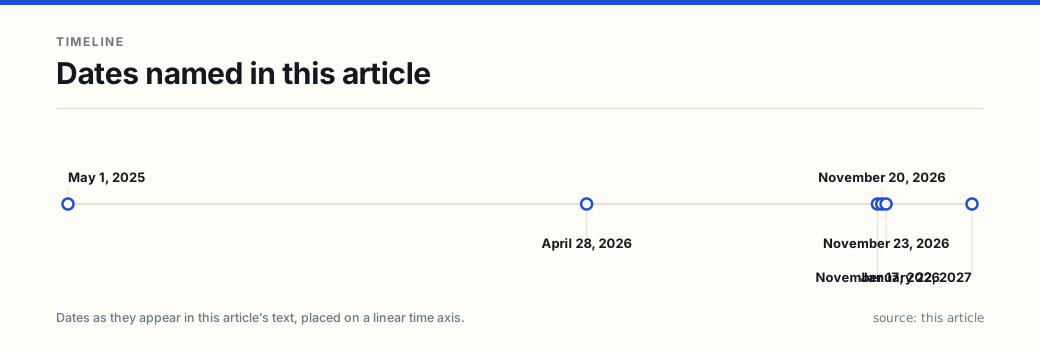
The U.S. Department of Labor has replaced the test its Wage and Hour Division uses to decide whether a worker is an employee or an independent contractor. The final rule — signed November 17, 2026, announced November 19, and printed in the Federal Register on November 23 — rescinds the 2024 rule, restores a five-factor “economic reality” analysis in which two factors carry the most weight, and applies that same analysis under the Family and Medical Leave Act and the Migrant and Seasonal Agricultural Worker Protection Act. It takes effect 60 days after publication, which is January 22, 2027 if the November 23 date holds.
Two things about that date matter more than the factor list. The Wage and Hour Division stopped applying the 2024 rule to its own investigations on May 1, 2025, so for eighteen months the enforcement practice and the regulation on the books have said different things. And the rule does not ask anyone to do anything on January 22 — the Department’s own FAQ says it “does not require employers, employees, or independent contractors to take any affirmative measures on or after that date.” What changes is the analysis that applies when a classification is challenged.
What the rule actually replaces
The 2024 rule set out six factors and said that “no one factor or subset of factors is necessarily dispositive,” with the weight of each depending on the facts. That is a totality-of-the-circumstances test, and the Department’s stated objection to it is that it gave workers and businesses no way to predict an outcome. The new rule keeps the same ultimate question — is the worker, as a matter of economic reality, in business for themselves or economically dependent on the employer — and changes how the factors are weighted.
| 2024 rule (rescinded) | 2026 rule (effective January 22, 2027) | |
|---|---|---|
| Factors | Six, no hierarchy | Five, two designated “core” |
| Weighting | No factor or subset dispositive; weight varies with the facts | Core factors typically carry greater weight; if both point the same way, a “substantial likelihood” that is the answer |
| Investment | A separate consideration, including the employer’s investment | Consolidated into the profit-or-loss factor; the employer’s own investment disregarded |
| Exclusivity | Considered under the permanence factor | Rejected as part of permanence, on the view that it duplicates the control factor |
| Production | Whether the work is “integral” to the business | Whether the work is “integrated” into the business — a narrower idea than importance |
| Examples | In the preamble only | 14 in the regulatory text, eight more than the 2021 rule |
| Statutes covered | FLSA | FLSA, FMLA and MSPA |
The five factors themselves are not new; they come from the 2021 rule that the 2024 rule displaced, and that a Texas district court held in 2022 had never stopped being effective. What is new is the codification of their relative weight and the examples.
The two core factors, and the sentence businesses will quote
Control over the work. The factor points toward contractor status to the extent the worker controls key aspects — setting their own schedule, choosing projects, working for others including competitors — and toward employee status to the extent the employer controls the schedule or workload, or directly or indirectly requires exclusivity.
Then comes the provision that will do most of the work in practice. Requiring a worker to comply with specific legal obligations, satisfy health and safety standards, carry insurance, meet contractually agreed deadlines or quality control standards, or satisfy similar terms “typical of contractual relationships between businesses” does not constitute control that makes the worker more or less likely to be an employee. Drug testing under federal transportation rules, a pesticide restriction written into a supply contract, a delivery window: none of those, by itself, is evidence of employment.
The rule closes the door it just opened in the next sentence. The nature of a requirement “turns on its substance and practical operation, not the characterization of its purpose,” and detailed instructions about how, when or where the work is done may indicate employment “even if described as promoting health or safety or maintaining quality control standards.” A safety program that in practice sets the worker’s hours is still control.
Opportunity for profit or loss. This factor looks at whether the worker can earn more or lose money through initiative — managerial judgment, business acumen — or through managing an investment in equipment, materials or helpers. Either one is enough; a worker does not need both. But evidence on one can be outweighed by stronger evidence on the other, and the factor points toward employment where the worker “is unable to affect his or her earnings or is only able to do so by working more hours or faster” — which is most hourly work, however it is labeled.
The three factors that now matter less
Skill required points toward contracting where the work needs specialized training the employer does not provide; a roofer hired for skills he already had is a contractor on this factor, one trained on the job is an employee. Permanence points toward contracting where the relationship is fixed in duration or sporadic, toward employment where it is indefinite or continuous — and the rule says seasonality alone does not make a relationship sporadic, which is why a housekeeper who returns to the same ski resort every winter is treated as an employee on this factor. Integration asks whether the work is a component of the employer’s production process rather than merely important to the business; a part-time editor who assigns, reviews and schedules articles alongside staff editors is integrated, a freelance journalist who files pieces the outlet may accept or reject is not.
Because the core factors dominate, these three mostly decide close cases where control and profit-or-loss point in opposite directions. The rule is explicit that they are “highly unlikely” to outweigh the core factors when those two agree.
The 14 examples, and the three pairs that decide most arguments
The examples are the most useful part of the rule for anyone trying to predict an outcome, because each pair holds most facts constant and flips one. The delivery-platform pair is the one that will be cited most:
| Scenario | Outcome under the rule | The fact that decides it |
|---|---|---|
| App gives seconds to accept, withholds time, distance and minimum pay, demotes low acceptance rates, multi-apping practically impossible | Employee | The worker has no meaningful choice about which orders to take |
| App allows declines without consequence and multi-apping, shows pay per delivery, monitors location only while the app is open | Contractor | The worker sets their own schedule and can work for competitors |
| Lease-purchase truck: carrier sets rates, no rate information before committing, lease terms make ownership unrealistic | Employee | Lease payments function as a cost of getting work, not an investment |
| Lease-purchase truck: rates negotiable, backhauls available, lease provides a realistic path to ownership | Contractor | The truck is an asset the driver manages |
| Farm labor contractor required to work exclusively for one grower, at wages the grower sets | Employee | Exclusivity plus wage-setting plus daily direction |
| Farm labor contractor working several farms, setting the crew’s schedule, bound only by environmental and quality terms | Contractor | Real independence, with compliance terms that are not control |
Two features of the examples are worth noticing. First, using software is not control: in the contractor version of the delivery example, dynamic pricing and location monitoring are treated as tools that also help the worker decide. Second, the size of the platform’s investment is expressly irrelevant — in the home-repair example the company’s spending on its app does not offset the worker’s own investment in equipment. That is a deliberate reversal of the 2024 approach.
Who the Department says this helps, and what it concedes
The rule’s regulatory impact analysis puts numbers on the bet. The Department estimates that the number of independent contractors will rise by 1 to 3 percent, that 40 classification cases a year would be avoided at a saving of $13.3 million annually in litigation costs, and that the added labor-force entry is worth about $2.63 billion a year annualized at a 7 percent discount rate, against a one-time familiarization cost of $495.7 million.
It also concedes the weak points. The labor-force estimate leans on a study of California’s AB 5, which found self-employment fell 10.5 percent and overall employment fell 4.4 percent in affected occupations after the state tightened its test in 2019; the rule acknowledges that the study’s authors “admit a lack of parallel trends for the pre-treatment period,” and that the Department may be over- or underestimating the effect. And it acknowledges that states with stricter tests blunt the impact: “the exact offsetting impact of such state laws is difficult to determine.”
That estimate is contested, and the rule records the argument rather than resolving it. Many commenters who opposed the rule objected that its analysis would “make it easier” to classify workers as independent contractors; the rule names the Center for WorkLife Law, Farmworker Justice, North America’s Building Trades Unions and Sen. Elizabeth Warren among them, and answers that the objective is proper classification “not to make classification in any direction more or less easy or difficult than another.” The comment record shows the volume on each side: about 16,500 comments arrived in the 60-day window that closed April 28, 2026, and 14,244 of them — 86.3 percent — were near-identical campaign submissions from seven organized efforts, all supporting the rulemaking. The Department treats that as support; a reader should treat it as volume rather than as 14,244 independent judgments. Separately, five lawsuits were filed against the 2024 rule, four of which remain pending with proceedings stayed. This rule does not resolve them; it removes the regulation they attacked.
What the rule does not change
This is where most summaries go wrong, so the Department’s own FAQ is worth quoting rather than paraphrasing:
- The tax test. The Internal Revenue Code and the IRS’s common-law control test are untouched. A worker can be a contractor for wage-and-hour purposes and an employee for employment-tax purposes, on the same facts, because the questions are asked by different agencies under different statutes.
- The NLRA. Different statutory language, different precedent, different agency.
- State law, including ABC tests. California and New Jersey apply an ABC test that presumes employment unless the hiring entity proves all three prongs, and the rule does not preempt it. 29 U.S.C. 218(a) says no provision of the FLSA excuses noncompliance with a state law setting a higher minimum wage or shorter workweek, and the rule cites that section for exactly this point.
- Waiver. A worker who is an employee under the FLSA cannot agree to be treated as a contractor and give up minimum wage or overtime; the FAQ says so directly, and notes the Supreme Court’s reason — permitting waiver would harm other employees and undercut the statute.
- The floor. $7.25 an hour, overtime at one and a half times the regular rate after 40 hours in a workweek, recordkeeping, retaliation protection and child labor rules all still attach to employment.
What to do before January 22
If you are a worker on a 1099 and the arrangement looks like the employee side of those examples — set hours, one client, work that is the client’s business, pay you cannot move except by working more or faster — nothing about the new rule shortens your options. An FLSA claim runs two years from the violation, three if it was willful, and state wage law usually runs on its own clock and often with better remedies. Keep the evidence while you still have the job: the messages that set your schedule, the app screens showing what you were and were not told before accepting work, invoices, and the contract. Complaints go to the Wage and Hour Division by phone or online; employment-tax questions go to the IRS on Form SS-8.
If you engage contractors, the compliance work is not a re-papering exercise. Write down, for each relationship, who actually sets hours, who decides which jobs are accepted, whether the worker markets to other customers and actually does, whether losses are possible as well as profits, how long it has run, and whether the work is a component of your production process. Then compare that file against the examples above, not against the contract. Two warnings from the rule itself: a safety or quality requirement that in practice dictates how the work is done is still control, and a contractual right you never exercise counts for little because actual practice governs.
The rule’s own framing is that clarity helps both sides. Whether it does depends on facts that were always facts — which is the one thing that did not change.
Disclaimer
This article describes federal law and the law of California as of November 20, 2026 and is general information, not legal advice. The rule was on public inspection at the time of writing and is scheduled for Federal Register publication on November 23, 2026; the January 22, 2027 effective date is arithmetic from the rule’s own 60-day clause and moves if publication moves. Worker classification turns on the facts of a particular relationship, four lawsuits over the 2024 rule remain pending, and state tests differ in ways a national summary cannot capture. Consult an employment attorney or tax professional in your state before acting on any of this.
Frequently asked questions
- Is the 2024 independent contractor rule still in effect?
- Only until January 22, 2027, and not in practice. The Department of Labor signed a final rule on November 17, 2026 that rescinds the 2024 rule, announced it on November 19, and the Federal Register prints it on November 23; the rule's own text makes it effective 60 days after publication, which is January 22, 2027 on that schedule. Since May 1, 2025 the Wage and Hour Division had already stopped applying the 2024 rule in its own investigations, so the practical change for workers is small and the change in stated law is large.
- What are the two core factors?
- The nature and degree of control over the work, and the worker's opportunity for profit or loss based on initiative or investment. The rule says each typically carries greater weight than any other factor, and that when both point to the same classification there is a substantial likelihood that is the correct one. The other three factors — skill required, permanence of the relationship, and whether the work is part of an integrated unit of production — are described as less probative and, in some cases, not probative at all.
- Does this make it easier to classify someone as a contractor?
- The Department says yes, in the narrow sense that a clearer test lets businesses engage genuine contractors with less fear of a misclassification finding, and it estimates that the number of independent contractors will rise by 1 to 3 percent. Many commenters who opposed the rule objected that its analysis would 'make it easier' to classify workers as independent contractors — the rule names the Center for WorkLife Law, Farmworker Justice, North America's Building Trades Unions and Sen. Elizabeth Warren among them — and the Department answered that its objective is proper classification, not making classification easier in either direction. Both positions are on the record. What is not in dispute is that the rule changes the analysis the Wage and Hour Division applies, and that it does not change the IRS test, the National Labor Relations Act, or any state ABC test.
- Does a contract that calls me a contractor settle it?
- No, and the rule moves further from that idea, not toward it. The regulation contains a section titled the primacy of actual practice: what the parties actually do is more relevant than what the contract says they could do, and a theoretical right to negotiate prices or work for competitors counts for little if in practice it cannot be exercised. The Department's revised fact sheet adds that the absence of a formal employment agreement, state licensing, and employer contributions to portable benefits do not help decide the question either way.
- I drive for a delivery app. Does the rule say whether I am an employee?
- It gives two examples that point in opposite directions, which is the honest answer. Where the app gives seconds to accept an order with no information about time, distance or minimum pay, demotes workers whose acceptance rate falls, and makes multi-apping practically impossible, the rule treats that as control indicating employee status. Where the app lets a worker decline orders without consequence, multi-app, and see the pay for each delivery, and monitors location only while the app is engaged, the rule treats that as contractor status. Your facts decide which example you resemble.
- What can I still do if I think I was misclassified?
- The same things as before, on the same clocks. Minimum wage and overtime claims go to the Wage and Hour Division or to court under the FLSA, with a two-year limitations period, extended to three years for a willful violation, and a separate claim usually available under state wage law. Employment taxes go through Form SS-8 and Form 8919 at the IRS. The rule changes which analysis an investigator applies to the facts, not the forums, and it does not let a worker sign away FLSA rights.
Sources
Each source is a primary or official reference, checked before publication. Links open the original.
- U.S. Department of Labor, Wage and Hour Division — 'Final Rule: Employee or Independent Contractor Status Under the Fair Labor Standards Act, Family and Medical Leave Act, and Migrant and Seasonal Agricultural Worker Protection Act', RIN 1235-AA46, announced November 19, 2026. Read for: the announcement date, the list of what the analysis does (economic reality test; two core factors; three other factors; primacy of actual practice; 14 examples), the statement that the rule 'does not change worker-classification assessments under other federal laws, including the Internal Revenue Code, and does not preempt state or local laws', and the note that farm labor contractor, digital platform and truck driver examples were added in response to comments — dol.gov/agencies/whd/flsa/misclassification/2026rulemaking
- U.S. Department of Labor — press release, 'US Department of Labor announces final rule clarifying employee, independent contractor status under federal wage and hour laws', November 19, 2026. Read for: the announcement date and venue, the statement that the rule rescinds the 2024 rule, and the Department's account of who the rule is meant to help — dol.gov/newsroom/releases/whd/whd20261119
- U.S. Department of Labor, Wage and Hour Division — 'Frequently Asked Questions (FAQs) for the 2026 Employee or Independent Contractor Final Rule'. Read for: question 5 (the rule has no effect on the Internal Revenue Code, the National Labor Relations Act, or state wage-and-hour laws using a more restrictive test such as the ABC test in California and New Jersey); question 6 (a worker cannot waive FLSA rights); question 7 (effective 60 days after publication, and no affirmative measures required); the itemized differences from the 2024 rule and from the 2021 rule; and the regulatory-impact figures of a 1 to 3 percent increase in independent contractors, a $2.63 billion annualized benefit at a 7 percent discount rate, and $495.7 million in one-time familiarization cost — dol.gov/agencies/whd/flsa/misclassification/2026rulemaking/faqs
- Federal Register — Document No. 2026-23777, 'Employee or Independent Contractor Status Under the Fair Labor Standards Act, Family and Medical Leave Act, and Migrant and Seasonal Agricultural Worker Protection Act', final rule, 313 pages, Docket No. WHD-2026-0001, RIN 1235-AA46, signed November 17, 2026 by Wage and Hour Administrator Andrew B. Rogers, publication date November 23, 2026. Read for: the DATES line ('effective on [INSERT DATE 60 DAYS AFTER DATE OF PUBLICATION]'); the rescission of prior inconsistent interpretations at new 29 CFR 795.100; the five factors and the core-factor weighting at 795.105(c) and (d), including the sentence that compliance with legal obligations, health and safety standards, insurance, deadlines and quality control standards 'does not constitute control' but that the nature of a requirement 'turns on its substance and practical operation, not the characterization of its purpose'; the primacy of actual practice at 795.110; the 14 examples at 795.115; severability at 795.120; the MSPA amendment at 29 CFR 500.20(h)(4) and the FMLA amendments at 825.102 and 825.105(a); the comment count of approximately 16,500 with 14,244 campaign submissions (86.3 percent); the litigation history of the 2024 rule; and the regulatory-impact estimates of 40 avoided cases, $13.3 million a year in avoided litigation cost, a 1 to 3 percent increase in independent contractors, and the California AB 5 study showing a 10.5 percent fall in self-employment and a 4.4 percent fall in overall employment in affected occupations, with the Department's own caveats about that study — public-inspection.federalregister.gov/2026-23777.pdf
- Federal Register — public inspection listing for Document No. 2026-23777, showing the filing timestamp of November 20, 2026 at 8:45 a.m. Eastern and the scheduled publication date of November 23, 2026 — federalregister.gov/public-inspection/2026-23777/employee-or-independent-contractor-status-under-the-fair-labor-standards-act-family-and-medical
- U.S. Department of Labor, Wage and Hour Division — Fact Sheet #13, 'Employee or Independent Contractor Status Under the FLSA', revised November 2026. Read for: the five-factor summary, the statement that the three other factors are 'highly unlikely' to outweigh the two core factors when those point the same way, the list of facts that do not help decide status (absence of a formal employment agreement, state or local licensing, employer contributions to portable benefits, and where the work is performed), the note that the time or mode of pay does not control the determination, and the current federal minimum wage of $7.25 an hour with overtime after 40 hours — dol.gov/agencies/whd/fact-sheets/13-flsa-employee-or-independent-contractor-2026
- U.S. Department of Labor, Wage and Hour Division — 'Examples Analyzing the Economic Reality Factors in 29 CFR 795.105(d)', the consolidated example set published with the final rule, covering the delivery platform, farm labor contractor, home-repair platform, lease-purchase truck driver, roofing, seasonal housekeeping and digital newsroom scenarios — dol.gov/agencies/whd/flsa/misclassification/employee-or-independent-contractor-status-examples
- U.S. Department of Labor, Wage and Hour Division — Field Assistance Bulletin No. 2025-1, May 1, 2025, which instructed field staff to stop applying the 2024 rule's analysis in FLSA investigations, and which the final rule's preamble declines to adopt as the permanent approach — dol.gov/sites/dolgov/files/WHD/fab/fab2025-1.pdf
- Internal Revenue Service — 'Independent Contractor (Self-Employed) or Employee?', the common-law control test and the Form SS-8 determination route, which the final rule does not change — irs.gov/businesses/small-businesses-self-employed/independent-contractor-self-employed-or-employee
- California Department of Industrial Relations, Labor Commissioner's Office — 'Independent contractor versus employee', setting out the ABC test, Dynamex Operations West v. Superior Court (2018) 4 Cal.5th 903, and Labor Code sections 2775 through 2787, none of which the federal rule alters — dir.ca.gov/dlse/faq_independentcontractor.htm
- 29 U.S.C. 255(a) — the two-year limitations period for an FLSA claim, extended to three years where the violation is willful — law.cornell.edu/uscode/text/29/255
- 29 U.S.C. 218(a) — no provision of the FLSA excuses noncompliance with a state or local law setting a higher minimum wage or a shorter maximum workweek, the provision the rule cites for the proposition that it does not displace stricter state tests — law.cornell.edu/uscode/text/29/218