Automatic emergency braking would arrive two years later under NHTSA's proposal
NHTSA proposes moving the AEB mandate for new light vehicles from September 2029 to September 2031 and asks whether the compliance test should be easier.
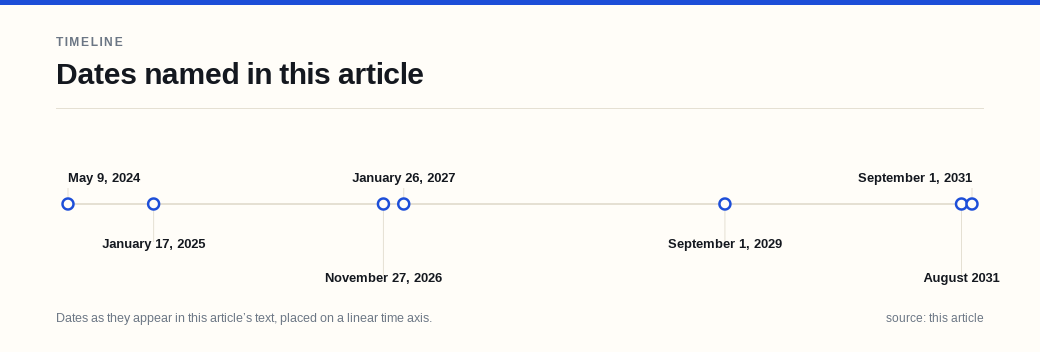
Automatic emergency braking (AEB) would become mandatory on new light vehicles built on or after September 1, 2031 — two years later than the September 1, 2029 date now in the regulation — under a proposed rule the National Highway Traffic Safety Administration (NHTSA) issued in a Federal Register notice dated November 27, 2026. The standard itself is not withdrawn. What the notice proposes to move is the deadline, and separately it asks whether parts of the compliance test should be made easier.
That combination is what makes the notice worth reading rather than skimming. The requirement that every new light vehicle brake for a pedestrian in the dark is still the law on paper — but the proposal says it would start two years later, and the same notice invites arguments for weakening it. Because this is a proposal and not a final rule, the 2029 date remains the operative one until NHTSA decides.
What the current rule requires
Federal Motor Vehicle Safety Standard No. 127 was created by a final rule published on May 9, 2024. It applies to passenger cars, multipurpose passenger vehicles, trucks and buses with a gross vehicle weight rating of 4,536 kilograms (10,000 pounds) or less — in practice, everything from a compact car to a half-ton pickup.
The standard imposes four requirements, which it numbers separately:
- Warn. Forward collision warning, audible and visual, for a lead vehicle at any speed above 10 km/h (6.2 mph) and below 145 km/h (90.1 mph), and for a pedestrian at any speed above 10 km/h (6.2 mph) and below 73 km/h (45.3 mph).
- Brake by itself. Apply the brakes automatically in the same speed bands when a collision is imminent, with or without the driver braking.
- Avoid contact, and do not brake without cause. In the standard’s test scenarios the vehicle must not hit the lead-vehicle target or the pedestrian mannequin — pedestrian testing runs in daylight and in darkness — and in two false-activation tests the automatic braking may add no more than 0.25 g above what the driver’s own braking would produce.
- Report failure. A telltale must light if the system malfunctions, including degradation caused solely by a blocked sensor. The manufacturer may not provide a control that switches the system out of compliance, apart from law-enforcement fleets and conditions such as low-range four-wheel drive or tow mode, and the system must return to its default mode at each new ignition cycle except when low-range four-wheel drive was selected on the previous cycle.
The compliance date in that text is September 1, 2029, with one extra year for small-volume manufacturers, final-stage manufacturers and alterers.
What the proposal would change
| Current rule | Proposal | |
|---|---|---|
| Most light vehicles | Built on or after Sept 1, 2029 | Built on or after Sept 1, 2031 |
| Small-volume, final-stage, alterers | One year later (Sept 1, 2030) | Sept 1, 2032 |
| Comment deadline | — | Jan 26, 2027 |
| Docket | — | NHTSA-2026-2476 (RIN 2127-AM69) |
The date is a manufacture date, not a model year. Under the proposal, a vehicle built in August 2031 sits outside the new date whatever model year it carries; under the rule as it stands, that same vehicle is covered, because it was built after September 1, 2029. That distinction matters more than it sounds, because compliance is certified per vehicle rather than per nameplate.
Why NHTSA says it is delaying
The agency’s stated reason is not that the technology is unwanted. It is that, on its own testing, the fleet is not converging on the standard fast enough, and that forcing the date could produce a worse outcome than moving it.
The evidence it cites is its 2025 New Car Assessment Program testing:
- Lead-vehicle braking. One vehicle, the 2025 Volkswagen Tiguan, avoided contact in all lead-vehicle scenarios across all tested speeds. Every other vehicle had instances of contact, and the decelerating-lead-vehicle scenario remained the hardest — nine of the ten tested vehicles contacted the target in at least one speed and parameter combination.
- Pedestrian braking. Performance improved, particularly in darkness, but no vehicle avoided collision at all test speeds. In the hardest scenario — a pedestrian crossing from the right behind an obstruction — five vehicles avoided contact up to 50 km/h (31.1 mph), three more contacted at that speed but not below it, and two contacted at 20 km/h (12.4 mph) and 40 km/h (24.9 mph).
- The earlier baseline. In the 2023 testing that informed the 2024 rule, six vehicles were run and none avoided contact in every trial. The closest was the 2023 Toyota Corolla Hybrid XLE, which avoided contact in most scenarios but still contacted the target on some trials.
The agency also points to a decade of field experience: 36 recalls affecting more than 600,000 vehicles related to AEB, and manufacturer warnings that a system tuned to pass the test at the margin may brake when nothing is there. Its conclusion is blunt about the timetable — “the current compliance date, September 1, 2029, may be impracticable for the fleet” — and its stated fear is a market disruption in which models that cannot be certified are pulled from sale rather than sold non-compliant.
Note the regulatory framing, because it tells you how the proposal was built: the notice says the rule, if finalized, “would be an E.O. 14192 deregulatory action”, is treated as significant under E.O. 12866, and was reviewed by the Office of Management and Budget.
The part that matters more than the date
A delay is easy to reverse: a date can be moved back again. A weaker test changes what compliance means for every vehicle certified under it, and the same notice asks about the test.
Under the heading “Request for Comment on Other Amendments”, NHTSA asks whether to allow low-speed contact with the test device — a change that would convert “must not hit the mannequin” into “must not hit it hard” — and relays a commenter’s suggestion of 4.0 km/h (2.5 mph), the maximum impact speed in the federal bumper standard, as a possible line. It asks whether to cap the number of test speeds the agency may select, suggesting up to thirteen within each existing range. It asks whether to allow multiple trials, so that a vehicle could pass a scenario without passing every run. And it asks how the standard should treat vehicles equipped with automated driving systems.
For each, it asks commenters to say whether the change should be temporary or permanent. None of this has been adopted. But it is the reason the comment file — not the headline date — is where this rulemaking will actually be decided.
What the delay does, and does not, do to the safety estimate
The 2024 rule’s analysis projected that the standard would save 362 lives and 24,321 non-fatal injuries a year, at a cost of roughly $354 million a year measured in 2020 dollars, most of it software. About 5% of the fleet would need hardware upgrades, on the notice’s restatement of the 2024 estimate, and the lifetime net benefit was put at between $5.82 billion and $7.26 billion, also in 2020 dollars.
Two cautions before anyone converts that into a cost of the delay.
First, the agency says it cannot do the conversion itself. “As NHTSA is unable to quantify the benefits and costs under the baseline, it is unable to quantify the impacts under this proposed rule,” the notice states, and its qualitative conclusion is that the delay would have no incremental effect — because a manufacturer that could not certify by 2029 would have pulled vehicles from the market, while one that can will still ship compliant systems as soon as it can rather than sitting on them until 2031. That claim is the contestable part: it treats the delay as costing nothing because no manufacturer would use the extra time, and the notice offers no number either way. The docket is where that will be tested.
Second, 362 is a rate for a fleet that complies, not a count for the first year the rule bites. The rule’s own summary says it is “estimated to save at least 362 lives and mitigate 24,321 non-fatal injuries a year”, while the same rule’s benefits section puts the estimate as accruing “over the course of one vehicle model year’s lifetime” — two descriptions of one model, and neither is a promise about any particular calendar year. The compliance date governs when new vehicles must meet the standard; the benefit accumulates as those vehicles replace older ones. Multiplying 362 by two would therefore overstate the delay’s effect rather than measure it, because the size of the gap depends on how many manufacturers were genuinely on track for 2029. Our own reading is that the honest statement is narrower: the projected benefits start later, and how much later depends on the manufacturer.
There is also a challenge in the background. The Alliance for Automotive Innovation, the industry group that pressed for changes to the standard, sued over the 2024 rule in the U.S. Court of Appeals for the District of Columbia Circuit on January 17, 2025; the notice records the case as No. 25-1026 and does not say how it stands.
If you are buying a car before 2031
The regulation is a floor with a date on it, not a label on a car. Three practical consequences:
- Do not wait for 2029 to get the feature. Automakers have been fitting AEB for years, and nothing in this proposal removes systems already on sale. What the rule fixes is the minimum performance of what is fitted — in particular pedestrian braking in the dark, which the 2025 testing found improved but still uneven across models.
- Ask about the specific system, not the checkbox. “Has AEB” covers systems that stop for cars at low speed and systems that brake for a pedestrian at 40 mph. The agency’s test results, published per vehicle under its New Car Assessment Program, are the closest thing to an independent comparison.
- If you want to be heard, the window is open until January 26, 2027. Comments go to Docket No. NHTSA-2026-2476 on Regulations.gov and are posted publicly. The notice asks for data rather than sentiment — false-activation reports from owners are the kind of evidence it says it lacks.
One boundary worth stating plainly: this is federal vehicle-safety regulation. What happens after a crash — who is at fault, what an insurer pays, how long you have to sue — is state law, and it varies by state. For that side of the question, see After a Car Accident: How Fault and Insurance Claims Actually Work and, for what a policy actually covers, Auto Insurance in the US.
The four sources for this page are listed above: the Federal Register notice (FR Doc. 2026-24140), the current text of 49 CFR 571.127 in the eCFR, the 2024 final rule (FR Doc. 2024-09054) and the Regulations.gov docket (NHTSA-2026-2476). For official government portals more generally, see the resources library.
The short version
AEB is still required, on paper, from September 1, 2029. The proposal published November 27, 2026 would move that to September 1, 2031, and would give small manufacturers until 2032. Whether the requirement gets easier as well as later is an open question with a comment deadline of January 26, 2027 — and that question, not the two-year shift, is the one that will decide what the system in your next car is required to do.
Frequently asked questions
- Is automatic emergency braking still required on new cars?
- Yes, in the regulation as written. Federal Motor Vehicle Safety Standard No. 127 still requires forward collision warning, automatic emergency braking and pedestrian automatic emergency braking on light vehicles built on or after September 1, 2029, and that is the text in the Code of Federal Regulations as of November 26, 2026. The November 27, 2026 notice is a proposal to move that date, not a final rule, so nothing has changed yet.
- When would the AEB requirement actually start?
- September 1, 2031 for most vehicles, if the proposal is finalized as drafted, with September 1, 2032 for small-volume manufacturers, final-stage manufacturers and alterers. Those are manufacture dates, not model years: the standard covers vehicles built on or after the date, so a vehicle built in August 2031 is outside it.
- Will a car I buy in 2030 have automatic emergency braking?
- Under the rule as it stands, yes. A vehicle built on or after September 1, 2029 must meet the standard, so a car you buy in 2030 that was manufactured after that date is covered today. If NHTSA finalizes the delay as drafted, a vehicle built before September 1, 2031 would fall outside the requirement — many would still have AEB, because automakers have been fitting it for years, but the regulation would no longer require it. The practical question for any specific car is which system it has and how that system performs at the speeds you drive.
- Can I comment on the proposal?
- Yes, until January 26, 2027. Comments go to Docket No. NHTSA-2026-2476 through Regulations.gov, and the notice states that everything submitted is posted without change, including any personal information you include. The agency specifically asks for data on false or unwanted braking, on the cost of complying, and on whether any change should be temporary or permanent.
- Does the proposal weaken the standard, or only delay it?
- The operative change is the date. But the same notice opens four questions that go to what passing means: whether low-speed contact with the test device should be allowed, whether the agency should cap how many test speeds it can pick, whether a vehicle may pass over multiple trials rather than every run, and how the standard should treat vehicles with automated driving systems. Each could be adopted temporarily or permanently, and none has been adopted.
- How many crashes does automatic emergency braking prevent?
- NHTSA's 2024 analysis estimated the rule would prevent 362 deaths and 24,321 injuries a year once the fleet complies, at an estimated cost of about $354 million a year, mostly software. That is a steady-state estimate for a compliant fleet, not a figure for any single year, and the agency now says it cannot quantify what the delay itself costs or saves.
Sources
Each source is a primary or official reference, checked before publication. Links open the original.
- National Highway Traffic Safety Administration (NHTSA), 'Federal Motor Vehicle Safety Standards: Automatic Emergency Braking Systems for Light Vehicles', notice of proposed rulemaking, FR Doc. 2026-24140, published November 27, 2026, 34 pages, Docket No. NHTSA-2026-2476, RIN 2127-AM69 — proposed compliance date September 1, 2031 ('September 1, 2032' for small-volume manufacturers, final-stage manufacturers and alterers); comments due January 26, 2027; the 2024 rule's estimate of '362 fatalities and 24,321 injuries' avoided annually, costs 'approximately $354 million annually' and lifetime net benefits of '$5.82 and $7.26 billion'; 'approximately five percent of the light vehicle fleet would require hardware upgrades'; the 2025 New Car Assessment Program results (the 2025 Volkswagen Tiguan avoiding contact in all lead vehicle scenarios, 'nine of the ten tested vehicles' contacting in the decelerating scenario, and 'no vehicle avoided collision at all NCAP test speeds' in pedestrian testing); '36 recalls issued affecting more than 600,000 vehicles in the past decade'; the finding that 'the current compliance date, September 1, 2029, may be impracticable for the fleet'; the statement that 'as NHTSA is unable to quantify the benefits and costs under the baseline, it is unable to quantify the impacts under this proposed rule'; the designation as 'an E.O. 14192 deregulatory action'; and the Alliance for Automotive Innovation's challenge filed January 17, 2025 in the U.S. Court of Appeals for the D.C. Circuit, Case No. 25-1026: https://www.federalregister.gov/documents/2026/11/27/2026-24140/federal-motor-vehicle-safety-standards-automatic-emergency-braking-systems-for-light-vehicles
- Electronic Code of Federal Regulations (eCFR), 49 CFR 571.127, 'Automatic emergency braking systems for light vehicles', current text read November 26, 2026 — S3 application to 'passenger cars and to multipurpose passenger vehicles, trucks, and buses with a gross vehicle weight rating (GVWR) of 4,536 kilograms (10,000 pounds) or less'; S5(a) 'vehicles manufactured on or after September 1, 2029 must meet the requirements of this standard'; S5(b) small-volume manufacturers, final-stage manufacturers and alterers 'until one year after'; S5.1.1 forward collision warning 'greater than 10 km/h (6.2 mph) and less than 145 km/h (90.1 mph)' for lead vehicles and S5.2.1 the same lower bound with 'less than 73 km/h (45.3 mph)' for pedestrians; S5.2.3 the vehicle 'does not collide with the pedestrian test mannequin'; S5.4.1 malfunction telltale including 'performance degradation caused solely by sensor obstructions'; S5.4.2 no control that places the system out of compliance, apart from law-enforcement fleets (S5.4.2.1) and low-range four-wheel drive, tow mode or another affected system (S5.4.2.2); S5.4.3 return to the default mode 'at the initiation of each new ignition cycle': https://www.ecfr.gov/current/title-49/subtitle-B/chapter-V/part-571/subpart-B/section-571.127
- NHTSA, 'Federal Motor Vehicle Safety Standards; Automatic Emergency Braking Systems for Light Vehicles', final rule, FR Doc. 2024-09054, published May 9, 2024, cited for the creation of Federal Motor Vehicle Safety Standard No. 127 and the September 1, 2029 compliance date it set: https://www.federalregister.gov/documents/2024/05/09/2024-09054/federal-motor-vehicle-safety-standards-automatic-emergency-braking-systems-for-light-vehicles
- Regulations.gov, Docket No. NHTSA-2026-2476 — the docket the notice designates for public comments, which are due January 26, 2027 and are posted without change, including any personal information provided: https://www.regulations.gov/docket/NHTSA-2026-2476