The $800 break for mail parcels is gone, and the paperwork is no longer done at your door
Duty now applies to most mail parcels from abroad, a bonded importer must file the entry, and CBP pushed the formal-entry deadline to January 20, 2027.
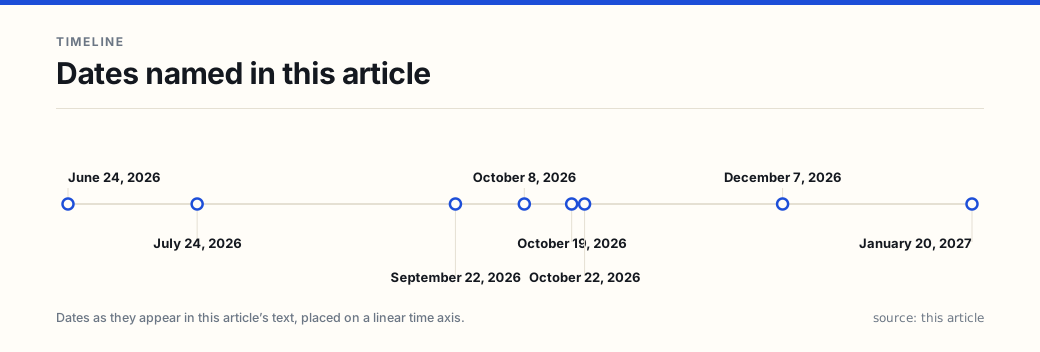
If you buy something from abroad and it arrives in the mail, the old arithmetic no longer holds. The $800 exemption that used to make small parcels clear without duty — the one shoppers know as Section 321, and the statute calls the de minimis administrative exemption — is suspended for merchandise arriving through the international postal network, and it has been since June 24, 2026.
The part almost nobody expects is what replaced it. Under the rule that took effect that summer, the duty on a mail parcel is no longer collected when the carrier hands you the box. Customs and Border Protection amended its mail-entry regulation to stop preparing entry forms by hand, and wrote into the preamble that duties “will not be collected upon delivery of such shipments to addressees.” The money is owed by whoever files the entry, and the filing now happens in a spreadsheet and a Pay.gov payment, not at your front door.
On October 22, 2026, CBP published a three-page document that changes one date in that structure. It matters because the date governs which parcels have to take the expensive route — a broker, a bond, a formal entry — rather than the cheap one.
The short version
| What was suspended | The de minimis administrative exemption, 19 U.S.C. 1321(a)(2)(C), for goods valued at $800 or less arriving through the international postal network |
| Since when | June 24, 2026 for the suspension (19 CFR 145.31); July 24, 2026 for the new informal mail-entry process |
| What replaced it | A postal informal entry for shipments of $2,500 or less classifiable in HTSUS Chapters 1-97, filed by a bonded importer |
| Who files | The owner or purchaser, or a licensed customs broker they designate — 19 CFR 143.26(a) parties only |
| Where the duty is paid | By the filer, through Pay.gov, by the seventh day of the month after the parcel arrives |
| Where it is not paid | At delivery. CBP’s rule removed manual preparation of mail entry forms and says duties are not collected on delivery |
| What moved on October 22, 2026 | The compliance date for the formal-entry provisions, 19 CFR 145.12(a)(2)(v) and (vi), from October 22, 2026 to January 20, 2027 |
| Still exempt | Bona fide gifts of $100 or less ($200 from certain island possessions), 19 U.S.C. 1321(a)(2)(A); travelers’ personal articles of $200 or less, 1321(a)(2)(B) |
What “de minimis” was
Three administrative exemptions sit in the same subsection of the tariff statute, and CBP’s rule separates them carefully. The first covers bona fide gifts valued at $100 or less ($200 where the gift comes from certain island possessions) sent from abroad to a person in the United States. The second covers personal or household articles valued at $200 or less that a traveler brings in with them. The third is the one that mattered for online shopping: any article whose value is $800 or less.
That third exemption was suspended for the postal channel by revising 19 CFR 145.31. The revised section keeps the old text and adds a paragraph saying the exemption “is suspended for merchandise arriving through the international postal network until such time as CBP determines that the application of the exemption is no longer inconsistent with the purpose of 19 U.S.C. 1321(a), no longer jeopardizes the revenue, and no longer facilitates unlawful importations.” Lifting it is not on a calendar; CBP says any modification or revocation will be announced by the Commissioner in the Federal Register.
A companion rule published the same day did the same thing for every other mode of arrival — air freight, courier, truck — and put it more bluntly: entries of merchandise valued at $800 or less arriving by those modes “must utilize formal or informal entry procedures.” So the change is not a postal quirk. What is specific to the mail is the process CBP built to collect the duty, and that process is the reason this article exists.
Two doors, and the list that decides which one
Most mail parcels now go through the informal process. It is available for shipments valued at $2,500 or less that are classifiable only in HTSUS Chapters 1 through 97. Everything outside it — and outside the gift and traveler exemptions described below, which are a separate part of the statute — takes the formal door, the broker-and-bond procedure most people associate with commercial importing. 19 CFR 145.12(a)(1) adds a discretionary one on top: CBP may require formal entry of any mail shipment, regardless of value, “if it is necessary to protect the revenue.”
The list of what cannot use the cheap door is in 19 CFR 145.12(a)(2), and it is worth reading as a consumer rather than as a trade lawyer, because each line describes a category of parcel that people actually order.
| The rule | What it catches |
|---|---|
| Value exceeds $2,500 — (a)(2)(i) | Anything expensive: a watch, a used camera, a small piece of furniture |
| Subject to an absolute or tariff-rate quota — (a)(2)(ii) | Goods whose import volume is capped; CBP’s consumer page uses linen textiles as its example |
| Subject to an antidumping or countervailing duty order — (a)(2)(iii) | Goods named in a Commerce Department order, which is a shifting list |
| Alcohol and tobacco — (a)(2)(iv) | Alcoholic beverages, and the tobacco list the rule spells out: cigars, cigarettes, cigarette tubes and papers, smoking tobacco, snuff, chewing tobacco |
| Subject to another agency’s requirements — (a)(2)(v) | Goods another agency screens at entry. CBP’s consumer page uses artisan cheese that needs a dairy permit as its example |
| Subject to Chapter 98 or Chapter 99 duties, or claiming duty-free treatment under Chapter 98 or a trade agreement — (a)(2)(vi) | The trade-remedy duties. CBP’s own footnote to its October notice names Section 232, Section 201 and Section 301 as examples |
The last two lines are the ones the October 22 document moved. Both were supposed to become mandatory for mail on October 22, 2026. They are now mandatory on January 20, 2027.
One more clause deserves a line, because it forecloses a workaround people try. Section 145.12(a)(3) says separate shipments mailed at different times cannot be combined to force a formal entry — but the shelter runs only one way: the carve-out does not apply where “there was a splitting of shipments in order to avoid the payment of customs duty.”
Who files, and why it is rarely you
The new informal process is not open to anyone who happens to receive a parcel. It is limited to parties with the right to make entry under 19 CFR 143.26(a) — the owner or purchaser of the merchandise, or a licensed customs broker properly designated by the owner, purchaser or consignee. The filer also needs a bond. New 19 CFR 145.15 is unusually direct about the consequence: a shipment valued at $2,500 or less that is to be delivered by the Postal Service “will not be released from CBP custody unless” a single-transaction or continuous bond meeting the conditions of 19 CFR 113.62 has been transmitted to CBP and secured by an approved surety or cash deposit.
Then there is the paperwork. The filer transmits, in an Excel spreadsheet, the filer code, bond number, description of the merchandise, country of origin, the full 10-digit HTSUS classification, quantity or weight where a specific duty rate is used, the duty rate, the value, the total duty owed, the carrier, the flight or conveyance number, the tracking number generated by the foreign postal operator, the arrival port and the arrival date. The spreadsheet and the payment are both due no later than the seventh day of the month following the parcel’s arrival — CBP’s example is a parcel arriving April 15, with the filing and payment due by May 7.
Nothing in that sequence is a job an ordinary recipient can pick up on a Saturday. CBP’s consumer guidance says the quiet part out loud: “When you buy goods from foreign sources, you become the importer.” And where the seller does not arrange delivery and clearance, “you will either need to hire a customs broker to clear your goods and forward them on to you, or go to the port of entry and clear them yourself.”
So the question that actually determines your cost is not what the duty rate is. It is who in the chain is the importer of record — the seller’s logistics provider, the marketplace, or you.
The bill no longer arrives with the box
This is the change with the widest reach and the least publicity. Before the June rule, 19 CFR 145.12(b)(1) contemplated a CBP officer preparing a mail entry form by hand for a low-value shipment. The interim final rule deleted that mechanism and replaced it with the filer-side process above, and its preamble states the consequence plainly: officers will no longer prepare those forms, and duties “will not be collected upon delivery of such shipments to addressees.”
Two things follow, and they point in opposite directions.
The good one: you will not be stopped at the door for cash, and a postal carrier is not going to invent a fee. If a message tells you a parcel is being held and a fee must be paid by card before it moves, that message is not describing this process.
The harder one: the absence of a bill at the door is not the absence of a debt. The obligation sits with the filer, and the parcel does not leave CBP custody without a compliant entry and a bond behind it. If no one in the chain files, the parcel waits — and CBP’s consumer guidance, in the context of goods held up by quota, warns that storage charges in such cases can be expensive. Nothing in the rule puts a clock on that, or a cap.
The deadline that moved, and what did not
The October 22 document is short and narrow. Its DATES line reads: “The compliance date for 19 CFR 145.12(a)(2)(v) and (vi) is January 20, 2027.” The reason CBP gives is capacity, not policy — importers, brokers and logistics providers need time to update systems, write procedures and build the technology to submit the data, and the agency says a failure to allow that time “could lead to disruptions in the flow of important international postal shipments destined to Americans.”
Three limits on the change are worth stating, because each is a way to misread it.
- It does not touch the suspension. The $800 exemption for mail was suspended on June 24, 2026, and that stays suspended. The delay is about which paperwork channel certain parcels must use, not about whether duty is owed.
- It does not change the informal process. CBP says the delayed date “does not change the process that importers and other parties currently use for informal mail entries” during the delay, and that anyone already ready can comply early.
- It is not necessarily the last extension. The document extends a date once and says nothing that would prevent a second extension. Treat January 20, 2027 as the current date, not a settled one.
That same day, CBP also loosened the voluntary route. Its Entry Type 13 test — an electronic informal mail entry filed in ACE, announced at 91 Fed. Reg. 38007 and running since September 22, 2026 — was modified so filings can be transmitted without complete electronic PGA data for now, “to allow filers to begin using the entry type 13 while they work to ensure that they can electronically submit all of the data required for complete PGA submissions.” CBP says it will announce the end of that temporary acceptance in a future Federal Register notice. The relaxation is about data plumbing; it does not relax what goods are legal to import.
Two documents in one week, both loosening, both procedural. That is the texture of this transition: the substantive rule is in place, and the machinery for applying it is still being built.
What is still duty-free
The gift exemption survives. CBP’s June rule states that it “does not affect the availability of the exemptions for bona fide gifts under 19 U.S.C. 1321(a)(2)(A) or personal or household articles accompanying travelers under 19 U.S.C. 1321(a)(2)(B),” and repeats the values: gifts of $100 or less, or $200 where the gift comes from certain island possessions, and travelers’ personal or household articles of $200 or less.
Two cautions belong with that. The exemption is for gifts, and a purchase relabelled as a gift is a false declaration — CBP’s consumer page is blunt that misleading information about the nature or value of an item is illegal and that the importer is the one exposed to fines. And the rule says these exemptions are unaffected; it does not restate their conditions, so a reader relying on the gift line should check it against the statute rather than against a summary, this one included.
What to do, in order
Before you order, price the duty in. Assume the parcel owes duty and ask the seller two questions: is duty included in the price at checkout, and who is the importer of record on the shipment. Sellers who ship at volume usually have an answer. Sellers who do not are telling you something.
Check the category, not just the price. Food, dairy, plants, cosmetics, medicines and devices sit behind another agency’s requirements, which lists them for formal entry — mandatory from January 20, 2027, and permitted to use the informal route until then — and makes them seizable regardless of paperwork. Alcohol and tobacco are formal entry at any value, always.
Get the description right, and keep it. CBP’s guidance is explicit that what is written on the customs declaration determines the classification and the duty rate. A vague line is not neutral; it is the input to a number you will be charged. Keep the order confirmation, the tracking number and the declaration alongside each other.
If the carrier or a broker asks for documents, answer. For a formal entry, 19 CFR 145.12(a)(4) says the addressee will be notified of the parcel’s arrival “and of the method by which entry is to be made.” That sentence is your test for a real notice: it tells you how to clear the goods, and it is not a payment link.
If a package is held, act on the parcel, not the message. Look the tracking number up on the carrier’s own site or on cbp.gov, and if the goods need formal entry, price a broker before the storage charges start compounding. The one thing not to do is pay a fee through a link in a text message.
That last point is the one worth repeating to anyone who orders from abroad regularly. A customs-themed message is cheap to send and hard to check at a glance, and the tell is not the logo — it is whether the message can be matched to a parcel you actually ordered, with a tracking number you can verify independently. Our checklist for the same problem in the benefits context is at finance.omc.center/americagov-scam-checklist, and the mechanics of message-based phishing are covered at tech.omc.center/how-to-spot-phishing.
The mirror image: what this means if you are the sender
The outbound half of the same system is a different rule with a different bill. The Postal Service’s new section 424 of the International Mail Manual, effective October 19, 2026, invoices the mailer when a destination country’s operator cannot collect duty from the recipient, charges 6 percent a year on unpaid amounts, requires payment even while a dispute is pending, and gives the mailer only one domestic dispute route — accounting errors in the Postal Service’s own invoice. If you send gifts or sell abroad, that piece is the one that reaches your bank account, and it is set out in full at law.omc.center/usps-unpaid-foreign-customs-charges.
What this article cannot tell you
It cannot tell you what your parcel will cost. Duty is a function of the 10-digit classification and the country of origin, and both change by product and by trade action; a rate quoted here would be wrong somewhere within a month. It also cannot tell you who will be the importer of record on a given order, because that is set by the sale, not by the regulation.
And it cannot tell you the process is finished. CBP has a proposed rule open on exactly this machinery — 91 Fed. Reg. 64532, published October 8, 2026, comments due December 7, 2026 — which would modify the filing requirements for informal entries of goods valued at $2,500 or less, establish a new electronic informal entry type for mail, add a carrier data element for mail shipments, and impose bonding for certain informal entries. The current process was adopted as an interim final rule, which means it binds now and can be revised later. Anyone who ships or buys across borders with any regularity has a comment window and a reason to use it.
A wider list of the official pages worth bookmarking for federal programs lives at omc.center/resources.
This article is general information about a federal rule, not legal advice, and it is not a substitute for advice about a specific shipment. Customs procedure is federal and does not vary by state, but the duty owed on any parcel depends on its tariff classification and country of origin, and those rates change by product and by trade action. The suspension of the de minimis exemption for mail took effect June 24, 2026, the postal informal entry process on July 24, 2026, and the compliance date for the formal-entry provisions discussed above is January 20, 2027 as of this writing; the process was adopted as an interim final rule and a proposed rule to revise it is open for comment until December 7, 2026. It is AI-written and independently AI-reviewed before publication; the review standard and this article’s findings are recorded in the network’s editorial review log.
Frequently asked questions
- I ordered a $60 item from overseas. Do I owe duty on it now?
- Probably, in the sense that duty is owed on the merchandise rather than waived because the parcel is cheap. Customs and Border Protection suspended the de minimis administrative exemption — the $800-or-less break most people know as Section 321 — for merchandise arriving through the international postal network, effective June 24, 2026. What that costs you depends on how the goods are classified and where they were made, and some classifications carry a zero rate. The exemption is no longer the reason a small parcel comes through free.
- Will the mail carrier collect the duty when it hands me the box?
- Under the process CBP set out in June 2026, no. The rule amending 19 CFR 145.12(b)(1) removed the provision for CBP officers to prepare mail entry forms by hand, and says duties 'will not be collected upon delivery of such shipments to addressees.' The money moves from whoever files the entry to CBP, through Pay.gov, by the seventh day of the month after the parcel arrives. Your leverage as the person named on the label is mostly upstream: what you buy, who ships it, and whether the seller has built the duty into the price.
- Can I just file the entry myself?
- The rule limits the new postal informal entry process to parties with the right to make entry under 19 CFR 143.26(a) — the owner or purchaser of the merchandise, or a licensed customs broker designated by the owner, purchaser or consignee — and 19 CFR 145.15 says a shipment 'will not be released from CBP custody unless' a single-transaction or continuous bond has been transmitted to CBP. That is filing infrastructure an individual rarely has. CBP's own consumer guidance describes the practical alternatives: hire a customs broker to clear the goods, or go to the port of entry and clear them yourself.
- Is a gift from abroad still duty-free?
- CBP's June 2026 rule says it does not affect the availability of the bona fide gift exemption under 19 U.S.C. 1321(a)(2)(A), which the rule describes as gifts valued at $100 or less, or $200 where the gift comes from certain island possessions, sent from a person abroad to a person in the United States. The exemption belongs to genuine gifts, not to purchases described as gifts, and the rule does not restate its conditions.
- What actually changed on October 22, 2026?
- One deadline, in one rule. CBP moved the compliance date for 19 CFR 145.12(a)(2)(v) and (vi) — the provisions requiring formal entry for mail shipments subject to another agency's requirements, or to Chapter 98 or Chapter 99 duties, or claiming duty-free treatment under Chapter 98 or a trade agreement — from October 22, 2026 to January 20, 2027. The suspension of the $800 exemption, and the informal process that replaced it, are untouched by that document. A separate CBP notice that took effect the same day did relax the voluntary Entry Type 13 electronic test, which can now be filed without complete PGA data for the time being.
Sources
Each source is a primary or official reference, checked before publication. Links open the original.
- U.S. Customs and Border Protection — 'Indefinite Suspension of the De Minimis Exemption for Mail Shipments and New Postal Informal Entry Process; Delayed Compliance Extension,' final rule, FR Doc. 2026-21600, 91 Fed. Reg. 66638, published and effective October 22, 2026. Read for: the DATES line moving the compliance date for 19 CFR 145.12(a)(2)(v) and (vi) to January 20, 2027; the statement that the suspension took effect June 24, 2026 and the rest of the June rule on July 24, 2026; the reason given for the extension, that a failure to allow more time 'could lead to disruptions in the flow of important international postal shipments destined to Americans'; the assurance that the delay changes nothing about 'the process that importers and other parties currently use for informal mail entries'; and the good-cause finding under 5 U.S.C. 553(b)(B) — federalregister.gov/documents/2026/10/22/2026-21600/indefinite-suspension-of-the-de-minimis-exemption-for-mail-shipments-and-new-postal-informal-entry
- U.S. Customs and Border Protection — 'Indefinite Suspension of the De Minimis Exemption for Mail Shipments and New Postal Informal Entry Process,' interim final rule, FR Doc. 2026-12669, 91 Fed. Reg. 37801, June 24, 2026. Read for: the DATES block (effective July 24, 2026 except amendatory instruction 4, which is 19 CFR 145.31 and took effect June 24, 2026; compliance date for 145.12(a)(2)(v) and (vi) October 22, 2026); the revised text of 19 CFR 145.31 suspending the $800 exemption for merchandise arriving through the international postal network; revised 145.12(a)(2)(i)-(vi) listing the shipments that require formal entry, (a)(3) on split shipments, and (a)(4) on notice to the addressee; new 145.15 on bonds for informal mail entries; the eligible-filer rule tied to 19 CFR 143.26(a); the data elements, the seventh-day-of-the-following-month deadline, and payment through Pay.gov; the sentence that duties 'will not be collected upon delivery'; and the statement that the bona fide gift exemption under 19 U.S.C. 1321(a)(2)(A) and the travelers' exemption under 1321(a)(2)(B) are unaffected — federalregister.gov/documents/2026/06/24/2026-12669/indefinite-suspension-of-the-de-minimis-exemption-for-mail-shipments-and-new-postal-informal-entry
- U.S. Customs and Border Protection — 'Indefinite Suspension of the De Minimis Exemption for Merchandise Arriving Through All Modes Other Than the International Postal Network,' interim final rule, FR Doc. 2026-12670, 91 Fed. Reg. 37789, effective June 24, 2026. Read for: the parallel suspension outside the mail channel, and the statement that entries of merchandise valued at $800 or less arriving by those modes 'must utilize formal or informal entry procedures' — federalregister.gov/documents/2026/06/24/2026-12670/indefinite-suspension-of-the-de-minimis-exemption-for-merchandise-arriving-through-all-modes-other
- U.S. Customs and Border Protection — 'Modification of the Test of the New Electronic Informal Entry Process for Mail,' general notice, FR Doc. 2026-21570, 91 Fed. Reg. 66707, modification effective October 22, 2026. Read for: the Entry Type 13 test beginning September 22, 2026; the statement that the test creates an informal pathway for mail shipments subject to PGA data requirements or to duties outside HTSUS Chapters 1-97; the temporary acceptance of filings without complete electronic PGA data; and footnote 1, which names Section 232, Section 201 and Section 301 duties as examples of the Chapter 98/99 duties that trigger formal entry — federalregister.gov/documents/2026/10/22/2026-21570/modification-of-the-test-of-the-new-electronic-informal-entry-process-for-mail
- U.S. Customs and Border Protection — 'Test of the New Electronic Informal Entry Process for Mail,' FR Doc. 2026-12668, 91 Fed. Reg. 38007, test commenced September 22, 2026 and continues until CBP announces its conclusion in the Federal Register. Read for: the entry type 13 description, the eligible participants, and the filing requirements — federalregister.gov/documents/2026/06/24/2026-12668/test-of-the-new-electronic-informal-entry-process-for-mail
- U.S. Customs and Border Protection — 'Low-Value Shipments,' notice of proposed rulemaking, FR Doc. 2026-20650, 91 Fed. Reg. 64532, October 8, 2026, comments due December 7, 2026. Read for: the proposal to modify filing requirements for informal entries of goods valued at $2,500 or less, to establish a new electronic informal entry type for merchandise entering through the mail, to add a carrier data element for mail shipments, and to impose bonding requirements for certain informal entries — federalregister.gov/documents/2026/10/08/2026-20650/low-value-shipments
- U.S. Customs and Border Protection — 'Internet Purchases.' Read for: 'When you buy goods from foreign sources, you become the importer'; the statement that if the seller does not arrange postal or door-to-door delivery, 'you will either need to hire a customs broker to clear your goods and forward them on to you, or go to the port of entry and clear them yourself'; the explanation that the description on the customs declaration determines the classification number and duty rate CBP assigns; and the quota example, which warns that goods held up in CBP can accrue storage charges — cbp.gov/trade/basic-import-export/internet-purchases
- U.S. Postal Service — 'Customs Requirements and Payment Procedures for Certain Customs Charges,' interim final rule, FR Doc. 2026-21310, 91 Fed. Reg. 66000, published and effective October 19, 2026, comments due November 18, 2026. Read for: new International Mail Manual section 424 (424.1-424.6); 424.2 (payment due 'even if the mailer disputes the assessment'); 424.4 (interest 'at a rate of 6 percent per annum' on unpaid amounts); and 424.5 (the mailer 'may dispute with the Postal Service only accounting errors related to Postal Service invoicing') — federalregister.gov/documents/2026/10/19/2026-21310/customs-requirements-and-payment-procedures-for-certain-customs-charges