The gift you mailed to Europe can come back as an invoice
A USPS rule effective October 19, 2026 bills the sender when a destination country seeks unpaid duties — with 6% interest and no real dispute route.
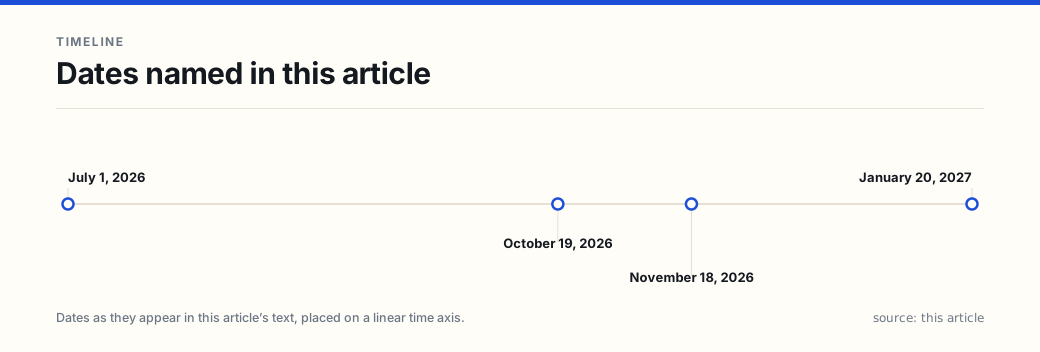
On October 19, 2026, the Postal Service added a section to its International Mail Manual that did not exist the day before. It is numbered 424, it is titled “Unpaid Destination Customs Charges,” and its effect is simple enough to state in one sentence: when a foreign customs authority or postal operator comes after the duty on a package you mailed, and the amount has not been paid, the Postal Service’s stated procedure is to bill you.
That is a change in who absorbs a loss, not a change in the duty itself. But it lands on the least glamorous part of international shipping — the birthday gift, the returned purchase, the box sent to a grandchild — and it comes with terms that a consumer contract would struggle to justify: pay the invoice in full even while you dispute it, interest at 6 percent a year from the due date, and no relief if the package is lost or comes back.
The short version
| What it is | An interim final rule by the U.S. Postal Service amending the International Mail Manual |
| Effective | October 19, 2026; comments must be received by November 18, 2026 |
| The new section | IMM 424, “Unpaid Destination Customs Charges,” with six subsections |
| Who it bills | The mailer — the sender identified on the shipment and customs form, whether a business or an individual |
| When | A relevant party in the destination country seeks duties, taxes or import fees from the mailer or from USPS, and they are unpaid |
| The terms | Pay the full invoice even if you dispute it; 6% per annum interest after the due date; no relief if the item is lost, damaged or returned |
| What you can dispute | Only accounting errors in USPS’s own invoice. The assessment itself must be challenged abroad |
| What it does not do | It creates no new duty and sets no new rate. The duty is the destination country’s |
What the six subsections actually say
The rule is short, and reading it in order is the only way to see how tightly the pieces fit.
424.1 — General procedures. Where the destination requires goods to move on a delivered-duty-paid basis, the mailer may use USPS Delivered Duty Paid service, “if available,” to prepay. Then the operative sentence: if any relevant party in the destination country — “for example, the customs authority, postal operator (or its agent), customs broker, or customs representative” — seeks to collect duties, taxes or import fees from the mailer or from the Postal Service, and the amounts have not been paid in full, “the Postal Service (or its representative) will send an invoice to the mailer for such amounts.”
424.2 — Mailer responsibilities. The mailer “must pay the Postal Service (or its representative) the entire amount due in accordance with the invoice terms, even if the mailer disputes the assessment.” And the second sentence, which is the one worth remembering: the mailer “is not relieved of its obligation to pay for duties, taxes, and import fees, regardless of whether the item is delivered, lost, damaged, or returned.”
424.3 — Assessments. The Postal Service “is not responsible for the accuracy” of the duties, taxes, import fees or other charges calculated by the destination country’s customs authority, postal operator, law enforcement or tax authorities.
424.4 — Collections. Interest accrues at 6 percent per annum on unpaid amounts from the invoice due date until they are paid in full, and the Postal Service reserves the right to collect the costs it incurs chasing the debt, “to the extent permitted by applicable law.”
424.5 — Disputes. The mailer may dispute with the Postal Service “only accounting errors related to Postal Service invoicing,” by seeking a refund. Any challenge to the total assessed by the destination side “must be addressed directly to such party without involvement from the Postal Service.”
424.6 — Adjustments and credits. If the Postal Service later receives a cancellation, refund or credit for an amount the mailer already paid, it will pass a corresponding adjustment back — but only “if deemed practical in the Postal Service’s reasonable judgment,” and “except to the extent the amount remains nonrefundable or is otherwise properly due under an applicable arrangement.” Where the duties were prepaid through USPS DDP, adjustments and refunds run through section 365 instead.
Read together, 424.2 and 424.5 are the shape of the deal: you pay first, you may contest only the Postal Service’s own accounting, and the substance of the charge belongs to a government you are not a constituent of.
Why this appeared now
The preamble gives the reason without drama. As of July 1, 2026, the European Commission eliminated the de minimis exemption for most low-value goods entering the EU customs territory, and established what the preamble calls “a new hierarchical system for determining who is responsible for paying applicable duties, taxes, and import fees” on those goods. European postal operators responded by imposing their own requirements — some now insist that certain items travel under an approved delivered-duty-paid arrangement, and some levy charges when the customs information is wrong. When an item travels duty-unpaid and the destination operator cannot recover from the addressee, “the destination postal operator may seek to collect unpaid amounts from the mailer.”
That is the gap the rule addresses. Its own summary describes the Postal Service as “establishing procedures” for mailers to pay, or reimburse it, for duties and fees assessed on a mailpiece — the language of a route being written down rather than of one already in use. What exists now is an invoice, a due date, an interest rate and a dispute route, and the route runs back to the sender.
The duty itself is not American, and this rule did not create it. USPS’s own explanation of the EU change says that from July 1, 2026, business-to-consumer packages valued up to €150 and consumer-to-consumer gifts valued over €45 and up to €150 lost their exemption, that the receiving country assesses a flat, nonrefundable €3 duty for each unique Harmonized System code used, and that the rules for packages over €150 are unchanged. A gift containing three different kinds of goods, described under three different codes, is a €9 duty before any national VAT or handling fee — which is exactly the kind of number a recipient at the door decides not to pay.
The choice that decides who pays
USPS sells the fix: Delivered Duty Paid service, in which the sender prepays the estimated duties, taxes and fees at the time of mailing. It is not available for every destination or every service. The Postal Service’s list is short — Austria, Belgium, Canada, Denmark, Estonia, Finland, France and Territories (Guadeloupe, French Guiana, Martinique, Andorra, Reunion, Mayotte), Germany, Italy, Luxembourg, Malta, Monaco, the Netherlands, Portugal, Slovakia, Spain, Sweden and the United Kingdom — and it works only with Priority Mail Express International, Priority Mail International and First-Class Package International Service. It cannot be bought after the fact: section 362 of the manual limits it to the time of mailing, at a retail counter, through Click-N-Ship, through certain USPS APIs, or through Global Shipping Software, and rules it out for First-Class Mail International, International Priority Airmail, “any type of M-bag service, and other workshare products.”
Two features of the product matter here. The first is price: opting in adds the duties, taxes, fees and a third-party service fee to your postage. The second is the Landed Cost Guarantee, under which the service provider covers the difference if the foreign authority assesses more than you prepaid, subject to limitations in its terms of service. That guarantee is the main mechanism in this system that keeps an unknown foreign number from landing on you later — which is why it is worth pricing before deciding it is too expensive.
Opt out, and the Postal Service’s own description of the choice gives you two outcomes — the duties become the recipient’s responsibility, or, in certain cases, you may not be able to buy postage at all. The page says it directly: “in other cases, if you opt out, you may not be able to purchase postage through the Postal Service.” So the practical question at the counter is not whether the €3 is fair. It is whether you are willing to be the party of last resort for a charge you cannot calculate and cannot contest.
The dispute is in the wrong country
This is the part that will surprise people who assume an invoice implies an adjudication.
If the invoice arrives, the only thing you can contest with the Postal Service is its own accounting — whether it billed the right amount, for the right mailpiece, to the right party. Whether the €3 was owed at all, and whether the item was classified correctly, are questions about the foreign assessment, and 424.5 sends those to the party that made it: any challenge to “the total combined sum of duties, taxes, import fees, and other charges” assessed abroad “must be addressed directly to such party without involvement from the Postal Service.”
Who bears the charge in the first place is a separate question, answered by the destination country’s requirements and by 424.1, not by 424.5. The practical import is the same: it is not a decision the Postal Service will revisit for you.
That is a real asymmetry. The party that assessed the charge sits in the destination country; the party that will pursue you is the U.S. Postal Service; and the clock that starts the 6 percent interest runs on the invoice, not on whatever answer you are waiting for from abroad. The rule contains no provision pausing interest while a foreign assessment is disputed.
What to do, in order
Before you mail. Decide whether the destination is one where duty is likely — for the EU, that now means business-to-consumer merchandise valued up to €150 and consumer-to-consumer gifts valued over €45 and up to €150. If DDP is offered, price it before you decide it is too expensive; the alternative is an open-ended liability with interest. And note what happens if you decline it: the Postal Service’s page describes two outcomes, and you do not choose between them — the duties become the recipient’s responsibility, or “in other cases” you may not be able to buy postage at all. Where DDP is not offered for a destination at all, the page says only that costs must be paid “before the recipient can get their package” — so the person receiving it should expect to be asked, and it is worth telling them before the parcel arrives.
When you fill in the customs form. Describe each item specifically. The EU duty is assessed per unique Harmonized System code, and both the Postal Service’s page and the revised section 112 of the manual put the accuracy obligation on the mailer: false or incomplete information can mean the item is returned or confiscated, and “the mailer may be subject to additional charges.” A vague line like “gift — assorted” is not neutral; it is the input to a classification you will not see.
Keep the paperwork. The customs declaration, the tracking number and the postage receipt are what let you match an invoice to a shipment. Without them you cannot check the billing, which is the only part of the charge the Postal Service will revisit.
If an invoice arrives. Verify it against the mailpiece before paying, confirm the amount and the due date, and if the billing looks wrong, ask for a refund in writing rather than simply withholding payment — withholding is what starts the interest. If you think the underlying assessment is wrong, pay the invoice and pursue the foreign party separately; that is the sequence the rule contemplates, whether or not it is the sequence that feels fair.
If the package was returned or lost. Expect the invoice anyway. Section 424.2 says the obligation survives the parcel.
What this rule does not reach
It governs outbound international mail sent through the Postal Service, not shipments generally. If you shipped with a private express carrier, its contract terms apply, and those terms are not this rule — they are the carrier’s own, and they differ. DDP itself does not cover every service: First-Class Mail International, International Priority Airmail, “any type of M-bag service, and other workshare products” have no DDP option. Section 424, by contrast, is written in terms of “the mailer” and “a mailpiece” rather than of any particular service, and its six subsections contain no service-specific exception — which is worth knowing before assuming that a format without DDP is a format without exposure.
One qualifier belongs here, because it changes what “no DDP option” means in practice. Section 362 of the manual says USPS-approved PC Postage providers or third-party marketplaces “may choose to use alternative solutions, other than USPS DDP service, for collecting and remitting duties, taxes, and fees to the foreign customs authority.” If you buy postage through a shipping platform rather than at the counter or through Click-N-Ship, the prepayment you are offered may come from that platform’s arrangement rather than from the Postal Service — and it is worth checking, because the invoice in section 424 does not care which one you used.
And it is an interim final rule with the comment window open until November 18, 2026 — comments “must be received by” that date, so it is a mailing deadline, not a postmark one. An interim final rule is binding now and can be revised later. Anyone whose business depends on this — small exporters, craft sellers, people with family abroad — has a month to say so, by mail to the manager of Product Classification at USPS headquarters or by email to the address in the notice.
One more thing worth keeping separate from the rule: an invoice is a document you can check, and that is the useful part. Anyone can send a message saying a package is held for customs and a fee is due. The test is whether the message matches a mailpiece you actually sent and a customs form you actually filled in. If it does not match, do not use the link in the message; go to the Postal Service’s own site and look the shipment up there.
The same system runs in the other direction, and it was rebuilt in 2026 too. If you are the one receiving a parcel from abroad, the $800 de minimis exemption no longer applies to international mail, the entry is filed by a bonded importer rather than prepared at your door, and one formal-entry deadline moved to January 20, 2027. That side is set out at law.omc.center/mail-parcel-duty-entry-process.
A wider list of the official pages worth bookmarking for federal programs lives at omc.center/resources.
This article is general information about a federal rule, not legal advice, and it is not a substitute for advice about your own shipment or dispute. The Postal Service’s rule is national; the amounts it invoices for are imposed by the destination country, and those rates, thresholds and procedures vary by country and can change without notice from Washington. The rule is an interim final rule effective October 19, 2026 with comments open until November 18, 2026, so its text may be revised. It is AI-written and independently AI-reviewed before publication; the review standard and this article’s findings are recorded in the network’s editorial review log.
Frequently asked questions
- I mailed a birthday gift to France and my cousin refused to pay the duty. Do I owe it now?
- You may be invoiced, yes. Section 424.1 of the International Mail Manual says that if a relevant party in the destination country seeks to collect duties, taxes or import fees from you or from the Postal Service, and the amounts have not been paid in full, the Postal Service will send you an invoice. A recipient who refuses the charge is one way that happens, but it is not the only trigger the section describes: the question it asks is whether money is being sought from you or from the Postal Service and remains unpaid. That is the mechanism the October 19, 2026 rule creates.
- Can I refuse to pay because the charge is wrong?
- You can dispute accounting errors in the Postal Service's own invoicing, by asking for a refund. You cannot use the Postal Service's process to challenge the amount the foreign side calculated. Section 424.5 says any challenge to the total of duties, taxes, import fees and other charges assessed by the destination country must be addressed directly to that party, without the Postal Service's involvement. And 424.2 says you must pay the invoice in full even while you dispute the assessment.
- The package was returned, or lost. Does that end it?
- No. Section 424.2 says the mailer is not relieved of the obligation to pay duties, taxes and import fees regardless of whether the item is delivered, lost, damaged or returned. That is the sentence to read twice, because it decouples the money from the parcel: the charge attached to the shipment, not to the thing arriving.
- Is this a new tax on gifts?
- No. The tax is the destination country's, and it existed before this rule. What changed on October 19, 2026 is who the Postal Service pursues when that tax goes unpaid — the sender, by invoice, with interest. For a European Union destination the underlying duty is a flat €3 per unique Harmonized System code on low-value shipments, which the EU began applying to packages that were previously exempt on July 1, 2026.
Sources
Each source is a primary or official reference, checked before publication. Links open the original.
- U.S. Postal Service — 'Customs Requirements and Payment Procedures for Certain Customs Charges,' interim final rule, 39 CFR Part 20, FR Doc. 2026-21310, filed for public inspection October 16, 2026 and published October 19, 2026 at 91 Fed. Reg. 66000, effective October 19, 2026, comments due November 18, 2026. Read for: the DATES line; the preamble's account of the European Commission's July 1, 2026 change; the revised second paragraph of IMM 112 and the new paragraph added after the third paragraph; the revised IMM 131.34; the revised IMM 361.13; and the full text of new IMM 424.1 through 424.6, including the 6 percent per annum interest rate and the sentence that the mailer 'is not relieved of its obligation to pay ... regardless of whether the item is delivered, lost, damaged, or returned' — federalregister.gov/documents/2026/10/19/2026-21310/customs-requirements-and-payment-procedures-for-certain-customs-charges
- USPS — 'USPS Delivered Duty Paid (DDP) Service: U.S. Senders: Prepay Import Duties, Taxes, & Fees.' Read for: the eligible destination list (Austria, Belgium, Canada, Denmark, Estonia, Finland, France and territories, Germany, Italy, Luxembourg, Malta, Monaco, Netherlands, Portugal, Slovakia, Spain, Sweden, United Kingdom); the three services DDP works with (Priority Mail Express International, Priority Mail International, First-Class Package International Service); the statement that opting in adds the duties plus a third-party service fee to postage and that opting out can mean the recipient pays or that you cannot buy postage at all; the Landed Cost Guarantee; and the note that DDP may not be available for certain low-value shipments — usps.com/international/prepaid-import-duties.htm
- USPS — International Mail Manual, section 362 'Availability,' the provision that limits USPS DDP to the time of mailing (retail counter, Click-N-Ship, USPS APIs or Global Shipping Software) and excludes First-Class Mail International, International Priority Airmail and M-bags. Read for: the availability rule and the country exhibit — pe.usps.com/text/Imm/immc3_018.htm
- USPS — 'New EU Requirement: Prepaid Duties for Packages Up to €150,' the same DDP page's explanation of the underlying foreign duty: from July 1, 2026, business-to-consumer packages up to €150 and consumer-to-consumer gifts over €45 and up to €150 are no longer exempt, the receiving country assesses a flat nonrefundable €3 duty for each unique Harmonized System code used, and packages over €150 are unchanged — usps.com/international/prepaid-import-duties.htm
- 39 CFR Part 20 — the regulation that incorporates the International Mail Manual by reference. Read for: the authority citation the interim final rule leaves unchanged, and the statement in the preamble that the Postal Service 'will publish an appropriate amendment to 39 CFR part 20 to reflect these changes' — ecfr.gov/current/title-39/part-20