How a flight delay gets blamed: five cause codes, a sixth on the way, and why it slipped to 2027
DOT sorts flight delays into five causes. Congress carved ten events out of the airline's own column. The change now applies to flights from January 2027.
Every few months a news story does the same arithmetic: this airline’s delays were mostly the weather, that one’s were mostly its own fault. That sentence is not a reporter’s judgment. It is a regulatory reporting rule — 14 CFR 234.4 — that has sorted delays into five causes since 2002, and carriers file their counts to the government every month.
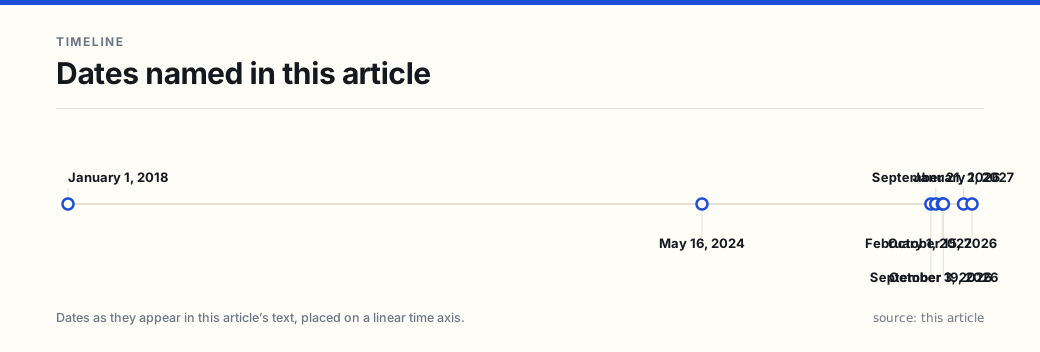
Congress ordered a sixth category in 2024. The Department of Transportation published the final rule on September 3, 2026, with an effective date of October 19, 2026. On October 15, 2026 — four days before it was to bite — DOT postponed it to February 1, 2027. What follows is what the five codes actually measure, what Congress ordered changed, and why the change is now a 2027 story.
What are the five codes — and the one that reads as blame?
Under 14 CFR 234.4, reporting carriers file monthly data identifying the causes of flight cancellations and delays of 15 minutes or more. Delays are attributed to one of five categories:
- Air Carrier
- Extreme Weather
- National Aviation System
- Security
- Late Arriving Aircraft
Cancellations use the same list, except that there is no Late Arriving Aircraft category for a flight that never operated. The events that belong in each bucket are spelled out not in the regulation but in a Bureau of Transportation Statistics technical directive — Technical Directive No. 40, “On-time Performance” — which DOT describes as a non-exclusive list.
Of the five, the Air Carrier code is the one that reads as blame, and the regulation reserves it for circumstances within the carrier’s control. The September 2026 rule describes that code as having historically covered “any delay or cancellation due to circumstances within the control of the carrier such as maintenance, crew scheduling, or aircraft cleaning”; the technical directive’s list for it runs on to fueling, baggage loading, catering, gate congestion, ground equipment out of service, slow boarding, cabin servicing and late crew. When a commentator says an airline’s delays were “self-inflicted”, that is the column being read.
Not every airline is in the data, and not every delay is either. A reporting carrier is an airline certificated under 49 U.S.C. 41102 that accounted for at least 0.5 percent of domestic scheduled-passenger revenues in the most recently reported 12-month period — the threshold was 1 percent for transportation taking place before January 1, 2018. Delays under 15 minutes and carriers below the revenue line never appear.
What did Congress actually order?
When Congress reauthorized the FAA in 2024 (FAA Reauthorization Act of 2024, Pub. L. 118-63, enacted May 16, 2024), § 511(b) named ten causes that “shall not be included within the Air Carrier code” for cancelled and delayed flights. They are, verbatim:
- Aircraft cleaning necessitated by the death of a passenger.
- Aircraft damage caused by extreme weather, foreign object debris, or sabotage.
- A baggage or cargo loading delay caused by an outage of a bag system not controlled by a carrier or its contractor.
- Cybersecurity attacks (provided that the air carrier is in compliance with applicable cybersecurity regulations).
- A shutdown or system failure of government systems that directly affects the ability of an air carrier to safely conduct flights and is unexpected.
- Overheated brakes due to a safety incident resulting in the use of emergency procedures.
- Unscheduled maintenance, including in response to an airworthiness directive, manifesting outside a scheduled maintenance program that cannot be deferred or must be addressed before flight.
- An emergency that required medical attention through no fault of the carrier.
- The removal of an unruly passenger.
- An airport closure due to the presence of volcanic ash, wind, or wind shear.
The direction is easy to read backwards. These ten events come out of the airline-blame column — Congress was not tightening the screw on carriers, it was instructing DOT to stop charging airlines with delays the statute treats as outside their control. An unruly passenger and a medical emergency are the clearest examples: both happen on the aircraft, both cost the airline time, and neither is the airline’s fault.
DOT implemented the instruction in the September 3 rule. Rather than reassigning the ten events to existing codes such as National Aviation System or Extreme Weather, the rule creates a new reporting category used exclusively for them, called the Section 511(b) category, and revises the Air Carrier definition to prohibit their inclusion explicitly. DOT issued that rule without public comment, invoking the Administrative Procedure Act’s good-cause exception at 5 U.S.C. § 553(b)(B): the exclusions are not discretionary, and the rule uses the statutory language without adding any interpretation of its own.
Why did it slip to 2027?
The original effective date was October 19, 2026. On September 21, 2026, Airlines for America — a trade association for large US carriers — wrote to DOT’s general counsel asking to move it to February 1, 2027. The stated reasons: time for DOT to update the BTS technical directive that gives carriers their reporting instructions, time for the industry to update its systems so the data is “collected, reported, and ingested properly”, time for BTS’s own systems, and time to obtain approval of the revised information collection under the Paperwork Reduction Act. A4A also argued that the start of a calendar year was the “natural and logical” point to begin.
DOT agreed, and said so in a rule published October 15, 2026. Two details in it matter more than the headline date. First, the delay is not a grace period on the substance: carriers must file their reports with BTS for the entire month of January 2027 in a manner reflecting the new categories. So the new coding applies to flights operating on or after January 1, 2027, and the reports covering them are due within 15 days of the month’s end. Second, DOT issued this delay without notice and comment as well, again on good cause — it said it had only recently learned of the carriers’ need and that there was not enough time to propose and take comment before the original effective date arrived.
What does that mean if you read the numbers?
- Nothing changes yet. Every monthly report covering 2026 still uses the old five categories. The first data built on the new coding is the January 2027 report, filed by mid-February 2027 and published after that.
- The Air Carrier share is the number worth watching when you compare airlines, because it is the column reserved for causes inside the airline’s control.
- A drop in that share after 2027 is not automatically an operational improvement. Ten categories of event move out of it by statute. Because the new category is separate rather than merged into weather or National Aviation System, the ten events stay visible — just not under the airline’s name.
- Both documents amend only the reporting rule at 14 CFR part 234. They do not create a payment, a claim, or a new obligation of an airline to a passenger, and they leave untouched which carriers must report and which flights are reported.
What is still on the table
The 2024 statute asked for more than the ten exclusions. § 511(a) directed the BTS director to initiate a rulemaking to create a new “cause of delay” category tracking delays and cancellations caused by instructions from the FAA Air Traffic Control System, and § 511(c) directed BTS to create a category tracking complaints related to family seating. DOT’s September rule addressed neither; it said implementing § 511(a) and assessing the requests in a separate rulemaking petition from Airlines for America both require the exercise of discretion, and that BTS “plans to address these issues through future rulemaking”. Neither category exists yet.
So the near-term position is a moving target with two clocks. The ten-event exclusion starts with January 2027 flights. The air-traffic-control category and the family seating complaint category are still unwritten proposals, which also means they will have to go through the notice-and-comment process the two rules above were allowed to skip.
What if you want to act on any of this?
- Read the carrier-caused share, and check the vintage of the data. An article written before February 2027 and one written after are describing two different accounting systems. Comparing them without saying so is the most likely way to be misled.
- Do not expect the code to decide your refund. If your own flight is cancelled or delayed for hours, what applies is the airline’s own commitments and separate federal consumer protection rules. The cause code only describes what the airline told the government afterwards.
- Check before you pay anyone. These two rules are about data. No part of either creates a payment to passengers. DOT’s Office of Aviation Consumer Protection is named in both documents as the contact for consumer questions, and a private service that offers to “claim” airline compensation for a fee is not administering a government program.
- The underlying data is public. The Bureau of Transportation Statistics publishes the monthly on-time and cause-of-delay figures that these categories feed; the two Federal Register documents listed below are where the category definitions themselves live.
Effective dates are their own genre of consumer rule, and this is not the only one waiting on a publication or a clock: the FCC’s most recent robocall and robotext order also takes effect a set number of days after its own Federal Register publication — see Replying STOP won’t stop everything anymore. The network’s government resources directory collects the federal agencies mentioned here.
This article is general information about a federal reporting rule, not legal advice, and it is not a substitute for advice about your own situation. Airline reporting rules are federal, but the duties an airline owes an individual passenger can also turn on its contract of carriage and on state consumer law, which varies by state. It is AI-written and independently AI-reviewed before publication; the review standard and this article’s findings are recorded in the network’s editorial review log.
Frequently asked questions
- Are airlines reporting delays under new categories yet?
- No. The final rule that creates the new category was published on September 3, 2026 with an effective date of October 19, 2026, but on October 15, 2026 the Department of Transportation delayed that effective date to February 1, 2027. The change applies to flights operating on or after January 1, 2027, which means every monthly report covering 2026 still uses the old five categories.
- If a delay is charged to the weather instead of the airline, do I get less back?
- Nothing in either rule changes what a passenger is owed. Both documents amend only the reporting rule at 14 CFR part 234, which governs what carriers report to the Bureau of Transportation Statistics about the cause of a delay. They create no payment, no claim and no new obligation of an airline to a passenger. Whether you are entitled to a refund or a rebooking depends on the airline's contract and on separate federal consumer protection rules, not on which cause code a delay is filed under.
- Which airlines and which flights appear in this data?
- Only 'reporting carriers' — airlines certificated under 49 U.S.C. 41102 that accounted for at least 0.5 percent of domestic scheduled-passenger revenues in the most recently reported 12-month period, a threshold that was 1 percent for transportation before January 1, 2018. The data covers cancellations and delays of 15 minutes or more, reported monthly. Short delays and carriers below the revenue threshold do not appear at all.
Sources
Each source is a primary or official reference, checked before publication. Links open the original.
- Federal Register — Department of Transportation, Bureau of Transportation Statistics, 'Cause of Airline Delay and Cancellation Categories Under Section 511(b) of the FAA Reauthorization Act of 2024', final rule, 91 Fed. Reg. 56588 (September 3, 2026), Docket No. DOT-OST-2026-1257 (creates the new Section 511(b) category, lists the ten excluded events, and revises the Air Carrier definition) — federalregister.gov/documents/2026/09/03/2026-18040/cause-of-airline-delay-and-cancellation-categories-under-section-511b-of-the-faa-reauthorization-act
- Federal Register — same title, '; Delay of Effective Date', final rule, 91 Fed. Reg. 65456 (October 15, 2026), Docket No. DOT-OST-2026-1257 (delays the effective date to February 1, 2027; states that the change applies to delays and cancellations of flights occurring on or after January 1, 2027 and that carriers must file the full month of January 2027 under the revised categories) — federalregister.gov/documents/2026/10/15/2026-21058/cause-of-airline-delay-and-cancellation-categories-under-section-511b-of-the-faa-reauthorization-act
- FAA Reauthorization Act of 2024, Pub. L. 118-63, § 511(b)-(d), 138 Stat. 1025 (enacted May 16, 2024) (subsection (b) lists the ten causes that 'shall not be included within the Air Carrier code'; subsection (a) requires a rulemaking on an FAA Air Traffic Control cause category; subsection (c) requires a family seating complaint category) — govinfo.gov/content/pkg/PLAW-118publ63/html/PLAW-118publ63.htm
- 14 CFR 234.4, 'Reporting of on-time performance' (the categories carriers report: Air Carrier, Extreme Weather, National Aviation System, Security and Late Arriving Aircraft, with no Late Arriving Aircraft category for cancellations) — ecfr.gov/current/title-14/section-234.4
- 14 CFR 234.2, 'Definitions' (definition of 'reporting carrier': an air carrier certificated under 49 U.S.C. 41102 accounting for at least 0.5 percent of domestic scheduled-passenger revenues for transportation on or after January 1, 2018, and at least 1 percent before that date) — ecfr.gov/current/title-14/section-234.2
- Docket No. DOT-OST-2026-1257 on Regulations.gov (the rulemaking record, including the September 21, 2026 letter from Airlines for America requesting that the effective date be moved to February 1, 2027) — regulations.gov/document/DOT-OST-2026-1257-0001