America.gov Weekly: The Portal's First Changelog, and the Claims It Cannot Yet Prove
October 19-26, 2026: America.gov published dated release notes and revised its privacy policy. What a changelog proves, and what it does not.
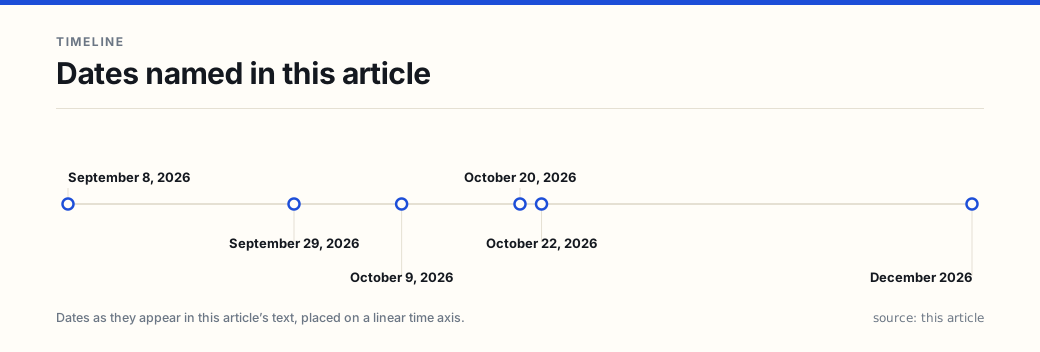
The short version
This is the third weekly record for America.gov, the federal portal that opened on September 29, 2026 under Executive Order 14432. One week after we recorded a stretch of official silence, the portal did something it had not done before: it started publishing dated notes about its own changes. That is worth more than a page refresh, and less than it looks like.
| What | Date | Why it matters to you |
|---|---|---|
| A Releases page appeared — the portal’s first public changelog, three entries | Oct 17 entry, surfaced this week | You can now date some changes to the site. You still cannot audit them: entries are prose, not diffs |
| The changelog claims a model trained in-house and answers “5x faster” | Oct 17 | First operator statement about the architecture — and it is untestable from outside, and compatible with the vendors named earlier |
| The privacy policy was revised | Oct 20 | First change to its stated date since launch day: fraud reports now route browser-direct to Treasury, and your language and theme settings are stored on your device |
| A bill would put one address-change form on Login.gov | Oct 22 | Not a portal change and not law. If you move, you still tell each agency separately |
| The demo passport screen still says “Arrives by Nov 5, 2026” | Nov 5 | A mock status screen is not a service date. Do not plan travel around it |
The week the portal started talking about itself
For three weeks the complaint in this series was specific: the government published dates, not results. No accuracy target, no evaluation method, no corrections log — nothing that would let a reader stop grading answers one at a time.
The Releases page is the first partial answer. It carries three entries, dated September 29 (the launch), October 17 and October 20, 2026. The October 17 entry is the substantive one. It describes a set of changes: faster answers, a wider check that runs before a message is sent, type-ahead suggestions, a downloadable PDF of the conversation, and a dark mode. In its own words:
“We trained our own model in-house and streamlined how every question gets answered, so America.gov now responds 5x faster.”
Read that as evidence, not as a specification. Three things are true at once. It is dated, which is new — the site had previously said nothing about itself in the past tense. It is first person, which is weaker than it sounds: a changelog written by the operator, describing the operator, with no version history attached, is a press release with a date on it. And it is unfalsifiable from outside: no vendor is named, no benchmark is published, no method accompanies the speed figure, and nothing says whether the in-house model replaced the commercial systems or runs on top of them.
That last gap is not a technicality. On October 9, 2026, the official in charge confirmed on the record that the assistant runs on Google’s Gemini and xAI’s Grok, and Google has acknowledged its involvement. A portal that added its own routing and prompting layer over those two could truthfully write “we trained our own model in-house.” So the sentence tells you the site now says something about its own architecture — and tells you nothing about which machine is answering you. We go through that conflict in What America.gov Runs On, which was updated when the page appeared.
The other thing the changelog does not do is the thing a changelog is for. It records what was added; it does not record what was removed, what was corrected, or which earlier answers were wrong. The Minecraft poem, the pasta recipe, the election answers that changed mid-launch: none of them appears as an entry. If you want to know what a portal page said last month, the only route we have found is an Internet Archive capture — which is how we know the privacy policy’s launch-day text lacked two sections it now contains.
The privacy revision, read the same way
The privacy policy carries “Last updated: October 20, 2026” — the first movement in that line since the launch-day version of September 29, with the text changed to match (a capture from October 1 still shows the older wording). The terms of use have not moved at all; they still read September 8, 2026.
The revision is mostly about one sentence of routing. Reports of fraud, waste or abuse now go from the browser directly to the Treasury Department’s Fraud.gov form: what you type, and any contact information or files you attach, do not pass through America.gov’s servers and are not seen by the model. America.gov records only whether the connection succeeded, how long it took, and what kind of error there was. Treasury’s privacy policy, not the portal’s, governs what you submitted. We cover the intake itself, and what a report has to contain, in The New Federal Reward for Reporting Fraud.
There is a lesson in how the two documents describe the same feature. The changelog speaks in the first person — “we send your report to the federal office most likely to act on it, and you get a reference number and a copy to keep” — while the policy describes a browser-to-Treasury handoff that does not pass through the portal at all. Those can both be true; the changelog sentence is written for a reader, the policy sentence for a lawyer. But if they ever conflict, the policy is the operating document, and the changelog is not.
Three practical consequences, in the order they are likely to matter:
- The wider pre-send check does not widen the attachment scrub. The October 17 entry says that before you send a message, the browser-side check “now catches names, street addresses, and Social Security numbers more reliably.” The policy’s separate sentence about PDFs still describes “a best-effort attempt in your browser to remove any private details,” and its list of what it looks for is illustrative — Social Security numbers, phone numbers, email addresses, credit card numbers. A case number, a patient ID, an account number and a medical detail are not on it. Two different objects, two different promises. Send the page a question needs, not the whole file.
- You can now take the answer with you. The conversation PDF is a manual export, not saved history — the portal still keeps no transcript for you to scroll back to. If a date or a dollar figure matters, export before you close the tab, and write down the agency page you checked it against. The portal’s own terms say asking a question does not file anything.
- Nothing about eligibility changed. The scrub, the export and the dark mode are conveniences. They do not make an answer a determination, and they do not create a claim if the answer was wrong — the fine print explains why that is structural rather than defensive drafting.
The other front door: a bill, not a service
On October 22, 2026, Rep. Young Kim (CA-40) and Rep. Suhas Subramanyam (VA-10) introduced the Tell the Government Once Act. It would direct the General Services Administration to create one voluntary form on Login.gov where a person verifies identity, enters a new address once, and chooses which agencies receive it. The release names the agencies Americans currently notify one at a time — the IRS, the Social Security Administration, Veterans Affairs and the Postal Service — and cites the IRS’s own figure that a change of address “generally takes 45 days to process.”
This is worth recording for two reasons, neither of which is that it will help you this year.
It is on a different rail from the portal. America.gov is a front end built by executive order, with a roadmap that says 2027. Login.gov is the existing sign-in service, and the release cites it as the place with “more than 180 million user accounts today.” If Congress wants one-form government, the vehicle already available is the identity platform, not the chatbot. That is a meaningful signal about where transactional government is likely to land first — and it is a signal, not a schedule.
It is a bill. Introduced bills do not obligate anyone. Nothing in it changes what you do after a move today: you still notify each agency on its own form or site, and mail forwarding through the Postal Service does not notify the IRS, Social Security or the VA. Until a single form exists, the working method is the unglamorous one — change the address with each agency, and keep the confirmation from each.
The test for whether this becomes real is narrow and easy to state: does GSA publish a form, or only a bill number? Until a GSA page exists that a person can actually submit, treat the proposal as a direction of travel.
The November 5 date on a sample screen
The portal’s landing page includes a preview of the passport flow. Part of that preview is a sample tracking screen, and it still reads “Arrives by Nov 5, 2026” — nine days from today.
It is a mock. Nobody’s passport arrives because of it, and online first-time applications are not open: the pages a real passport flow would live on still return nothing, and the two reporting positions in circulation are a December 2026 window reported from the State Department and a 2027 timeline on the portal’s own roadmap. The White House fact sheet said “later this year”; the roadmap says 2027; State’s briefing gave December. We have kept all three side by side since the first week rather than picking one, because the disagreement is itself the information.
The general rule is worth stating plainly, because a date rendered in a realistic-looking interface is the easiest thing on a government site to misread: a date inside a demonstration is a design element. A service date lives in an agency notice, a Federal Register document, or a page that accepts your application. Check the second kind. Your First Passport Is Going Online tracks which kind exists today.
What the week did not produce
Stated plainly, because a changelog invites the assumption that everything is now disclosed:
- No new release entry after October 20. Three entries total, the newest dated October 20.
- No OMB implementation memorandum. The order gives the Office of Management and Budget 90 days from September 29, which lands in late December 2026. Until it exists, agency integration is a direction, not an obligation anyone can be held to on a date.
- No accuracy target, evaluation method or correction log. This is the gap the changelog narrows but does not close: it tells you what the operator chose to announce, not how well the thing answers.
- No disclosure of hosting or security certification. Still unanswered, and it becomes the material question the moment the portal handles applications rather than answers.
- No resolution of the roadmap conflict. The fact sheet’s “later this year” and the roadmap’s 2027 are both still on the record.
How to read a government changelog
Five tests, and they will work on any agency’s release notes, not just this one:
- A dated entry is not a diff. You are reading a summary written by the party being described. Ask what it omits: corrections, removals, and anything that went wrong. On this page, so far, that is everything.
- First person is marketing until a document or a benchmark exists. “We trained our own model in-house” and a confirmed vendor list are not in conflict — which is exactly why the sentence cannot settle the question a reader actually has.
- The governing document wins. Where a changelog and a privacy policy describe the same feature differently, the policy governs the service and the terms govern your relationship with it. Quote the policy’s date line when it matters.
- Cross-check the date against the page’s own “Last updated” line. It is the only independent check available, and it is decisive: it is how the October 20 policy change can be verified at all, and how you know the terms have not moved since September 8.
- An empty week is a data point, not a verdict. No entry means either nothing shipped or nothing was announced, and from outside those are identical. Verify behavior, not notes.
One more, about the reading itself: these pages are served behind a browser check that refuses scripted clients, so open them in a normal browser and read the date lines on the page. If you need a permanent record — for a deadline dispute, say — save the page or an archive capture, because the site publishes entries, not versions.
The rest of this series
- America.gov Weekly: The Passport Date Is December 2026 — the first week’s record: the December window, the chatbot’s change of heart on election questions, and how to grade a date.
- America.gov Weekly: The Answer the Portal Denied Giving — the pre-written poem, the first benchmark for government chatbots, and why a wrong answer leaves you no claim. (The week of October 12–18 produced no material change; we recorded that on the pillar page instead of publishing an empty report.)
- What Is America.gov? — what launched on September 29, 2026, under which authority, and what is still only a roadmap.
- What America.gov’s Own Terms Say About the Answers It Gives You — the fine print: no filing, no eligibility decision, answers that “can be wrong,” and what happens to your attachments, voice and feedback.
- Your First Passport Is Going Online — the State Department’s timeline, and what has not changed today.
- An Expert Tested America.gov’s Health Answers — where the chatbot was right and wrong on coverage.
- Is That Really America.gov? — the habits that catch look-alike sites before you type anything.
- What America.gov Runs On, and Why It Matters Now — the models behind the assistant, and why the changelog’s model claim does not settle it.
- The network’s official government resources directory collects the primary sources behind all of these guides.
This article is general information about a federal service, not legal or financial advice about your situation. It is AI-written and independently AI-reviewed before publication; the review standard and this article’s findings are recorded in the network’s editorial review log.
Frequently asked questions
- Did America.gov launch any new service this week?
- No. Nothing you can apply for, enroll in or track was added. What changed is the paper trail: the portal is now publishing dated release notes on its own Releases page, and it revised its privacy policy on October 20, 2026 — the first change to that page's stated date since launch day. The pages a transaction would live on, such as /passport and /medicare, still return nothing.
- The release notes say America.gov trained its own model in-house. Is that true?
- There is no way for an outside reader to check it. The October 17, 2026 entry says the portal 'trained our own model in-house' and now answers '5x faster.' It names no vendor, publishes no benchmark and no method for the speed figure, and does not say whether that model replaced the commercial systems — Gemini and Grok — that were identified on the record on October 9, 2026, or was built on top of them. A site that ran its own layer over both could write the same sentence truthfully.
- Can I now change my address with every federal agency in one place?
- No. A bipartisan bill introduced on October 22, 2026 would direct the General Services Administration to build one voluntary form on Login.gov, where you would enter a new address once and choose which agencies receive it. A bill is not a service: until it passes and GSA builds the form, you still notify each agency separately, and mail forwarding through the Postal Service does not notify the IRS, Social Security or the VA.
- The passport preview says my passport arrives by November 5. Is that a real date?
- No. It is a sample status screen inside a product demonstration on the portal's landing page, and it still reads 'Arrives by Nov 5, 2026.' It is not a service date and not a promise to anyone. Online first-time applications are not open; the two reporting positions in circulation are a December 2026 window reported from the State Department and a 2027 timeline on the portal's own roadmap.
Sources
Each source is a primary or official reference, checked before publication. Links open the original.
- America.gov — Releases page, the portal's first public changelog, carrying three dated entries (September 29, October 17 and October 20, 2026); the October 17 entry states 'We trained our own model in-house and streamlined how every question gets answered, so America.gov now responds 5x faster' and says the pre-send personal-information check 'now catches names, street addresses, and Social Security numbers more reliably', alongside type-ahead suggestions, a downloadable conversation PDF and dark mode; the October 20 entry covers fraud-report routing in the first person — 'we send your report to the federal office most likely to act on it, and you get a reference number and a copy to keep' — america.gov/releases
- America.gov — Privacy policy, 'Last updated: October 20, 2026': the section routing fraud, waste and abuse reports to the Treasury Department's Fraud.gov form, the statement that language and theme preferences are kept in the browser's local storage, the best-effort in-browser scrub of PDF attachments using Rampart, and the cache and retention periods — america.gov/privacy-policy
- America.gov — Terms of use, 'Last updated: September 8, 2026': asking a question does not submit an application or contact an agency on the user's behalf, answers 'can be wrong', and users are told to check the linked source 'especially for anything involving money, immigration status, benefits, or a deadline' — america.gov/terms
- Internet Archive Wayback Machine — capture of america.gov/privacy-policy dated October 1, 2026, showing the launch-day text without the fraud-report sharing section and without the local-storage note — web.archive.org/web/20261001000903/https://america.gov/privacy-policy
- America.gov — landing page and roadmap pages, read October 27, 2026: the passport preview's sample tracking screen still reads 'Arrives by Nov 5, 2026'; the roadmap frames the later phases as 2027 while the White House fact sheet of September 29, 2026 said passport renewal and Medicare enrollment were coming 'later this year' — america.gov and america.gov/coming-soon
- Congresswoman Young Kim — press release, 'Rep. Young Kim Introduces Tell the Government Once Act to Cut Red Tape for Americans on the Move', October 22, 2026: introduced with Rep. Suhas Subramanyam (VA-10), directing the General Services Administration to create one voluntary form on Login.gov, which the release says 'supports more than 180 million user accounts today'; names the IRS, Social Security Administration, Veterans Affairs and the Postal Service as the agencies Americans currently notify one at a time, cites the IRS figure that a change of address 'generally takes 45 days to process', and links the bill text and a section-by-section summary — youngkim.house.gov/2026/10/22/rep-young-kim-introduces-tell-the-government-once-act-to-cut-red-tape-for-americans-on-the-move
- Internal Revenue Service — 'Topic no. 157, Change of address', the source of the 45-day processing figure cited in the October 22 release — irs.gov/taxtopics/tc157
- Executive Order 14432, 'Streamlining Access to Government Services Through America.gov' (September 29, 2026): the covered-service definition, the exclusions for tax filing and national-security services, and the 90-day deadline for OMB implementation guidance — whitehouse.gov/presidential-actions/2026/09/streamlining-access-to-government-services-through-america-gov
- Spectrum News, 'State Department to launch online-only first passport applications in December' (October 2026); PassSnap, 'First-time US passport online application and the photo' (status as of October 8, 2026) — the two reporting positions on the passport window, December 2026 and 2027