America.gov Weekly: A Late Changelog Line, a Contested Sign-In, and the First Audit of Chatbot Voter Guides
October 27–November 3, 2026: a late changelog entry, a withdrawn feature, SBA routing fraud tips to the portal, and Treasury choosing ID.me over Login.gov.
The short version
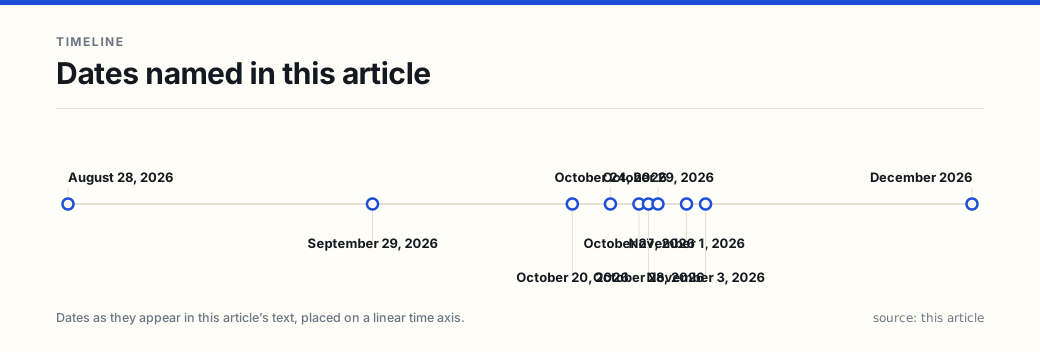
America.gov is the federal single portal that opened on September 29, 2026 under Executive Order 14432. In the week of October 27 to November 3, 2026 it shipped no new service and no roadmap revision. What it did to its own record, on the last day of that week, moves in two directions at once: it added a changelog entry for a voter-fraud reporting door that had been live and unlisted for five days, and it quietly withdrew a company-research feature that an earlier heading had promised. Everything else that moved this week moved around the portal — who is being routed to it, which sign-in the government actually honors, and whether anyone outside the government can grade the answers it gives.
| What | Date | Why it matters to you |
|---|---|---|
| The SBA told the public to report pandemic-era fraud at america.gov/fraud | Oct 27 | First agency outside Justice and Treasury to market the portal’s fraud door. If you have a PPP or EIDL complaint, this is now the advertised route |
| Treasury required ID.me to sign in to TreasuryDirect, refusing Login.gov | Oct 28 | The portal’s premise is one sign-in. A major Treasury system just went the other way, and savings-bond holders are the ones holding the extra account |
| Two senior senators asked Treasury to delay that requirement until after the 2027 filing season | Oct 29 | Not a reversal. A letter with a November deadline for answers and no power to stop the change |
| The first county-scale audit of AI voter guides published | Oct 24, reported onward | Six chatbots, 3,000-plus guides: wrong district 22 percent of the time when a district was named at all. The same failure mode applies to any assistant asked a ballot question |
| The passport rule finished its comment period | Oct 27 | Closer to a final rule, still not a service. Nothing opens for you yet |
| The Releases page changed twice on Nov 3 | Oct 29 entry added; Oct 27 heading cut | It gained a line for the voter-fraud door five days after that page went live — and dropped “company research” from an earlier heading |
The single sentence worth quoting: as of November 3, 2026, America.gov has published five dated changelog entries and zero accuracy figures, while the only independent test of chatbot voter guides at county scale found district errors in the answers that gave one.
What changed on America.gov this week?
Not the product — its record, which is the part a reader can actually audit. When this column was first published on the morning of November 3, 2026, the newest entry on the portal’s Releases page was dated October 27. Re-reading the same page at 08:30 UTC that day produced two differences on /releases, and the first of them also shows in the “Latest release” block of /coming-soon:
- A fifth entry, dated October 29, 2026. Headed “Voter fraud reporting,” it reads: “Name the person, describe what you saw, and add documents if you have them. If you share your contact details and your report leads to an arrest and conviction, you may qualify for a reward of up to $1 million.” That is the page we examined on October 29 in Reporting Voter Fraud to the Federal Government — which at the time had no line in the changelog. The entry adds no terms: no agency, no statute, no appropriation, no claim procedure, no deadline.
- A shortened heading on the October 27 entry. “Images, housing maps, and company research” now reads “Images and housing maps,” and no entry on the page describes a company-research feature. The mismatch this series flagged for seven consecutive monitoring passes — a heading promising a third feature its body never described — was closed by withdrawing the promise, not by shipping the feature.
Why an entry dated October 29 surfaced only now is not something the page explains, and we will not guess. A backdated line and a page served from a cache that did not refresh are both consistent with what we saw; only one of them is consistent with the changelog having been accurate on October 29. What is checkable is the result: for five days, the voter-fraud door was live with no line in the portal’s own record, and the correction, when it came, was a paragraph that restates the offer without answering any of the questions the offer raises.
That is five entries in five weeks — September 29, October 17, October 20, October 27, October 29 — and still no correction, accuracy figure or published method.
The number that did not move
The portal’s terms of use still carry the sentence that governs everything else: answers “can be wrong,” and you should check the linked source “especially for anything involving money, immigration status, benefits, or a deadline.” That sentence is honest and it is also the whole disclosure. There is no published error rate to compare it against, which means the only way to know whether an answer was right is to check it yourself — every time. We set out how to do that in What America.gov’s Own Terms Say About the Answers It Gives You.
Who started sending people to the portal this week?
The Small Business Administration (SBA), on October 27, 2026. Its news release asked the public, federal employees, lenders and small-business owners to report suspected SBA loan and grant fraud — specifically Paycheck Protection Program (PPP) and COVID-19 Economic Injury Disaster Loan (EIDL) fraud — through the centralized federal portal at america.gov/fraud.
This is a routing decision, not a product launch, and the distinction is the point. Since the October 20, 2026 privacy revision, a fraud report submitted through the portal goes browser-direct to the Treasury Department’s intake, and the portal itself records only whether the connection succeeded. The Justice Department’s National Fraud Enforcement Division reviews submissions under its own FAQ. The SBA’s inspector general has been one of the offices on the portal’s published routing list since that list appeared.
What a fraud report through america.gov actually gets you
- One form, several agencies. You submit once; the portal says it sends the report to “the federal office most likely to act on it,” and the routing list names 20-plus offices. The SBA’s release is the first time a single agency has advertised that path on its own letterhead.
- A reward, if the rules are met. Tips can qualify for $10,000 to $30,000 under the Fraud Whistleblower Incentive Program, paid when charges are unsealed — not when a conviction lands, and not on request. The tests, exclusions and the gap between the podium version and the written rules are in The New Federal Reward for Reporting Fraud.
- No promise of a reply. Nothing on the portal commits to a response time. A report is not a call for emergency help, and should not be treated as one.
If you have first-hand knowledge of a pandemic loan that was obtained with false payroll numbers, the SBA’s release is now the clearest official instruction to use the portal. If your complaint is about a bank, a servicer or a collections agency, this is not your door — the routing table in How to Report Fraud Through America.gov tells you which one is.
Why did Treasury require ID.me for savings bonds?
Because the Treasury Department decided that the platform where Americans buy and redeem U.S. savings bonds — TreasuryDirect — would require an ID.me account, effective October 28, 2026. Login.gov is not accepted there. Treasury announced the move over the summer; this week it took effect.
On October 29, 2026, Senators Ron Wyden (D-Ore.), ranking member of the Finance Committee, and Elizabeth Warren (D-Mass.), ranking member of the Banking Committee, wrote to Treasury Secretary Scott Bessent and IRS chief executive Frank Bisignano asking Treasury to delay the requirement “at a minimum” until after the 2027 tax-filing deadline. Their argument rests on three points:
- Savings bonds are held disproportionately by older Americans, who may not have “the digital proficiency” to open and verify a new commercial account on a deadline.
- The administration has ordered agencies to move toward Login.gov as the government’s universal sign-in, and Login.gov already meets the federal identity standard known as IAL2, with multi-factor authentication, in-person verification at participating post offices and passport-based verification.
- TreasuryDirect is where taxpayers retrieve Form 1099-INT interest statements, so a sign-in change lands in the middle of filing season for the people least able to absorb it.
The letter contains a dozen questions and sets a November deadline for answers. It does not change the rule. Treasury did not respond to a request for comment, and ID.me’s position is that it has outperformed the government alternative on service and fraud, that it shares only what TreasuryDirect needs, and that no biometric data goes to TreasuryDirect.
What the sign-in split means for the portal
America.gov’s entire architecture assumes one credential: you sign in once with Login.gov and the front door knows you. That assumption is now visibly contested at an agency that is not on the portal’s roadmap at all. Treasury did not route bond buyers through the front door; it routed them to a commercial identity broker.
We think the useful reading is narrower than “the portal is failing” and wider than “this is routine procurement.” Two things are true: the portal’s sign-in works, and the government does not yet act as if one sign-in is enough. Until an agency with a high-traffic money function adopts Login.gov on its own initiative, “one front door” describes the website, not the identity layer underneath it.
If you hold savings bonds, the practical note is short: you need an ID.me account to sign in, and the 5.51 percent composite rate on bonds issued from November 1, 2026 is worth understanding before you decide how much to buy — our I-bond explainer has the fixed-versus-variable breakdown.
What did the first independent audit of chatbot voter guides find?
On October 24, 2026, The Washington Post published the results of a test that had not been run before at that scale. Reporters Kevin Schaul and Ian Duncan, working with the data firm Promptwatch, asked six leading chatbots to build a voter guide for an address in every U.S. county — more than 3,000 guides — listing the races and the candidates’ positions.
The findings, in order of how much they should worry a voter:
| Finding | Figure | What it means at the ballot box |
|---|---|---|
| The guide did not name a congressional district | 48% of guides | Every voter has a House race. A guide that omits the district has omitted the race |
| The guide named the wrong district | 22% of the guides that answered | You are told to consider candidates you cannot vote for, and not told about the ones you can |
| A chatbot was wrong for an address | Claude and Alexa+, more than 1 in 5 | The error rate is not a rounding error at the edge; it is the middle of the distribution |
| A race was invented | Missouri Senate seat | Missouri had no Senate race on the ballot. The guide listed one anyway |
| A candidate was misplaced | Wyoming Senate listing | Two state-office candidates were presented as U.S. Senate candidates |
Two details from that reporting deserve to survive the headline. First, the chatbots’ errors were often inherited: a source the models favored, an AI-written site called Ballot Brief, carried errors — a bill attributed to a senator who had not yet taken office, two different California candidates with the same name merged into one profile — and the models repeated them. Second, refusing to answer looked like accuracy: ChatGPT, Google’s AI Mode and Perplexity were “wrong the least often” largely because they frequently declined to name a district at all. A blank is not a correct answer, and a scoreboard that counts it as one is measuring the wrong thing.
The second study, published this week
On November 1, 2026, Agence France-Presse reported a Forum AI study of eight models finding that nearly 40 percent of answers to election questions contained at least one factual error — and that questions about how to vote produced more errors than questions about who is running. One example is the kind that costs a ballot: Google’s Gemini gave a Pennsylvania mail-ballot application deadline of November 3 when the actual deadline was October 27.
We take the ranking of models lightly and the shape of the failure seriously. Both studies point the same way: the errors cluster in procedural, local, date-bound facts — district lines, deadlines, which office is on which ballot — which is exactly the category a federal portal is now answering questions about, and exactly the category a general-purpose model is worst at keeping current.
Does any of that testing cover America.gov?
No — and that gap is the story. Neither the Post audit nor the Forum AI study tested America.gov at county scale. What exists is one comparative observation, from Ars Technica in late October 2026: asked who won recent presidential elections, Google’s AI Mode in the United States often returned links rather than an answer, while Gemini, ChatGPT, Claude and “even the government-run AI model at America.gov” answered directly.
Read that as a fact about willingness, not accuracy. The portal answering a settled question directly is the behavior you want; it says nothing about whether the portal would name your congressional district correctly. The two properties come from different machinery — one is a refusal policy, the other is a data problem — and only one of them has been audited, and not on this site.
This is why we keep returning to the same missing artifact. The portal has published a changelog that describes features and a terms page that warns answers can be wrong. It has not published an accuracy rate, an evaluation method or a corrections log. Until it does, the honest summary of America.gov’s election answers is the one we can defend: untested at the scale that matters, by anyone outside the government, as of November 3, 2026.
If you are voting, the sequence that works takes about five minutes and does not involve a chatbot: confirm your registration at vote.gov, open your sample ballot from your county or state election office, and check every race and deadline against that page. Registration deadlines, identification requirements and mail-ballot cutoffs vary by state, and no federal portal — this one included — tracks them for you. Our voter registration walkthrough and what happens after Election Day cover the steps that follow.
Did the passport promise move this week?
One procedural step, on October 27, 2026, when the 60-day comment period closed on the State Department’s proposed rule to let qualified U.S. citizens abroad renew passports online. The rule, published August 28, 2026, would end the two in-person consular visits that renewal currently requires, drop the condition that a passport must have a year or less of validity left, and reach applicants inside the United States too. The department estimates it would add about 220,000 applicants to the online platform in fiscal 2027.
What has not changed: the rule is proposed, not final. Eligibility would still require a previous 10-year passport issued at age 16 or older; lost, stolen or 15-year-old passports would not qualify; the department has described a phased rollout limited to countries on a list it has not published. Domestic renewal through MyTravelGov is unchanged, and first-time applications are still not online — which is the promise the portal’s own landing page is still illustrating with a sample screen that reads “Arrives by Nov 5, 2026.”
That sample date is worth repeating because it is the most-quoted number in this series and the least real: it is a mock status screen in a product demonstration, not a service date and not a promise to anyone. Your First Passport Is Going Online tracks the two reporting positions on the real window — a December 2026 start reported from the State Department, and 2027 on the portal’s roadmap.
How we decided what counted this week
A weekly column is only as good as its threshold, so here is ours in full. We treated an item as a change this week if it passed all four tests:
- Does it change what a reader can do? A new form, a new sign-in requirement, a new deadline. The SBA routing and the ID.me requirement pass. A changelog entry describing photographs inside answers does not — which is why the October 27 entry got a paragraph here and a full treatment on the pillar page instead.
- Does it change who holds your data? A new intake route or a new identity broker moves your information to a different custodian, and that is material even when the interface looks identical. Both pass.
- Is it dated, and attributable to a named source? A press release with a date, a letter with a sender, a study with authors. Undated claims and unattributed screenshots fail, and that standard is why we did not treat “the portal feels slower” anecdotes as news.
- Can you check it without the operator’s help? A rule you can read, a rate you can confirm, a deadline on a state page. Claims that only the operator can verify — “we trained our own model in-house,” “5x faster” — are recorded as claims, never as findings.
Two corollaries we apply to ourselves. An empty week is a data point: no entry means either nothing shipped or nothing was announced, and from outside those are indistinguishable, so we say “unchanged” rather than “nothing happened.” And a study about chatbots is not a study about this chatbot: we will use outside testing to describe the failure mode, and we will not attribute its numbers to America.gov unless the portal was in the sample.
How official text is linked in this series
Every America.gov reference in this series is given as a path plus the date we read it — america.gov/releases, read November 3, 2026 — because the changelog publishes no per-entry permalink, so a path and a reading date are the only citation a reader can re-check. We do not link to portal pages as if they were permanently citable documents, and we do not link to pages we have not opened. Where a primary document exists outside the portal — a congressional letter, an agency release, a court filing — we link to that instead, because a link that a reader can open is worth more than a citation that only looks authoritative.
The rest of this series
- America.gov Weekly: The Passport Date Is December 2026 — the first week’s record, including the chatbot’s change of heart on election questions.
- America.gov Weekly: The Answer the Portal Denied Giving — the pre-written poem and the first attempt to benchmark a government chatbot.
- America.gov Weekly: The Portal’s First Changelog, and the Claims It Cannot Yet Prove — the Releases page, the privacy revision, and a bill that is not a service.
- What Is America.gov? — what launched on September 29, 2026, under which authority, and what is still only a roadmap.
- What America.gov’s Own Terms Say About the Answers It Gives You — the fine print on answers that “can be wrong.”
- How to Report Fraud Through America.gov — the routing table, and what a report has to contain.
- The New Federal Reward for Reporting Fraud — the $10,000 to $30,000 program, its tests and its exclusions.
- Is That Really America.gov? — the habits that catch look-alike sites before you type anything.
- The network’s official government resources directory collects the primary sources behind all of these guides.
This article is general information about a federal service, not legal or financial advice about your situation. It is AI-written and independently AI-reviewed before publication; the review standard and this article’s findings are recorded in the network’s editorial review log.
Frequently asked questions
- Did America.gov launch anything new this week?
- No new service you can apply for, enroll in or track. But the portal's Releases page did change on November 3, twice, and both changes matter to the record rather than to what you can do today. It gained a fifth entry, dated October 29, 2026, for the voter-fraud reporting door that had been live since that date without a changelog line; and the October 27 heading was shortened from 'Images, housing maps, and company research' to 'Images and housing maps,' withdrawing a feature the portal had promised and never described. We found both when we re-read the page at 08:30 UTC on November 3, after this column was first published; the correction is set out in full below.
- Can I report small-business fraud through America.gov now?
- Yes, and as of October 27, 2026 the Small Business Administration is actively telling people to. The SBA asked the public, federal employees, lenders and small-business owners to report suspected Paycheck Protection Program and COVID-19 Economic Injury Disaster Loan fraud through america.gov/fraud, where the Justice Department's reward program also takes tips. The portal is the intake, not the decider: the reward rules belong to the Justice Department, and SBA's inspector general is one of the offices a report can be routed to.
- Do I need ID.me to buy savings bonds now?
- At TreasuryDirect, yes — since October 28, 2026, buying or redeeming U.S. savings bonds there requires an ID.me account, and Login.gov is not accepted on that site. That is the opposite direction from the rest of the federal sign-in effort, which is why two senior senators asked Treasury on October 29, 2026 to delay the requirement until at least after the 2027 filing season. The letter does not change the rule; only Treasury can.
- Can I trust America.gov for a voting deadline or a polling place?
- No. Use vote.gov, your state election office and your sample ballot, and check the URL ends in .gov. The portal publishes no accuracy metric and no corrections log, and the only independent, county-scale test of chatbot voter guides this cycle found that when a guide named a congressional district it named the wrong one 22 percent of the time. A wrong date costs you a ballot; a wrong district costs you a race you never saw.
- Is the online first-passport service open yet?
- No. The State Department's proposed rule on online renewal for Americans abroad finished its comment period on October 27, 2026, which moves it toward a final rule — not toward a live service. A final rule must still be published, and the department has described a phased rollout limited to named countries. Domestic renewal through MyTravelGov is unchanged, and first-time applications are still not online.
Sources
Each source is a primary or official reference, checked before publication. Links open the original.
- Small Business Administration — news release, October 27, 2026, asking the public, federal employees, lenders and small-business owners to report suspected SBA loan and grant fraud, including Paycheck Protection Program and COVID-19 Economic Injury Disaster Loan fraud, through the centralized federal portal at america.gov/fraud following the Fraud Whistleblower Incentive Program announcement of October 20, 2026; summarized with a link to the release in PilieroMazza's 'Weekly Update for Government Contractors and Commercial Businesses', October 29, 2026 — sba.gov and jdsupra.com/legalnews/weekly-update-for-government-4728964
- America.gov — Releases page, the portal's public changelog: five entries dated September 29, October 17, October 20, October 27 and October 29, 2026, read at 08:30 UTC on November 3, 2026; the October 29 entry is headed 'Voter fraud reporting' and reads 'Name the person, describe what you saw, and add documents if you have them. If you share your contact details and your report leads to an arrest and conviction, you may qualify for a reward of up to $1 million'; the October 27 entry is now headed 'Images and housing maps', a change from 'Images, housing maps, and company research', which it still carried in our read eight hours earlier — america.gov/releases
- America.gov — Terms of use, 'Last updated: September 8, 2026': asking a question does not submit an application or contact an agency, answers 'can be wrong', and readers are told to check the linked source 'especially for anything involving money, immigration status, benefits, or a deadline'; no accuracy rate, error rate or corrections log appears on the page — america.gov/terms
- FedScoop — 'Treasury, IRS use of third-party ID verification under fire from top Senate Finance, Banking Dems', October 29, 2026: Treasury began requiring ID.me for TreasuryDirect this week; the letter from Sens. Ron Wyden (D-Ore.) and Elizabeth Warren (D-Mass.) to Treasury Secretary Scott Bessent and IRS chief executive Frank Bisignano asks for a delay 'at a minimum' until after the 2027 filing deadline, and states that Login.gov 'is already used by over 180 million users across 54 agencies and states' — fedscoop.com/treasury-direct-irs-id-me-login-gov/
- POLITICO — live updates, October 29, 2026: TreasuryDirect users needed ID.me to sign in 'starting Wednesday' (October 28, 2026); the senators' letter cites older Americans and people without modern devices as the users most exposed by the change, notes that Treasury awarded ID.me a five-year purchasing agreement, and sets a November deadline for answers; an ID.me spokesperson said the company shares only what TreasuryDirect needs and no biometric data with the site, and Treasury did not respond to a request for comment — politico.com/live-updates/2026/10/29/congress/oklahoma-senate-seat-hern-armstrong-01141441
- The Washington Post — 'We asked AI chatbots to make voter guides. They invented races and misidentified candidates', by Kevin Schaul and Ian Duncan, October 24, 2026: six chatbots, more than 3,000 AI-generated voter guides covering addresses in every U.S. county, built with the data firm Promptwatch; the chatbots failed to name a congressional district 48 percent of the time and named the wrong district 22 percent of the time when they did answer; Claude and Alexa+ were wrong for more than one address in five; a Missouri Senate race that does not exist, a Wyoming listing that put state-office candidates in a Senate race, and a Maryland district error naming a retiring incumbent; Amazon paused Alexa's voter-guide feature after the findings; 2 in 5 Americans said they had used AI to look up election information, per a National Conference on Citizenship survey cited in the piece — washingtonpost.com/technology/2026/10/24/we-asked-six-chatbots-make-voter-guides-they-made-serious-errors/
- Agence France-Presse, reported November 1, 2026: a Forum AI study of eight AI models found that nearly 40 percent of answers to election questions contained at least one factual error, that voting-procedure questions produced more errors than candidate questions, and that Google's Gemini answered a Pennsylvania mail-ballot application deadline as November 3 when the deadline was October 27; the study also recorded hundreds of quotations attributed to candidates and officials who never said them — cna.com.tw/news/aopl/202611020136.aspx
- Ars Technica — 'Google AI gets cagey when asked who won the 2020 elections', by Kyle Orland, October 2026: Google's AI Mode in the United States often returned links instead of naming recent presidential winners, while Gemini, ChatGPT, Claude and 'even the government-run AI model at America.gov' answered the same questions directly; access from outside the country produced direct answers, and repeating a question in the U.S. did too — arstechnica.com/ai/2026/10/google-ai-gets-cagey-when-asked-who-won-the-2020-elections/
- TheTravel — 'The 6 New Rules For Renewing A U.S. Passport', October 2026: the State Department's proposed rule of August 28, 2026 would let qualified citizens abroad renew online, ending the two in-person consular visits the process now requires; the department estimates about 220,000 additional applicants in fiscal 2027; the rule would also drop the one-year-validity condition, keep the requirement for a prior 10-year passport issued at age 16 or older, exclude lost, stolen or 15-year-old passports, and roll out by country; the 60-day comment period closed October 27, 2026, and a final rule is still required — thetravel.com/the-6-new-rules-for-renewing-a-us-passport
- Executive Order 14432, 'Streamlining Access to Government Services Through America.gov' (September 29, 2026): covered services are public-facing federal services used by more than 100,000 people in a 12-month period and available online, with tax filing and national-security services excluded — whitehouse.gov/presidential-actions/2026/09/streamlining-access-to-government-services-through-america-gov
- Vote.gov and USA.gov — the two federal starting points for registration deadlines, polling places and state election-office contacts, which remain the authoritative sources for anything on a ballot — vote.gov and usa.gov