Fraud.gov's Tip Intake, in Treasury's Own Words: AI Triage, 80,000 Reports a Year
Treasury's Federal Register notice finally documents the Fraud.gov tip intake: AI-assisted triage, 80,000 reports a year, and what happens after you submit.
Fraud.gov is the Treasury Department’s government-wide intake portal where the public reports suspected waste, fraud, abuse, improper payments, and misuse of federal funds affecting federal programs — and on November 30, 2026, a Federal Register notice (FR Doc. 2026-24266) formally documented it for the first time on Treasury’s side: an AI-assisted triage workflow, an estimated 80,000 reports a year, and referrals routed to federal agencies, inspectors general, and law enforcement.
Until now, the closest thing to official documentation of the form came from the other direction — America.gov’s privacy policy describing the report button as Treasury’s Fraud.gov service. The new notice is the government speaking about its own intake, and it answers several questions the portal pages never did. It also leaves several open. This article walks through what the notice says, what it does not, and what a person actually filing a report should expect.
What the notice says, in one place
The document is a Paperwork Reduction Act notice: Treasury’s Departmental Offices asking the Office of Management and Budget to keep clearing the “Fraud.gov Tip Intake and Referral Form” under OMB Control Number 1505-0284. Its description paragraph is where the substance sits:
- Who runs it: the Department of the Treasury, “on behalf of the Task Force to Eliminate Fraud” — the body created by Executive Order 14395 (March 19, 2026), implementing the payment-integrity order EO 14249 (March 28, 2025).
- What it takes: reports of “suspected waste, fraud, abuse, improper payments, misuse of Federal funds, and related misconduct affecting Federal programs.” Federal programs — this is not a channel for a dispute with a private company or a state agency.
- What it does with them: receives, reviews, triages, categorizes, de-duplicates, and refers allegations to “the appropriate Federal agency, inspector general, law enforcement organization, or other authorized entity.”
- What you give it: a narrative description of your allegations, supporting documentation, and contact information you choose to provide.
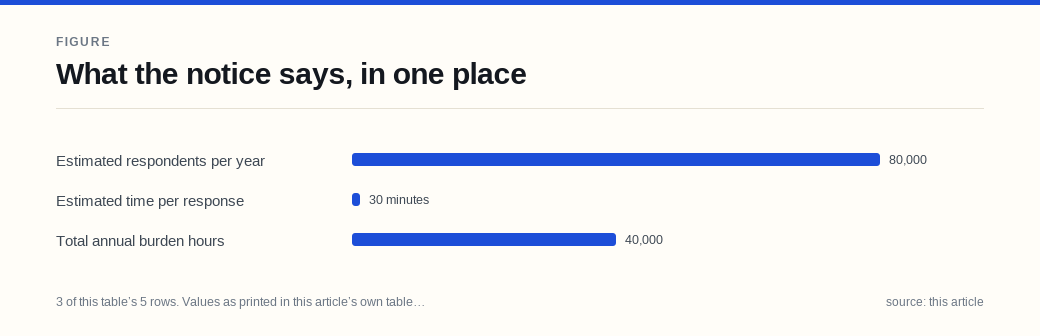
The burden table is small but worth reading, because these are Treasury’s own estimates of how the public uses the form:
| Notice estimate | Figure |
|---|---|
| Estimated respondents per year | 80,000 |
| Responses per respondent | Once |
| Estimated time per response | 30 minutes |
| Total annual burden hours | 40,000 |
| Affected public | Individuals and households |
The arithmetic checks out — 80,000 responses at 30 minutes each is exactly 40,000 hours. But both figures are the agency’s planning estimates, not measurements, and the notice gives no basis for them. If your own report takes five minutes or two hours, that tells you nothing about the estimate was wrong — only that you were not average.
The AI tool, exactly as described
The notice describes the artificial-intelligence step in three sentences, and each limit in them matters:
“An artificial intelligence tool will process the initial entry and populate it into standardized fields, along with suggested routing recommendations, which respondents can review and edit before submitting. The tool is intended to assist with standardization and routing recommendations; respondents may review and edit populated fields before submission, and Treasury personnel will apply appropriate review and quality-control procedures before referral.”
Three things follow from that language. First, the AI does initial entry processing: it reads your narrative, fills standardized fields, and suggests where the report should go. Second, you correct it: the populated fields are presented for review and edit before anything is submitted — so read what the tool inferred about your report before you sign off on it. Third, a human checks it again: Treasury personnel apply review and quality-control procedures before any referral leaves the building.
What the notice does not say is as notable: no statement that the AI makes eligibility decisions, scores or ranks tips, or that algorithmic de-duplication ever causes a report to be discarded rather than linked. The description says de-duplication is part of intake (“receive, review, triage, categorize, de-duplicate, and refer”), which suggests duplicates are consolidated — but nothing published promises that, and this article will not guess at what happens to a report the system matches to an existing one.
The paperwork trail behind a service that already runs
One wrinkle deserves its own section, because it changes how you should read the notice. The form is classified as an “Extension without change of a currently approved collection” — paperwork language meaning Treasury already had an approved collection and is asking OMB to continue it, not asking permission for something brand new. Yet the description says Treasury “is launching a government-wide intake and referral portal.”
Both statements trace to the same reality. The intake has been live since at least October 2026 — America.gov’s privacy policy, last updated October 20, 2026, describes the report form behind america.gov/fraud as Treasury’s Fraud.gov service, fed browser-direct from the portal. What is new on November 30 is not the form but the formal description of it: before this notice, no Treasury document publicly stated who operates it, what the AI does, the referral destinations, or the volume estimates. The notice is the government catching its paperwork up to its service.
The address, meanwhile, still behaves as it did when we first checked it in October: typing fraud.gov on November 29, 2026 redirected to the White House’s “Fraud Ledger” — a public docket of Task Force enforcement actions with a rollup dated November 10, 2026 and its own report link. The redirect could change; the address bar, not the name in it, is what tells you where you are.
What this changes for someone filing a report
Honest answer: the mechanics you will experience are unchanged — the notice documents an existing form, and its practical guidance is thin. What it does give a filer:
- Expect the AI’s fields to be editable. You write the narrative; the tool structures it. Check every populated field — agency names, dollar amounts, dates — before submitting, because the referral follows the fields, not your prose.
- Expect de-duplication. If someone else has reported the same scheme, your report may be linked to an existing file rather than opened fresh. That is not a reason not to report — a single report is what you can control — but it recalibrates expectations about being “the” tip.
- Attachments stay your responsibility. The notice mentions supporting documentation; it says nothing about scrubbing them. America.gov’s privacy policy already says attached files “are sent as you provide them” and are not checked or redacted — send only what proves the point, redacted.
- Keep your own record. The notice promises nothing about responses, status updates, or turnaround. No published response-time commitment exists anywhere in this chain, and the Justice Department’s FAQ for the reward program says tipsters may or may not be contacted.
If you want the reward program’s eligibility tests rather than the intake’s mechanics, those are covered in The New Federal Reward for Reporting Fraud, and the page-level promises and privacy mechanics of the America.gov side are in Reporting Fraud Through America.gov.
Comment on the form, not the policy
The comment window here is narrow and worth stating precisely: by December 30, 2026, through www.reginfo.gov/public/do/PRAMain, on the information collection — the form itself, its 30-minute burden estimate, and the AI workflow description. This is the PRA process, which governs how the government collects information from the public, not the underlying fraud-enforcement policy. If your concern is that 30 minutes is underestimated for complex matters, or that the AI field-population step needs more disclosure, this is the venue where those comments are actually considered.
Three things to refuse, whatever the portal looks like
A national fraud-reporting channel that advertises itself is exactly the kind of name impostors borrow. No official document describes any of these, so treat each as a scam signal:
- A fee to file, expedite, or “release” a report. The notice mentions no fee anywhere in it, and nothing else in this chain has ever charged one.
- An inbound call quoting a reference number and asking you to verify your bank details or pay a “processing deposit.” Your reference number is for your records; return any contact by calling a number you looked up yourself.
- A third party who found you and wants your documents and signature to “submit on your behalf.” If you want representation, you choose the lawyer.
The twelve checks for verifying you are on the real portal are in Is That Really America.gov?, and consumer scams that have nothing to do with federal programs belong at the FTC’s reportfraud.ftc.gov instead.
The bottom line
The November 30 notice does not change how you report federal fraud — it changes what the government has publicly committed to about the system that receives your report. As of this notice, the documented facts are: Treasury runs it for the Task Force to Eliminate Fraud, an AI tool pre-fills fields and suggests routing, you edit before submitting, people at Treasury review before referral, and the government expects about 80,000 reports a year. What remains undocumented — response times, what happens to a de-duplicated report, how long a referral takes — is now a shorter and clearer list than it was a week ago, which is its own kind of progress.
The rest of this series
- Reporting Fraud Through America.gov — the portal page’s promises, the browser-to-Treasury handoff, and what the privacy policy admits.
- The New Federal Reward for Reporting Fraud — the $10,000 to $30,000 Justice Department program, its tests and its exclusions.
- Reporting Voter Fraud to the Federal Government — the second door on the same chooser page.
- What Is America.gov? — what launched on September 29, 2026, and what is still only a roadmap.
- Is That Really America.gov? — twelve checks that separate the real portal from an impostor.
- The network’s official government resources directory collects the primary sources behind these guides.
This article is general information about a federal reporting channel, not legal advice. It is AI-written and independently AI-reviewed before publication; the review standard and this article’s findings are recorded in the network’s editorial review log.
Frequently asked questions
- What is Fraud.gov?
- It is the Department of the Treasury's government-wide intake portal for reports of suspected waste, fraud, abuse, improper payments, and misuse of federal funds affecting federal programs. Treasury collects the reports on behalf of the Task Force to Eliminate Fraud, triages them, and refers them to the appropriate federal agency, inspector general, or law enforcement organization. As of November 29, 2026, typing fraud.gov redirects to the White House's 'Fraud Ledger' page, which carries the report link.
- Does an AI tool decide where my fraud report goes?
- No, not by itself. The notice says an artificial intelligence tool processes the initial entry, populates it into standardized fields, and generates suggested routing recommendations — but you review and can edit every populated field before submitting, and Treasury personnel apply review and quality-control procedures before any referral goes out. The tool's stated role is standardization and routing suggestions, not adjudication.
- Is Fraud.gov already running, or is it new?
- Both descriptions appear in the government's own paperwork and they are not reconciled in it. The notice describes Treasury as 'launching' a government-wide portal, yet also classifies the form as an 'extension without change of a currently approved collection' — paperwork language for a form that already exists. America.gov's privacy policy has described its fraud-report form as Treasury's Fraud.gov service since October 2026. The accurate reading: the intake has been operating; the November 30 notice is the first Treasury-side document that formally describes it.
- How do I comment on the notice?
- Comments on the information collection go through www.reginfo.gov/public/do/PRAMain — select 'Currently under 30-day Review – Open for Public Comments' and find OMB Control Number 1505-0284. Comments should be received on or before December 30, 2026 to be assured of consideration. This comment window is about the paperwork (the form, its burden estimate, the AI workflow), not about fraud policy itself.
- Will reporting through Fraud.gov make me eligible for a reward?
- A reward is never automatic, and this notice says nothing about rewards. The paid program is the Justice Department's separate Criminal Tip Rewards Pilot Program, with its own eligibility tests and its own terms. What the two share is the channel: the Justice Department's terms direct tips through america.gov/fraud, and America.gov's privacy policy says that form is Treasury's Fraud.gov service.
- Is my report anonymous?
- The Treasury notice does not address anonymity, so this article will not import an answer from anywhere else. What is documented elsewhere: the America.gov report page treats your name as optional, and the Justice Department reward terms require contact information and verified identity before any award. If you are reporting only to have conduct looked at, unnamed is a real option; if you are reporting for a reward, anonymity is not.
Sources
Each source is a primary or official reference, checked before publication. Links open the original.
- U.S. Department of the Treasury, Departmental Offices — 'Agency Information Collection Activities; Submission for OMB Review; Comment Request; Fraud.gov Tip Intake and Referral Form,' OMB Control Number 1505-0284, FR Doc. 2026-24266, filed November 27, 2026, Federal Register Volume 91, Number 228, publication date November 30, 2026, pages 77286–77287: the primary source for the portal description, the AI-tool workflow and its limits, the Task Force delegation, the 80,000-respondent estimate, the 30-minute and 40,000-hour burden figures, and the December 30, 2026 comment deadline — https://www.federalregister.gov/documents/full_text/text/2026/11/30/2026-24266.txt
- The White House — 'The Fraud Ledger,' the Task Force to Eliminate Fraud docket page that fraud.gov redirected to when checked November 29, 2026 (a public record of enforcement actions with a Task Force rollup dated November 10, 2026, and its own report-fraud link) — https://www.whitehouse.gov/fraud/
- Executive Order 14249, 'Protecting America's Bank Account Against Fraud, Waste, and Abuse,' published March 28, 2025: one of the two executive orders the Treasury notice says the collection supports — https://www.federalregister.gov/documents/2025/03/28/2025-05524/protecting-americas-bank-account-against-fraud-waste-and-abuse
- Executive Order 14395, 'Establishing the Task Force To Eliminate Fraud,' published March 19, 2026: the order creating the cabinet-level Task Force on whose behalf Treasury operates the intake — https://www.federalregister.gov/documents/2026/03/19/2026-05497/establishing-the-task-force-to-eliminate-fraud
- America.gov — Privacy policy, 'Last updated: October 20, 2026' (the report form used behind america.gov/fraud is the Treasury Department's Fraud.gov service; what you enter goes browser-direct to Treasury; attached files are sent as provided and are not checked or redacted) — https://america.gov/privacy-policy
- Office of Management and Budget — reginfo.gov Portal for the Paperwork Reduction Act, the submission channel named in the notice for public comments on the collection — https://www.reginfo.gov/public/do/PRAMain
- 44 U.S.C. 3501 et seq. — the Paperwork Reduction Act of 1995, the authority cited in the notice for the information collection — https://www.law.cornell.edu/uscode/text/44/chapter-35/subchapter-II
- Federal Trade Commission — ReportFraud.ftc.gov, the intake for consumer scams that are not federal-program fraud, named here to separate the two channels — https://reportfraud.ftc.gov