The first-passport online pilot takes effect November 16: who qualifies, how the oath works, and the $35 that stays
The State Department's first-passport online pilot takes effect November 16, 2026: who qualifies, how the oath works, and the $35 fee that stays.
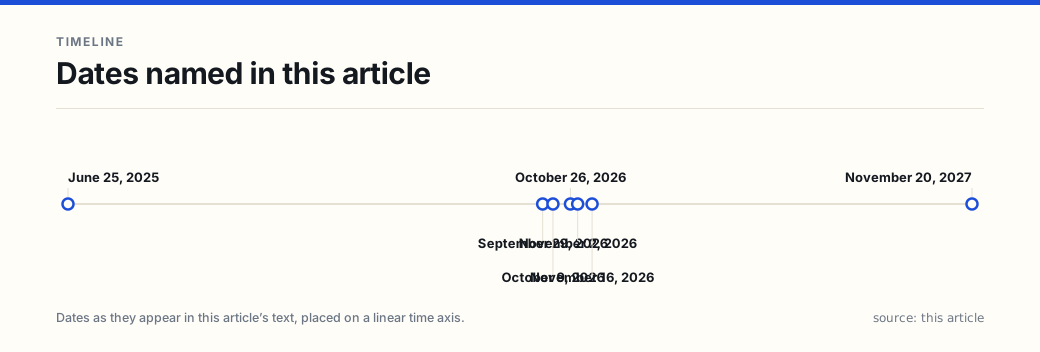
Some U.S. adults will be able to submit Form DS-11 — the application used for a first U.S. passport, or for a new one when renewal on Form DS-82 is not allowed — online through America.gov starting November 16, 2026. The pilot runs until November 20, 2027 unless the department extends it. Its terms appear in a Federal Register notice for the first time, Public Notice 13173 (Doc. No. 2026-23317), filed November 12 and published November 16, 2026 — the date the pilot takes effect.
Status on November 16, 2026, in Beijing time: the notice is published and in force from this date in the United States. We re-checked the portal on the morning of November 16 in Beijing — the evening of November 15 in Washington — and found no passport application entry point: every passport path we tried returned a 404, and the portal’s releases page carried no new item. Being in force and being open are different questions, and the notice itself warns that “technical limitations may prevent otherwise eligible applicants from using the pilot application.”
The notice matters less for the announcement than for the detail. It names the two groups who may use the online form on day one, describes the steps in order, and states the department’s position on a question our earlier coverage left open: how it intends to satisfy a statute that requires a first-time applicant’s oath to be verified “before a person authorized and empowered by the Secretary of State to administer oaths.”
The short answer to that question is a recording. The applicant recites the oath on camera; a passport agent reviews the recording and confirms it before the application is adjudicated. Several regulations are set aside temporarily to make that work.
Who can use the pilot on day one?
| Condition | What the notice requires |
|---|---|
| Age | 18 or over. Minors are excluded. |
| Location | In the United States. Applicants abroad are named only as a later expansion. |
| Identification | An ID that Login.gov accepts, which the notice lists as: a valid U.S. passport book or card, or a valid driver’s license or non-driver state-issued ID card from a U.S. state, D.C. or a U.S. territory. Mobile driver’s licenses are excluded. |
| Group A | Adults who were previously issued a fully valid U.S. passport and are not eligible to renew on Form DS-82 — a category the notice defines only by exclusion from that form. |
| Group B | First-time adult applicants who establish citizenship with a Certificate of Naturalization issued by USCIS. |
Both groups must also pass the eligibility questions on America.gov. Those questions include whether the applicant is applying for their own passport, whether they are a U.S. citizen, and whether they have urgent travel plans.
None of this varies by state the way most of what we cover does. Passport eligibility and the citizenship evidence required are set by federal statute and regulation, and the test is the same in every state. State lines enter in two narrow places: which government issued the ID you present at Login.gov — it must be a U.S. state, D.C. or a territory, and a mobile driver’s license is not accepted — and, for the birth-certificate expansion described below, whether your state’s vital records authority elects to participate.
The notice adds a caveat that is easy to miss: “Technical limitations may prevent otherwise eligible applicants from using the pilot application.” Being eligible is not the same as being able to complete the form on a given day.
Who is left out — for now?
- Anyone under 18. Children’s applications still require an in-person appearance. The pilot does not touch that.
- First-time applicants who would use a birth certificate. The notice names this group as a later expansion, and even then only for “a valid certified U.S. birth certificate that meets all requirements listed in 22 CFR 51.42 issued by vital records authorities in a state that elects to participate.” That last clause makes this part of the rollout state-dependent: whether your state’s records are accepted will depend on whether your state participates.
- First-time applicants using a Certificate of Citizenship or a Consular Report of Birth Abroad. Also named as later expansion.
- Applicants located overseas. Later expansion.
- Applicants whose file needs an affidavit or a court order. The notice routes them to the paper process. It does not give a reason.
How the process works, step by step
- Screen on America.gov. Answer the eligibility questions. If you do not qualify, the site points you to the process that fits your situation rather than leaving you to guess.
- Verify identity at Login.gov. Create or sign in to an account, provide an ID, pass a liveness check, enter your Social Security number and address, and confirm the details.
- Return to America.gov. Confirm the biographical information Login.gov passed to the State Department — name, sex, date of birth — and correct anything that imported wrong before you accept it.
- Complete the DS-11 fields Login.gov does not hold. That includes your USCIS or alien registration number if you have one, an emergency contact, and your occupation.
- Upload a photo and choose the product. Select the passport product and the delivery method, then review the application.
- Record the oath. State the oath on camera, declaring under penalty of perjury that the information is true.
- Wait for an agent, then for adjudication. A passport agent reviews the recording alongside the rest of the file for acceptance. After that, the application is adjudicated the way a paper DS-11 is — including system checks against citizenship records, among them USCIS records — and the passport is mailed to the address you gave.
Why the $35 execution fee survives
The execution fee exists to pay for someone receiving your application in person. Under 22 CFR 51.51, it is collected “when the applicant is required to execute the application in person before a person authorized to administer oaths for passport purposes.” A pilot applicant does not appear in person, so the obvious inference is that the fee should disappear.
The department says it should not. Its reasoning is that the work does not go away. The notice says: “The Department must still review the entire application, including the recorded oath and evidence of identity, for execution and acceptance.” So even though the applicant never stands at a counter, the $35 execution fee still applies. The department adds that it will use the pilot to study the real costs and “will update its fee schedule as necessary” — which leaves open the possibility of a change later, without promising one.
Two related points:
- Existing fee exemptions carry over. Applicants who are exempt from passport fees under 22 CFR 51.52(b) — the section covering people whose applications would be executed before a federal official — remain exempt from both the passport fee and the execution fee.
- Nothing else in the fee schedule is changed by this notice. The application fee, the expedited-processing fee and the $22 passport-book surcharge in 22 CFR 51.51 are untouched here.
The oath: what the statute requires, and what the pilot does instead
This is where the pilot departs furthest from the paper process, and it is the part that responds to the question we flagged in October.
22 U.S.C. §213 provides that an applicant who has not previously been issued a U.S. passport must have the application “duly verified by his oath before a person authorized and empowered by the Secretary of State to administer oaths.” A screen is not a person. The Congressional Research Service reported on November 2, 2026 that the department’s position was that first-time applicants “would still be required to verify their application in person, as required by law.”
The notice does not argue the point. It describes a substitute, names the regulations it is temporarily setting aside, cites both 22 U.S.C. §211a (authority to grant, issue and verify passports) and §213 as authority for the pilot, and states that “for purposes of this temporary pilot program, eligible applicants who are required to take an oath will record themselves reciting it, the recording will be uploaded, and a passport agent will review and confirm the recorded oath before the application is adjudicated.”
The regulations the notice says the pilot will “temporarily alter”:
| Regulation | What it normally requires | What the pilot does instead |
|---|---|---|
| 22 CFR 51.8(b) | When applying online, the applicant must have the currently valid passport of the same type available for cancellation | A first-time pilot applicant has no such passport |
| 22 CFR 51.21 | Specified groups must appear in person before a passport agent or acceptance agent and verify by oath before that agent | Pilot applicants who qualify do not appear in person for the oath |
| 22 CFR 51.22(e) | Acceptance agents certify they “personally witnessed the applicant signing” | Pilot applicants need not be personally witnessed |
| 22 CFR 51.29 | Applicants may be physically accompanied by third parties of their choice | Pilot applicants “will not need to be physically accompanied” |
| 22 CFR 51.42 / 51.43 | First-time applicants born in, or outside, the United States must submit certain evidence in original form | Pilot applicants “may only be required to submit evidence electronically” |
| 22 CFR 51.51 / 51.52(b) | Execution fee attaches to in-person execution; certain applicants are exempt | Fee still applies to pilot applicants; existing exemptions preserved |
That table is the honest summary of what “online first passport” means in practice. For a pilot applicant the counter visit is gone; the oath is not. The notice says eligible applicants “will not appear in person for the oath to be administered,” and the oath moves instead to a recording that a passport agent reviews and confirms. Whether a recorded oath satisfies “before a person” is the department’s stated position, not a holding: the notice cites §213 as authority without explaining how the recording meets it, and nothing in the notice amends the statute. The notice’s framing — a temporary pilot, with the department hoping “to gain insights to inform an eventual transition to allow an option to submit DS-11 applications online on a permanent basis” — suggests a permanent version would need rulemaking, or legislation, or both.
What does not change
- Eligibility for a passport. The notice is explicit: “Eligibility criteria for a U.S. passport and the applicability of relevant passport statutes and regulations, including 18 U.S.C. 1541 et seq., will not change during or as a result of this pilot.”
- The obligation to prove who you are. Applicants must still establish citizenship and identity and follow departmental instructions, online or on paper.
- The rules for applicants under 18. Unchanged. The pilot does not open a route for minors.
- The consequences of a false statement. The oath is taken under penalty of perjury and is now recorded, which if anything makes the record of what an applicant declared more durable.
How big is the workload this is meant to dent?
The notice carries the department’s own volume figures:
| Measure | Figure |
|---|---|
| DS-11 applications processed in fiscal year 2025 | 13,913,231 |
| Average time for an applicant to complete a DS-11 | 85 minutes |
| OMB control number for Form DS-11 | 1405-0004, last approved June 25, 2025, for three years |
The department expects that taking a share of those filings online “will decrease the time burden for the applicants,” but declines to estimate the saving: “the amount of time saved will be one of the data points to be learned in the pilot.” No figure for hours or dollars saved appears in the notice, so any specific number in circulation is an estimate rather than a published figure.
How does this fit the dates the government has already given?
Since late September, official statements have disagreed about when first-time online applications would arrive. This notice adds a seventh statement, and it is the first one with a legal effective date and a sunset.
| Where it comes from | What it says about timing |
|---|---|
| Secretary of State Rubio, September 29, 2026 | Goal is the “vast majority of Americans” applying on the platform by the end of 2027 |
| America.gov about page | “Phase 2 begins in 2027” |
| America.gov coming-soon page | Additional services “Coming early 2027” |
| Joe Gebbia, October 9, 2026 (Politico Playbook) | The first-time online feature “will launch Dec. 1” |
| State Department, October 26, 2026 | The online process “will launch for most first-time U.S. passport applicants in December” |
| White House fact sheet, September 29, 2026 | Passport renewal and Medicare enrollment “later this year” |
| State Department notice (published November 16, 2026) | Pilot effective November 16, 2026, until November 20, 2027, limited to two groups, expanded “as the Department makes progress on testing and technological capability” |
Two things follow, and neither should be overstated.
First, the pilot is narrower than the October language. “Most first-time U.S. passport applicants in December” describes a broader group than naturalized citizens and former passport holders who cannot renew by mail. The notice does not mention December, and it does not promise that the birth-certificate group joins by then.
Second, the notice is compatible with an expansion in December. It describes a phased rollout and says expansion is anticipated as testing progresses. A December widening would not contradict the notice; it simply is not in it. We are not choosing between the two — the notice is what is in writing today, and the December statements remain statements.
Can you comment on the pilot?
Yes. The notice is styled “Notice of pilot program; comments,” and it directs readers to Regulations.gov, Docket No. DOS-2026-1222. It says comments “relating to the time and money saved” will be particularly helpful, and that comments “will assist Department personnel in evaluating the pilot and deciding on future actions, including possible rulemaking.”
Two limits a commenter should know before writing: the notice states that comments “will not receive a response,” and the notice text states no closing date — check the docket page for a deadline before assuming you have time.
The scam angle: a new channel is a new script
A government process moving onto a new website is, for fraudsters, a new story to tell. The durable rules do not change with the channel:
- The federal starting points are America.gov, for the pilot, and travel.state.gov, for everything else including the locator for in-person acceptance facilities. The notice names America.gov as the entry point and identifies Login.gov as the identity step. A site that offers to “file your DS-11 online” for a fee is a private business, not the pilot.
- No one needs your Login.gov password. Not a passport agent, not a help desk, not an email, not a text.
- The $35 is a fee, not a deposit. The notice sets out no arrangement in which paying a third party accelerates acceptance, and no legitimate intermediary can admit your application to a pilot you are not eligible for.
- Check before you pay. Fee amounts are published by the State Department, and the notice does not create any new fee. If a page asks for a payment the official fee schedule does not list, that is the signal.
Our network’s checklist, Is That Really America.gov?, covers the verification steps in detail.
What to do now
- If you were naturalized and need a passport: check the eligibility questions on America.gov from November 16, and have your Certificate of Naturalization and an accepted photo ID ready. If the online flow does not admit you, the paper process still works and is not slower than waiting for a feature.
- If your last passport is expired, damaged or too old to renew by mail: you are in Group A. The notice publishes no figures for either group, so there is no way to say from it how large yours is. The online route may save you an appointment — but not the $35.
- If you need a passport in weeks, not months: use the existing process, including expedited service if you qualify. The pilot asks about urgent travel precisely because it is not built for it.
- If you have a child who needs a passport: nothing here applies. Book the in-person appointment.
- If you want the pilot widened: the docket is the place to say so, and time-and-money evidence is what the department says it wants.
This is a fast-moving area — our earlier guide, Your First Passport Is Going Online, tracks the statements that preceded this notice, and The 2028 passport redesign covers the separate change to the book itself. Related guides across the network are collected at omc.center/resources.
Frequently asked questions
- Can I apply for my first U.S. passport online today?
- The notice takes effect November 16, 2026 in the United States, but being eligible and finding the form are two different things: on the morning of November 16 in Beijing — the evening of November 15 in Washington — we found no passport route on America.gov, and the notice warns that technical limitations may keep otherwise eligible applicants out. If the online flow does not appear, or does not admit you, the paper process at an acceptance facility is unchanged. Eligibility is limited to applicants aged 18 or over, physically in the United States, holding an identification document that Login.gov accepts, and either a previously issued fully valid U.S. passport that cannot be renewed on Form DS-82, or a first-time application supported by a USCIS Certificate of Naturalization.
- I was naturalized. Does the pilot cover me?
- Yes, if you are 18 or older, are located in the United States, can prove citizenship with a Certificate of Naturalization issued by USCIS, and can verify your identity through Login.gov with an accepted ID. That is one of the two groups the pilot opens with; applicants relying on a U.S. birth certificate are not included until the department expands it.
- Do I still have to mail original documents?
- The notice says pilot applicants 'may only be required to submit evidence electronically' — it temporarily sets aside the regulations (22 CFR 51.42 and 51.43) that otherwise require original documents from first-time applicants. Read the instructions in the application flow rather than assuming no document will ever be requested.
- Does applying online cost less?
- No. The department says the $35 execution fee still applies, because it must still review the whole application, including the recorded oath and identity evidence. Fee exemptions that already exist under 22 CFR 51.52(b) are preserved, and the department says it will study the pilot's costs and update its fee schedule if needed.
- Can my child apply online under the pilot?
- No. The pilot is limited to applicants aged 18 and over. Applications for minors still require an in-person appearance, and nothing in this notice changes that.
- What if I need a passport in a hurry?
- Use the existing process, not the pilot. The America.gov screening asks whether you have urgent travel plans, and applicants who do not meet the pilot's criteria are redirected to the process that fits their answers. The notice also warns that technical limitations may prevent some otherwise eligible people from using the online form.
Sources
Each source is a primary or official reference, checked before publication. Links open the original.
- U.S. Department of State, 'Pilot for Online Version of Application for a U.S. Passport (Form DS-11)', Public Notice 13173, RIN 1400-ZA28, Doc. No. 2026-23317, published November 16, 2026 — effective dates, the two eligibility groups, the America.gov and Login.gov process, the recorded-oath method, the list of regulations temporarily altered, the $35 execution fee, the FY 2025 volume of 13,913,231 DS-11 applications at 85 minutes each, the warning that technical limitations may prevent otherwise eligible applicants from using the pilot, and docket DOS-2026-1222. This article was first written from the filed public-inspection text on November 14 and re-verified line by line against the published document on November 16, 2026 — federalregister.gov/documents/2026/11/16/2026-23317/pilot-for-online-version-of-application-for-a-us-passport-form-ds-11
- America.gov — the about page's 'Phase 2 begins in 2027' and the coming-soon page's 'Coming early 2027', read November 14, 2026. Cited by name as the portal's own published wording, in line with this network's rule that America.gov is used as an interface and a subject rather than a source of harvested text: america.gov
- The White House, 'Fact Sheet: President Donald J. Trump Streamlines Access to Government Services Through America.gov' (September 29, 2026) — the statement that passport renewal and Medicare enrollment would arrive 'later this year': whitehouse.gov/fact-sheets/2026/09/fact-sheet-president-donald-j-trump-streamlines-access-to-government-services-through-america-gov
- 22 U.S.C. §213, 'Application for passport; verification by oath of initial passport' — an applicant who has not previously been issued a U.S. passport must have the application 'duly verified by his oath before a person authorized and empowered by the Secretary of State to administer oaths': law.cornell.edu/uscode/text/22/213
- 22 CFR 51.51, 'Passport fees' — the execution fee is collected 'when the applicant is required to execute the application in person before a person authorized to administer oaths for passport purposes', with the amounts set in the Schedule of Fees for Consular Services at 22 CFR 22.1: ecfr.gov/current/title-22/chapter-I/subchapter-F/part-51/subpart-C/section-51.51
- U.S. Department of State — remarks by Secretary of State Marco Rubio at the America.gov launch (September 29, 2026), where the goal of moving first-time applications online by the end of 2027 was stated: state.gov/releases/office-of-the-spokesman/2026/09/secretary-of-state-marco-rubio-at-president-trumps-america-gov-event/
- U.S. Department of State, ShareAmerica — 'New passport tells America's story', published October 26, 2026, stating the online process 'will launch for most first-time U.S. passport applicants in December': share.america.gov/new-passport-tells-americas-story/
- Congressional Research Service, 'U.S. Passport Services' (In Focus IF12466), updated November 2, 2026, author Cory R. Gill — records the department's earlier position that first-time applicants 'would still be required to verify their application in person, as required by law': crsreports.congress.gov/product/details?prodcode=IF12466