America.gov Weekly: Login.gov, an AI Agent, and a Dashboard — Promised, Not Shipped
November 3-9, 2026: no new service on America.gov, but two officials described its future — Login.gov sign-in, an AI agent, a dashboard.
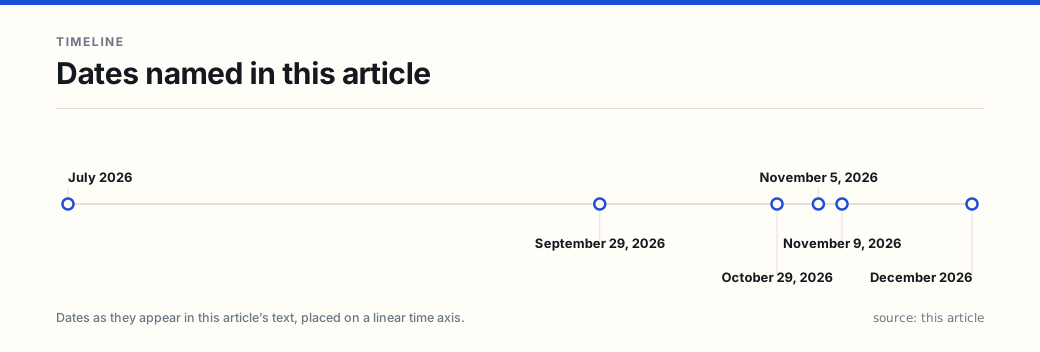
The short version
America.gov is the federal single portal that opened on September 29, 2026 under Executive Order 14432. In the week of November 3 to November 9, 2026 the portal shipped nothing: no new entry on its Releases page, no new service route, no published accuracy figure. What it got instead was something it had not had before — two named officials narrating its future in public, in the same week. Mary Bati, Chief Information Officer of the National Design Studio (NDS), put Login.gov at the center of phase two; Amy Gleason, Acting Administrator of DOGE (the Department of Government Efficiency), described an AI agent that does work for the user, with a dashboard showing what it did. A third signal came from an agency building toward the portal rather than being ordered to it: the Office of Personnel Management (OPM) has a beta chatbot for federal workforce data, reportedly destined for America.gov.
| What | Date | Why it matters to you |
|---|---|---|
| NDS CIO Mary Bati: Login.gov integration is “one of the biggest things” for phase two | Week of Nov 3-9 (Fed Gov Today interview, via FedScoop) | Confirms, from the operator’s own IT lead, that every future transaction will run on one sign-in |
| Bati: the White House, NDS and GSA “don’t own” the portal’s functions — the portal is “a doorway” | Same interview | Sets expectations: America.gov will not adjudicate your passport or your benefits; the agencies still do |
| Bati restates the passport window: online applications “come live in December of this year,” “vast majority” online by end of 2027 | Same interview | A restatement, not a new date. Nothing is open yet |
| DOGE Acting Administrator Amy Gleason: authenticated experience → AI agent → dashboard | Nov 5, Digital Services Coalition event | The most explicit official description yet of the portal acting for you, not just answering |
| OPM beta chatbot for federal workforce data, reportedly headed for America.gov | Reported this week | First reported agency-side chatbot built with portal integration as the destination |
| The portal’s Releases page | Unchanged since Oct 29 | Five dated entries; no new capability for anyone |
The single sentence worth quoting: as of November 9, 2026, America.gov’s Releases page still lists five dated entries and no new service, while the two officials most responsible for its future have described a phase two built on Login.gov sign-in, an AI agent that acts for the user, and a dashboard that shows what the agent did — none of it dated, none of it shipped.
What changed on America.gov itself this week?
Nothing that a reader can use. Our automated monitoring read the portal’s Releases page at multiple points during the week and found it unchanged since the October 29, 2026 entry — five dated entries in total, the newest headed “Voter fraud reporting.” No new route appeared, no new transactional page opened, and the portal’s terms of use still carry the same governing sentence: answers “can be wrong,” and you should check the linked source “especially for anything involving money, immigration status, benefits, or a deadline.”
That makes this the first week in this series where every item that passed our threshold is a statement about the future rather than a shipped feature or a change to the portal’s own record. That fact is itself the finding: the portal’s public product is static while the public narrative around it is accelerating.
What did the National Design Studio’s IT chief say about phase two?
The clearest new material of the week. In an interview with Fed Gov Today, reported by FedScoop during the week of November 3-9, 2026, Mary Bati — the National Design Studio’s Chief Information Officer, on detail there since July 2026 after nineteen years inside the State Department — laid out the same three-part picture:
- Login.gov is the identity layer for everything that comes next. Asked how users will reach services such as Medicare or Social Security, she described a flow in which “they come through America, they securely log in through Login, and then they have the suite of government services that are available to them.” Integration with Login.gov, she said, is “one of the biggest ways that we’ll see phase two really in effect.”
- The portal owns the doorway, not the service. Bati stated that the White House, NDS and the General Services Administration (GSA) — which hosts the platform’s infrastructure — “don’t own” the functions America.gov will provide. On passports, “NDS and the chatbot aren’t adjudicating passports”; they are “a doorway for the customer to be able to navigate through the back end” hosted by the State Department.
- The measure of success is time saved. “Our greatest sign of success, I think, will ultimately be the hours that we’re saving Americans at home.”
We read the second point as the most useful for ordinary users, because it draws a boundary the launch-week excitement blurred. When a passport application goes wrong, the portal will not be the office that answers for it — the State Department will. A front door that makes that explicit is easier to hold accountable than one that implies it does everything behind it.
This is consistent with the executive order itself: Executive Order 14432 already mandated Login.gov as the platform’s authentication service and required agency heads to integrate with it. What is new this week is the operator’s own IT lead saying, on the record, that this integration — not any new chatbot capability — is where phase two will actually show up first.
Did the passport date move?
No. Bati said the online application process should “come live in December of this year,” with the “vast majority of Americans” able to apply online by the end of 2027. Those are the same two positions already on file — a December 2026 start reported from the State Department, and the end-of-2027 goal stated at launch — and her restatement adds no day and no eligibility rule. We keep the full comparison table of every official statement, including the ones that disagree, in Your First Passport Is Going Online. First-time applications still happen in person today; if you need a passport now, the current process is the one that works.
What did DOGE’s acting administrator sketch?
A longer arc. Speaking at a Digital Services Coalition event on November 5, 2026, Amy Gleason, Acting Administrator of DOGE, described — per Federal News Network reporting — a sequence for the portal:
“Right now, [America.gov] doesn’t give you any data that comes from outside the government. But the next step is an authenticated experience. Then, the next step is an artificial intelligence agent [that is] actually going to do work for you, and you’ll have a dashboard, so you actually know what’s happening.”
Three things sit in that sequence, and they are worth separating:
- An authenticated experience — the portal knows who you are. This is the same unlock Bati described, and it arrives through Login.gov.
- An AI agent that acts — filing, scheduling, checking status, collecting documents. An agent that takes actions with consequences is a different product from a chatbot that answers questions, and carries a different risk profile: an informational answer that is wrong can be corrected with an edit, while an action taken on your behalf cannot be un-taken as easily.
- A dashboard — the promise that you can see what the agent did and what is still pending. Visibility is the accountability mechanism, and its absence would be the first thing to object to.
Gleason went further than the portal’s own roadmap, suggesting a future in which AI chatbots replace individual agency websites — a claim about all of government, not just this portal — and she paired it with an unusually blunt account of the constraints: agencies “don’t have enough tech talent,” procurement is hard, and teams “can’t just chase every shiny object that comes around.”
No date, vendor, model or funded schedule accompanies any part of the sequence. We record it as a direction with named sponsorship, not a project with a timeline — and we note that the person describing it acknowledged, in the same remarks, that the government does not yet have what it would take to build it.
What do the satisfaction numbers add?
Gleason cited new data from the American Customer Satisfaction Index (ACSI), whose annual Federal Government Study found overall satisfaction with government services fell 2.6 percent over the past year, with the Department of Health and Human Services recording the largest drop at 4 percent from 2025 to 2026. The same study found that digital-first service delivery resonates with citizens when agencies invest in it.
Treat those figures as context, not as a verdict on the portal: they measure satisfaction with government services overall, and America.gov publishes no accuracy figure, error rate or evaluation method of its own that anyone could compare them against. The gap the ACSI documents is the argument officials are making for the portal; whether the portal closes that gap remains unmeasured by anyone outside the government, as of November 9, 2026.
Is OPM building a chatbot for the portal?
Reportedly, yes — with heavy caveats. FedScoop reporting, as carried in a secondary briefing we could access, states that the Office of Personnel Management (OPM) launched a beta AI chatbot to help users navigate federal workforce data, and plans to integrate it into America.gov. The accessible reporting specifies no data scope, no user count and no integration date, and OPM’s own public announcements have not (as of this writing) detailed the program.
Three honest limits on the item:
- It is beta, and its subject is workforce data — information about federal employment, not a public service you can transact.
- Integration is a plan, not a shipment. No date was reported.
- Our access to the primary FedScoop piece was indirect, through a briefing that summarizes it, so we hold this item more loosely than the Bati and Gleason records, which come with direct quotes and named events.
Why it still passes our threshold: every capability America.gov has shown so far was built for the portal by its own team. OPM’s chatbot would be the first reported case of an agency building a conversational front-end with the portal as its destination — the supply side of the EO 14432 integration mandate starting to move on its own.
What should an ordinary user do differently this week?
Nothing new is open, so nothing new is required. The durable advice does not change:
- The sign-in future is Login.gov, but today the government still splits. TreasuryDirect still requires ID.me and refuses Login.gov — the standing contradiction to the one-sign-in story, which we covered in last week’s record. Until a high-traffic money function adopts Login.gov on its own initiative, one front door describes the website, not the identity layer underneath it.
- First-time passport applications still happen in person. A December window for an unbuilt service is a target. If you need a passport now, apply now.
- Treat “phase two” talk as a promise, not a capability. An agent that “does work for you” does not exist on the portal today. Until it ships — with a date and, we would add, a published error rate — anything you need done still needs you to do it at the agency’s own site, and to check every answer against the linked source, exactly as the portal’s own terms instruct.
How we decided what counted this week
The threshold is unchanged from prior weeks, restated here so the record stays auditable. An item is a change if it passes these tests:
- Does it change what a reader can do? Nothing did this week — which is why the portal itself contributes no capability item.
- Does it change who holds your data or sets expectations for it? Bati’s “doorway, not adjudicator” framing passes: it tells you which office is accountable when something goes wrong. Gleason’s authenticated-experience step passes as an expectation-setting claim about personal data.
- Is it attributable to a named source? All three items pass — two named officials in recorded remarks, one agency named in reporting. Where a publication date could not be verified from our access point, we say so rather than invent one.
- Can you check it without the operator’s help? This is where the week’s items land differently from previous weeks. A shipped feature or a rule can be checked directly. A roadmap statement cannot — so each is recorded as a claim by its speaker, with the quote, the venue and the date, and is never converted into a capability. The headline reflects that: promised, not shipped.
One more corollary we apply to ourselves: when two officials describe the same future in the same week, the convergence is worth reporting even though nothing shipped, because it narrows the space of disagreement about what the portal becomes. Both Bati and Gleason place authentication through Login.gov as the next concrete step. Neither names a date. That convergence is the week’s real news, and it is a claim, not a fact on the ground.
How official text is linked in this series
Every America.gov reference is given as a path plus the date we read it — america.gov/releases, read November 3-9, 2026 through automated monitoring — because the changelog publishes no per-entry permalink. Where a primary document exists outside the portal — an executive order, an interview report, a study — we point to it directly. Where our own access was indirect, the source line says so.
The rest of this series
- What Is America.gov? — what launched on September 29, 2026, under which authority, and what is still only a roadmap.
- America.gov Weekly: The Passport Date Is December 2026 — the first week’s record, including the chatbot’s change of heart on election questions.
- America.gov Weekly: The Answer the Portal Denied Giving — the pre-written poem and the first attempt to benchmark a government chatbot.
- America.gov Weekly: The Portal’s First Changelog, and the Claims It Cannot Yet Prove — the Releases page, the privacy revision, and a bill that is not a service.
- America.gov Weekly: A Late Changelog Line, a Contested Sign-In, and the First Audit of Chatbot Voter Guides — the ID.me split at TreasuryDirect, the SBA’s fraud-routing announcement, and the county-scale voter-guide audit.
- Your First Passport Is Going Online — every official statement on the passport window, including the ones that disagree.
- What America.gov’s Own Terms Say About the Answers It Gives You — the fine print on answers that “can be wrong.”
- How to Report Fraud Through America.gov — the routing table, and what a report has to contain.
- Is That Really America.gov? — the habits that catch look-alike sites before you type anything.
- The network’s official government resources directory collects the primary sources behind all of these guides.
This article is general information about a federal service, not legal or financial advice about your situation. It is AI-written and independently AI-reviewed before publication; the review standard and this article’s findings are recorded in the network’s editorial review log.
Frequently asked questions
- Did America.gov launch anything new this week?
- No. Nothing you can apply for, enroll in or track was added during the week of November 3-9, 2026. The portal's Releases page still ends at its October 29 entry, and no new service route appeared. What moved were statements about the portal's future from two named officials — National Design Studio Chief Information Officer Mary Bati and DOGE Acting Administrator Amy Gleason — plus a report that the Office of Personnel Management is building a chatbot intended for the portal.
- What is phase two of America.gov?
- Phase one, the September 29, 2026 launch, is a chatbot that answers questions and links out. Phase two, as described by NDS Chief Information Officer Mary Bati, is when transactions arrive: users sign in through Login.gov, the government's single sign-on service, and reach services such as Medicare or Social Security through the portal. Login.gov provides the identity verification; the portal provides the doorway; the agencies still run the actual service behind it.
- When can I apply for a first passport online?
- Not today. The officials responsible restated the same two positions already on record: a start 'in December of this year' and the 'vast majority of Americans' able to apply online by the end of 2027. Neither statement names a day or an eligibility rule, and first-time applications still happen in person. When the service actually opens, it will be usable — until then, a launch date for an unbuilt service is a target, not a schedule.
- Will America.gov ever do things for me, not just answer questions?
- That is the stated direction. DOGE Acting Administrator Amy Gleason said on November 5, 2026 that the next steps are an authenticated experience, then 'an artificial intelligence agent [that is] actually going to do work for you,' plus 'a dashboard, so you actually know what's happening.' No date, vendor or funded schedule accompanies that description. Today the portal answers questions and hands you links; it does not file, pay or submit anything on your behalf.
- Is OPM's new chatbot available to the public?
- Not as a public service. The Office of Personnel Management launched a beta AI chatbot to help users navigate federal workforce data, and FedScoop reported plans to integrate it into America.gov. The accessible reporting details no data scope, user count or integration date. For ordinary users this week it changes nothing; the signal is that agencies are beginning to build conversational front-ends aimed at the portal.
Sources
Each source is a primary or official reference, checked before publication. Links open the original.
- FedScoop — 'Next up for America.gov? Integration with Login.gov, design studio IT leader says', published during the week of November 3-9, 2026 (exact day not verifiable from our access point): an interview with Mary Bati, Chief Information Officer of the National Design Studio (NDS), given to Fed Gov Today; Bati called Login.gov integration 'one of the biggest things' for phase two of the chatbot, described users coming 'through America' and signing in 'securely through Login' before reaching services such as Medicare or Social Security, said the online passport application process should 'come live in December of this year' with the 'vast majority of Americans' able to apply online by the end of 2027, stated that the White House, NDS and the General Services Administration 'don't own' the functions America.gov provides — on passports, NDS and the chatbot are 'a doorway for the customer to be able to navigate through the back end' hosted by the State Department — and framed the measure of success as 'the hours that we're saving Americans at home' — fedscoop.com/america-gov-integration-login-national-design-studio-cio/
- Federal News Network — reporting of remarks by DOGE Acting Administrator Amy Gleason at a Digital Services Coalition event on November 5, 2026, as summarized at pivotnews.ai/public-sector/doge-s-gleason-sketches-an-ai-agent-future-for-america-gov: 'Right now, [America.gov] doesn't give you any data that comes from outside the government. But the next step is an authenticated experience'; then 'an artificial intelligence agent [that is] actually going to do work for you, and you'll have a dashboard, so you actually know what's happening'; a future in which AI chatbots could replace individual agency websites; and a blunt account of constraints — agencies 'don't have enough tech talent' and struggle to procure tools
- American Customer Satisfaction Index (ACSI), annual Federal Government Study, as cited in the Gleason remarks coverage: overall satisfaction with government services fell 2.6 percent over the past year, with the Department of Health and Human Services recording the largest drop at 4 percent from 2025 to 2026; the same study found digital-first service delivery resonates with citizens when agencies invest in it
- FedScoop, as reported via a Renascence news briefing (renascence.io/id/en/news/161286/opm-luncurkan-chatbot-ai-beta-untuk-data-tenaga-kerja-federal-as), during the week of November 3-9, 2026: the Office of Personnel Management (OPM) launched a beta AI chatbot to help users navigate federal workforce data and plans to integrate it into America.gov; the accessible reporting specifies no data scope, user count or integration date
- America.gov — Releases page, the portal's public changelog, read at multiple points during November 3-9, 2026 through this network's automated monitoring: five dated entries (September 29, October 17, October 20, October 27 and October 29, 2026), the last headed 'Voter fraud reporting'; no entry added and no new service route observed during the week — america.gov/releases
- Executive Order 14432, 'Streamlining Access to Government Services Through America.gov' (September 29, 2026): the executive order accompanying the portal's launch mandates Login.gov as the authentication service for the platform and requires agency heads to integrate with the single sign-on platform consistent with federal cybersecurity requirements — whitehouse.gov/presidential-actions/2026/09/streamlining-access-to-government-services-through-america-gov
- America.gov — Terms of use, 'Last updated: September 8, 2026': answers 'can be wrong' and readers are told to check the linked source 'especially for anything involving money, immigration status, benefits, or a deadline' — america.gov/terms