Absentee vs. mail voting: what is the difference?
Absentee voting is reason-based; mail voting is the delivery method; all-mail elections send every voter a ballot. Here is how the three terms differ.
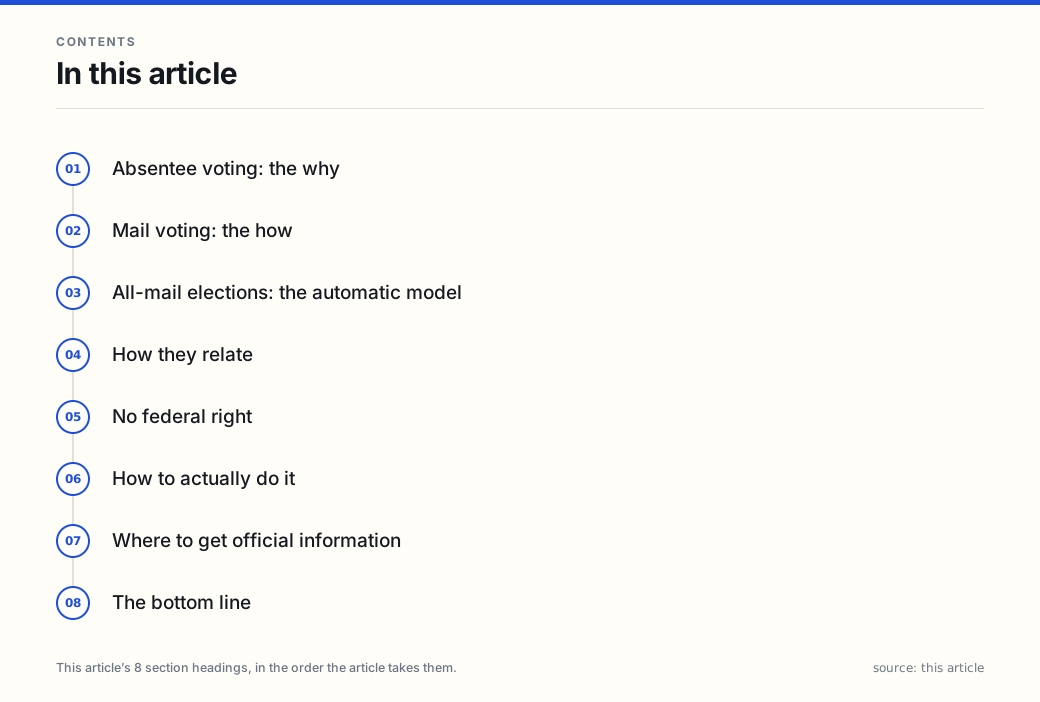
Three terms get tangled constantly: absentee, mail, and all-mail. They overlap, but they are not the same, and confusing them is how a lot of “I thought I could vote by mail” surprises happen.
If you remember one thing: absentee voting is about why the ballot exists (you are absent or qualify); mail voting is about how it is delivered; an all-mail election sends every voter a ballot automatically. All three are set by state law, not federal law.
Absentee voting: the why
Absentee voting means casting a ballot because you will not be at your polling place on Election Day — or, in many states today, for any reason the state allows. You request or receive a ballot, mark it, and return it.
Historically, many states required an excuse to vote absentee (you would be out of town, ill, etc.). A growing number now allow no-excuse absentee voting, where any eligible voter may request a ballot without stating a reason. Whether an excuse is required varies by state.
Mail voting: the how
Mail voting describes the delivery method. The ballot is sent to you through the postal system and returned by mail, by a secure drop box, or in person. Mail is simply the channel — it says nothing about why you got the ballot. An absentee ballot usually travels by mail, but “mail voting” can also describe ballots sent automatically in an all-mail state.
All-mail elections: the automatic model
In an all-mail (vote-by-mail) election, every registered voter is automatically sent a ballot — no request needed. A small number of states conduct elections largely or entirely by mail. This is a distinct model from traditional absentee voting, where the voter must ask for the ballot first.
How they relate
Think of it as two axes:
- Reason axis: absentee (you qualify / are absent) vs. in-person.
- Delivery axis: mail vs. in-person.
They cross. An absentee ballot is usually mailed, but you can also return it in person or by drop box. An all-mail ballot arrives by mail but may be returned the same ways. So “absentee” and “mail” are related but not interchangeable.
No federal right
As with early voting, there is no federal right to absentee or mail voting. The rules — whether an excuse is required, how to request a ballot, and the return deadline — are set by state law and differ sharply. The main federal role is ensuring certain voters get ballots by mail: under the federal Uniformed and Overseas Citizens Absentee Voting Act (UOCAVA), military members, their families, and citizens living abroad must be able to receive and return ballots from abroad.
How to actually do it
The process is entirely state-run:
- Your state or local election office publishes the request form (if one is required), the deadlines, and the accepted return methods.
- Deadlines — especially for return-by-mail postmarks — are strict and vary by state.
- The EAC’s state lookup points to each office: eac.gov/vote.
Where to get official information
- Your state or local election office — the only authority on whether an excuse is required, how to request a ballot, and return deadlines where you live.
- vote.gov — the official federal voting-information site, in place since 2016 and administered by the General Services Administration until the EAC assumed management of the site in 2025; the EAC now operates and hosts it — state-by-state paths.
- usa.gov/voting-and-elections — the federal front door that links to state and local election offices.
- The network’s Voting & Elections topic page collects these explainers, alongside What Is Early Voting?, How to Register to Vote in the U.S., and What Happens After Election Day.
If whether you can vote by mail or absentee matters, the answer lives at your state or local election office — not in a general explainer.
The bottom line
Absentee voting is reason-based (you are absent or qualify), mail voting is the delivery method, and all-mail elections send every voter a ballot automatically. They are governed by state law with no federal right, so the rules — excuse requirements, request steps, and return deadlines — vary by state and can change. To confirm what applies where you live, check with your state or local election office or at vote.gov.
Counsel is the law site of the Omni Mundi Compendium network. How federal agencies describe their own role in civic life is covered in What Is America.gov? The New Federal Front Door, Explained.
This article is general information about absentee and mail voting in U.S. elections, not legal advice, and not official voting information. Whether absentee or mail voting is available, excuse requirements, and deadlines vary by state and can change. Confirm current details with your state or local election office or at vote.gov before relying on them. It is AI-written and independently AI-reviewed before publication; the review standard and this article’s findings are recorded in the network’s editorial review log.
Frequently asked questions
- What is absentee voting?
- Absentee voting means casting a ballot because you will be absent from your polling place on Election Day (or, in many states, for any allowed reason). You request or receive a ballot, mark it, and return it by mail, drop box, or in person. Historically many states required an excuse to vote absentee; a growing number now allow 'no-excuse' absentee voting.
- What is mail voting?
- Mail voting refers to how the ballot travels: it is sent to the voter and returned through the mail system (or a secure drop box or in person). Mail voting is the delivery method and can apply whether the ballot was requested as an absentee ballot or sent automatically in an all-mail state.
- What is an all-mail (vote-by-mail) election?
- In an all-mail election, every registered voter is automatically sent a ballot, with no need to request one. A small number of states conduct elections largely or entirely by mail. This is a different model from traditional absentee voting, where the voter must request a ballot.
- Are absentee and mail voting the same thing?
- Not exactly. 'Absentee' describes why the ballot exists (you are absent or qualify); 'mail' describes how it is delivered. They overlap heavily — most absentee ballots travel by mail — but the terms are not interchangeable. A voter can also return an absentee ballot in person or by drop box rather than by mail.
- Is there a federal right to absentee or mail voting?
- No. Like early voting, absentee and mail voting are governed by state law, not by a federal right. Whether you must give an excuse, how to request a ballot, and the return deadline all vary by state. The federal government does mandate that certain voters — such as military and overseas citizens under UOCAVA — receive ballots by mail.
- How do I request or return an absentee or mail ballot?
- The process is set by your state. Your state or local election office publishes the request form, the deadlines, and the accepted return methods (mail, drop box, or in person). The EAC's state lookup points to each office: eac.gov/vote. Rules and deadlines vary by state.
Sources
Each source is a primary or official reference, checked before publication. Links open the original.
- U.S. Election Assistance Commission — 'Voter FAQs': explains absentee and mail voting and that the rules, including how to request and return a ballot, vary by state — eac.gov/voters/voter-faqs
- National Conference of State Legislatures (NCSL) — 'Absentee and Early Voting': tracks state rules on absentee voting, excuse vs. no-excuse requirements, and all-mail elections; the rules differ by state — ncsl.org/elections-and-campaigns/absentee-and-early-voting
- U.S. General Services Administration, vote.gov / USA.gov 'Voting and Elections': the federal front door that links to state and local election offices, where each state's absentee and mail-voting rules are published — usa.gov/voting-and-elections