Reporting Voter Fraud to the Federal Government: What the $1 Million Reward Actually Requires
America.gov offers a voter-fraud reporting door with a $1 million reward attached. What the page requires, and what it leaves out.
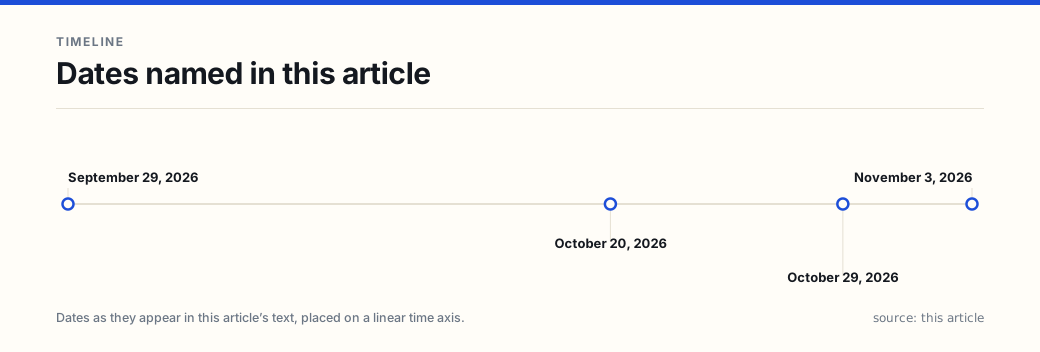
America.gov now says the President “has announced a reward of up to $1,000,000 for reports of voter fraud that lead to an arrest and conviction.” The page carrying that sentence sits under a Department of Homeland Security heading, and it is one of two doors the portal’s fraud page now offers — the other being the Treasury-routed benefits-fraud report that has been there since October 20.
What the page does not have is a program behind it that anyone can read. There is no reward-specific terms document, no Federal Register notice, no agency press release announcing the reward, no funding figure and no claim procedure. The portal’s own changelog was silent on the page for five days; as of November 3, 2026 it carries a one-paragraph entry dated October 29, 2026 that restates the offer in the same conditional language and adds no terms. That gap matters more than the headline number, because it decides what a reader can actually rely on.
Update, November 3, 2026: the Releases page now has a fifth entry, dated October 29, 2026, headed “Voter fraud reporting.” It reads, in full: “Name the person, describe what you saw, and add documents if you have them. If you share your contact details and your report leads to an arrest and conviction, you may qualify for a reward of up to $1 million.” That closes the “no changelog entry” gap recorded below when this article was published on October 29 — but only formally, because the entry names no agency, no statute, no appropriation and no claim procedure. Two details of the record are worth keeping. The entry is dated the same day the page went live, yet it did not appear in our reads of the Releases page between October 29 and the start of November 3 (UTC), and the page does not explain why; a backdated line and a cached page are both consistent with what we saw, and only one of them means the changelog was accurate on October 29. And the same re-read found the October 27 heading shortened from “Images, housing maps, and company research” to “Images and housing maps,” withdrawing a feature the portal had promised and never described.
This article covers what the page says, what it leaves unsaid, who would really have to act on a report, and what to do first if the problem is your own registration rather than a stranger’s.
What the page says
| Question | What the page says |
|---|---|
| How much | “A reward of up to $1,000,000” in the header; the reward card reads “A reward of up to $1,000,000”; the closing block says you “may be paid up to $1,000,000” |
| Paid when | “your report leads to an arrest and conviction” — and, per the card as amended on October 30, only “[i]f you include your contact information” |
| Which elections | “in a past election or the 2026 midterms” |
| Who runs it | A “Department of Homeland Security” heading, and “Homeland Security reviews it” |
| Do I have to give my name | “Your name is optional” |
| What the form asks | The person being reported; additional information; what raised your concern; supporting documents; your contact information |
Three details in that table are worth slowing down for.
The trigger is two events, not one. An arrest is not a conviction, and a conviction requires a prosecutor to charge a case, a court to accept it, and either a plea or a verdict. The page names Homeland Security as the reviewer of reports, but a federal department cannot convict anyone by receiving a tip.
The card now conditions payment on contact information. When the page first appeared, the reward card said simply that a reward is “paid when a report leads to the arrest and conviction of those who created the fraud.” On October 30 the card was rewritten, and three things changed at once. The payment condition now includes sharing contact information, which sits in tension with “Your name is optional” (the page never explains how an anonymous report could qualify). The hedged “may be paid” replaced the flat “Paid when.” And “those who created the fraud” — the page’s most specific description of who could be the subject of a qualifying report — was removed in the rewrite; the broader phrase “the people responsible” still appears lower on the page. The closing “What happens next” block already carried the contact-information condition; the card now agrees with it.
The figure is stated qualified everywhere but one. “Up to $1,000,000” in the header, “up to $1,000,000” on the card, “up to $1,000,000” in the closing block — with a bare “$1,000,000” remaining only in the stat chip at the top of the card. Nothing on the page says what share of the maximum any particular report would be worth.
What the page does not say
This is the part a reader cannot get anywhere else, because it is defined by absence — and absence is checkable. As of November 3, 2026:
- No legal authority is cited. No statute, no delegation, no executive order. The benefits-fraud page at least carries a White House task-force framing and a named routing list; this page carries a department name and nothing else.
- No funding is identified. No appropriation, no ceiling on total payouts, no statement that money has been set aside. A reward announced without a funding source is a promise about a decision, not an appropriation.
- No claim procedure exists. Nothing says who decides, on what standard, in what timeframe, or how a person who believes they qualified would ask to be paid.
- No deadline is stated. The page does not say when the offer ends, whether it covers elections after 2026, or what happens if a case is still pending after the midterms.
- No Federal Register notice. A search of the Register for voter-fraud reward documents since September 2026 returns no notice, rule or proposed rule on this program.
- No DHS announcement. The department’s election-security releases as of November 3, 2026 (the latest date checked for this item) are still three arrest announcements, dated October 23, 26 and 28. None of them announces or describes the reward, and the department’s name appears on the reward page without any departmental document behind it.
- No terms in the changelog. The portal’s Releases page now has an entry dated October 29, 2026 for this page (quoted in the update above), but it is a two-sentence restatement of the offer. It publishes no authority, no funding ceiling, no claim route and no deadline, and it does not name Homeland Security as the reviewer — that name appears only on the page itself.
- No privacy section. The portal’s privacy policy is still dated October 20, 2026, and its fraud section is headed “Reporting fraud to the Department of the Treasury” — it describes the Treasury form, browser-direct submission, and the rule that attached files are sent without checking or redaction. The policy does not contain the word “voter,” and it does not mention Homeland Security. Whatever data handling the new form has, the published policy does not describe it.
None of that makes the page fake; it is on the federal portal, under a federal department’s name, and the arrest releases behind it are real. It does mean that everything beyond “a reward has been announced” is currently unwritten. If a payment process is published later, this article will say so.
Who would actually have to act
Elections in the United States are run by states and counties, not by a federal agency, and that shapes what happens to a report.
The Election Assistance Commission is explicit about the fragmentation: state cancellation forms and local election office directories are published one state at a time, “states and local jurisdictions have different options,” and some states offer an online withdrawal portal while others use a PDF. The same is true of election crimes. Each state defines its own offenses and its own penalties, so what counts as voter fraud varies by state.
Federal criminal law covers a narrower slice:
- 52 U.S.C. § 20511 makes it a crime to intimidate or coerce a voter, or to knowingly procure or submit materially false registration applications or ballots — but the section is limited to “any election for Federal office.”
- 18 U.S.C. § 594 covers intimidating, threatening or coercing a person to interfere with their right to vote, or to control how they vote, in an election for president, vice president, presidential elector, senator, representative, the District of Columbia’s delegate or the resident commissioner. It carries up to one year.
- 18 U.S.C. § 3282 gives federal prosecutors five years to bring a non-capital charge, unless another statute says otherwise. Reports about distant elections run into that clock, and state limitations periods differ by state.
So the honest description of the pipeline is: a report goes to a federal department, and any actual prosecution — the thing the reward is conditioned on — most often belongs to a county prosecutor or a state attorney general. The page does not say whether Homeland Security refers reports to states, and it does not promise that anyone will look at yours.
The walkthrough is an illustration, again
The page’s “how reporting works” section walks through four steps — describe what you saw, name the person, review, submit — and the review screen, as of October 30, itemizes five things before submission: the person being reported, additional information, what raised your concern, supporting documents, and your contact information. It ends on a submission screen whose reference number reads DEMO-2026-001, and every “Start your report” button links to the portal’s assistant with a pre-filled question (“How do I report voter fraud?”) rather than directly to a form.
That is the same pattern as the benefits-fraud page: a product demonstration, not a description of the interface you will meet. The difference is that this walkthrough carries a dollar figure, which makes the gap between demo and terms more consequential. If you are preparing documents on the assumption that this screen is the whole process, you are preparing for a form that does not exist yet in published form.
If you are the one being named
The flow’s first screen asks “What raised your concern?” — the conduct, not the person. The second screen, “Tell us what you saw,” asks you to name “the person you’re reporting, then describe what happened and how you know,” and the review screen lists the person being reported first, before what raised your concern. Putting a named individual that close to the start of the record is a meaningful design choice, with two consequences.
Accuracy is the whole game — a report about a named individual reaches a law enforcement office, and a knowingly false material statement to a federal agency in a matter within its jurisdiction can be prosecuted under 18 U.S.C. § 1001. And a report is not a publication: telling an agency what you believe is a different act, with different legal protection, from posting the same accusation publicly, where defamation exposure varies by state and by what you said.
If you are not sure who did it — a ballot arrived for a deceased neighbor, a registration changed without explanation — describe the facts and say you do not know who is responsible. Do not name a person to complete a field.
Is voter fraud widespread? The two accounts
This article does not resolve that question, and readers should know that we could find no federal agency that publishes a running national count of voter-fraud convictions. The tallies that circulate come from advocacy groups and newsroom reviews with different methodologies and different windows, which is why they do not agree; none of them is an official count, and none is independently verified here.
The administration describes an extensive problem. Homeland Security’s election releases report arrests — “dozens” in the October 28 release, with thirteen named individuals who, the department says, illegally voted in past elections — and says the investigations are continuing.
Critics of the announcement — voting-rights groups and some former election administrators among them — argue that proven cases are rare relative to the number of ballots cast, and that announcements of this kind overstate a small phenomenon. This article takes no position on which account is closer; the point is that neither can be checked against a national total, and the page at america.gov/voter-fraud offers no data either way.
Neither account can be settled from the page at america.gov/voter-fraud, which contains no data at all. What is not in dispute is structural: the conduct is defined by state law, prosecuted mostly by state and local authorities, and the federal statutes cover federal offices. A reader deciding whether to file a report is deciding about a channel, not about a statistic.
Four things to refuse
A page that advertises a seven-figure payment attracts people who want a share of it. None of the following appears in any official document:
- A fee to “process,” “file” or “release” your reward. There is no application, no filing fee and no release step. Anyone charging one is selling something the government does not sell.
- A request for your Social Security number or bank details to “reserve” the payment. The published page asks for contact information, not financial account data, and no payment mechanism has been described at all.
- An intermediary who contacted you first. Lawyers are legitimate in reward programs — the separate whistleblower-reward program for fraud tips expressly contemplates counsel — but someone who found you, rather than the reverse, is a different proposition.
- A lookalike domain. Check the address bar, not the page design. The tests for telling the real portal from an impostor are in Is That Really America.gov?.
What to do, in order
- Decide what problem you have. If your own registration or ballot is wrong, a federal tip will not fix it — the county or municipal election office will, and the Election Assistance Commission publishes every state’s cancellation form and local office directory.
- Write down what you saw, with dates. The specific election, the specific record or ballot, and how you know. “Something felt wrong” is not a report anyone can act on.
- Report to the office that can act, and consider reporting twice. Your county election office for the record; your state attorney general or secretary of state for a state election offense; the federal page if the conduct involves a federal office or a federal program.
- Keep a copy of everything you send. If a payment process is published later, your contemporaneous record is the only evidence of what you reported and when.
- Attach less than you are tempted to. Redact identifiers that are not needed to show the conduct. The portal’s privacy policy promises no scrubbing on report attachments for the Treasury form, and it says nothing at all about this one.
- Do not report the same thing repeatedly. A duplicate adds nothing, and in the separate whistleblower-reward program for fraud tips, frivolous submissions carry a permanent bar.
- If you are threatened at a polling place, treat it as urgent and separate. Intimidation in a federal election is its own federal crime under 18 U.S.C. § 594, and it is a matter for a poll official, local law enforcement and the Justice Department’s Civil Rights Division, not for a tip line that reviews submissions later.
The bottom line
America.gov now offers two fraud doors, and the newer one carries the larger number. What exists today is a page: a department’s name, a figure stated as “up to $1,000,000” and conditioned on contact information as well as on an arrest and conviction, a walkthrough with a placeholder reference number, and conditions that depend on decisions made by prosecutors and courts the page does not name. What does not exist is a published program, and a reader should not plan around one until it does.
Report what you actually saw, to the office that can actually act, and keep the record. The reward, if it becomes a real process, will be decided on documents — and yours will be the ones you kept.
The rest of this series
- Reporting Fraud Through America.gov — the benefits-fraud door, the Treasury handoff, and the three-step walkthrough that is a demo.
- The New Federal Reward for Reporting Fraud — the $10,000 to $30,000 tip program, its tests and its exclusions.
- What America.gov’s Own Terms Say — the portal’s admissions about accuracy, privacy and retention.
- What Is America.gov? — what launched on September 29, 2026, and what is still only a roadmap.
- Who Certifies U.S. Election Results? and How Midterm Elections Work — the process a fraud claim would have to run through.
- The network’s official government resources directory collects the primary sources behind these guides.
This article is general information about a federal reporting channel, not legal advice, and election law varies by state. It is AI-written and independently AI-reviewed before publication; the review standard and this article’s findings are recorded in the network’s editorial review log.
Frequently asked questions
- Do I get $1 million for reporting voter fraud?
- Not on those terms. The page says you "may be paid up to $1,000,000" if you include your contact information and your report leads to an arrest and conviction. An arrest can be made by law enforcement alone, but a conviction requires a prosecutor to charge a case, a court to accept it, and either a plea or a verdict — so the condition runs through decisions the page does not name. Nothing on the page says how much of that figure any particular report is worth, who decides, or how you would claim it. A report that is never charged, or is charged and then dismissed or acquitted, does not meet the stated condition.
- Who actually investigates and prosecutes voter fraud?
- In practice, state and local authorities. Elections are administered by states and counties, and states set their own election crimes and their own rules for cancelling a registration — the Election Assistance Commission says plainly that states and local jurisdictions have different options, and publishes each state's cancellation form and local election office directory. Federal criminal statutes are narrower and, for the false-registration and false-ballot provisions, limited to elections for federal office. The America.gov page names Homeland Security as the reviewer without saying whether a report is then referred to a state prosecutor.
- The page says my name is optional. Can I still be paid?
- The page does not say — and as of October 30 it makes contact information a stated payment condition, which sharpens the question. It treats your name as optional and asks for contact information as a separate step, but it publishes no rule requiring identity, no verification step, and no payment procedure at all. That silence is the finding: there is no published terms document for this reward, so nothing sets out how an anonymous report would be handled or whether it could ever be paid.
- What does the form ask for?
- In the illustrated walkthrough: the name of the person you are reporting, what raised your concern, supporting documents or photos, and your contact information — with an "additional information" item added to the review screen on October 30. The walkthrough ends on a placeholder reference number, DEMO-2026-001, and every "Start your report" button on the page opens the portal's assistant with a pre-filled question rather than a form — the same product-demo pattern as the benefits-fraud page. Expect a real form with fields and an attestation, not this walkthrough.
- Is naming someone in a report defamation?
- A report to a law enforcement or oversight office is a different act from publishing an accusation, and the legal treatment differs — but the safe statement is that it varies by state and by what you say. What is uniform is that a knowingly false material statement to a federal agency in a matter within its jurisdiction can be prosecuted under 18 U.S.C. § 1001. Report what you saw and how you know it; do not fill a gap with a conclusion.
- Where else can I report, if this is not the right channel?
- If the problem is your own registration or ballot — you were left off the rolls, a mail ballot went to someone else, or someone appears to have voted in your name — start with your county or municipal election office, which is the office that can fix the record, and use the Election Assistance Commission's state-by-state directories to find it. State-level election offenses go to a state attorney general or secretary of state. Intimidation or coercion at a polling place in an election for federal office is separately a federal crime under 18 U.S.C. § 594.
Sources
Each source is a primary or official reference, checked before publication. Links open the original.
- America.gov — 'Report voter fraud,' the page served at america.gov/voter-fraud (a Department of Homeland Security heading; 'a reward of up to $1,000,000 for reports of voter fraud that lead to an arrest and conviction'; reward card as rewritten on October 30, 2026: 'A reward of up to $1,000,000 — If you include your contact information and your report leads to an arrest and conviction, in a past election or the 2026 midterms, you may be paid up to $1,000,000' (before October 30 the card read 'A $1,000,000 reward — Paid when a report leads to the arrest and conviction of those who created the fraud'); name optional; the walkthrough's review screen lists the person being reported, additional information, what raised your concern, supporting documents, and contact information, and ends on the DEMO-2026-001 placeholder reference number) — america.gov/voter-fraud
- America.gov — 'Report fraud,' the chooser page now served at america.gov/fraud ('Choose what you want to report'; a White House benefits-fraud card covering Medicaid, Medicare, SNAP and unemployment, and a Department of Homeland Security voter-fraud card covering 'illegal voting, ballot tampering, or registration fraud in a past election or the 2026 midterms') — america.gov/fraud
- America.gov — 'Task Force to Eliminate Fraud' / report benefits fraud, the page the task-force explainer now sits on at america.gov/benefits-fraud (report routed to the Treasury Department, name optional, the agency routing list, and the reward language that stops short of a figure) — america.gov/benefits-fraud
- America.gov — Releases, the portal's public changelog, read at 08:30 UTC on November 3, 2026 (five entries dated September 29, October 17, October 20, October 27 and October 29, 2026; the October 29 entry is headed 'Voter fraud reporting' and reads 'Name the person, describe what you saw, and add documents if you have them. If you share your contact details and your report leads to an arrest and conviction, you may qualify for a reward of up to $1 million'; the October 27 entry, headed 'Images, housing maps, and company research' when this article was published, is now headed 'Images and housing maps' and no entry describes a company-research feature; no entry states the reward's legal authority, funding, claim procedure or deadline) — america.gov/releases
- America.gov — Privacy policy, 'Last updated: October 20, 2026' (the fraud section is headed 'Reporting fraud to the Department of the Treasury' and describes only the Treasury form; attached report files 'are sent as you provide them; Rampart does not check or redact them'; the page contains no reference to voter fraud or the Department of Homeland Security) — america.gov/privacy-policy
- Federal Register — searched through the Register's public documents API for everything published from September 1, 2026 onward matching 'voter fraud' and 'election fraud reward' (no notice, rule or proposed rule establishing or funding this reward; the results returned are unrelated documents) — federalregister.gov
- U.S. Department of Homeland Security — Election Security topic page, listing the department's most recent election releases (October 23, October 26 and October 28, 2026, all arrest announcements; no release announcing the reward appears among them as of October 29, 2026) — dhs.gov/topics/election-security
- U.S. Department of Homeland Security — 'Dozens of Illegal Aliens Arrested In Nationwide Voter Fraud Crackdown,' release dated October 28, 2026 (ICE arrests 'in connection with alleged voter fraud and election-related offenses,' with thirteen named examples of people who 'illegally voted' in past elections, alongside the release's general statement that it is investigating aliens who 'admitted to voting') — dhs.gov/news/2026/10/28/dozens-illegal-aliens-arrested-nationwide-voter-fraud-crackdown
- 52 U.S.C. § 20511 — criminal penalties under the National Voter Registration Act, covering intimidation and the knowing procurement or submission of materially false registration applications or ballots 'in any election for Federal office' (U.S. Code, 2024 edition) — govinfo.gov/content/pkg/USCODE-2024-title52/html/USCODE-2024-title52-subtitleII-chap205-sec20511.htm
- 18 U.S.C. § 594 — intimidation, threats or coercion of a voter in an election for a federal office; punishable by fine, up to one year, or both — law.cornell.edu/uscode/text/18/594
- 18 U.S.C. § 3282 — five-year limitations period for non-capital federal offenses, unless otherwise provided by law — law.cornell.edu/uscode/text/18/3282
- 18 U.S.C. § 1001 — false statements in any matter within the jurisdiction of the federal government — law.cornell.edu/uscode/text/18/1001
- U.S. Election Assistance Commission — 'Voter Registration Cancellations' (states and local jurisdictions have different options for withdrawing a registration; state cancellation forms and local election office directories published state by state) — eac.gov/voters/voter-registration-cancellations
- U.S. Election Assistance Commission — 'Register And Vote in Your State,' the commission's routing page for state registration information — eac.gov/voters/register-and-vote-in-your-state