Midterm vs. presidential election: what is the difference?
A presidential election every four years puts the White House on the ballot; a midterm every two years decides Congress but not the president. How they differ.
Two words show up every cycle — presidential and midterm — and they describe elections two years apart that put very different things on the ballot. The simplest distinction: a presidential election includes the race for the White House; a midterm does not.
If you remember one thing: a presidential election happens every four years and puts the presidency on the ballot; a midterm happens every two years, at the midpoint of a president’s term, and decides Congress but not the president. Both include House, Senate, and many state and local races.
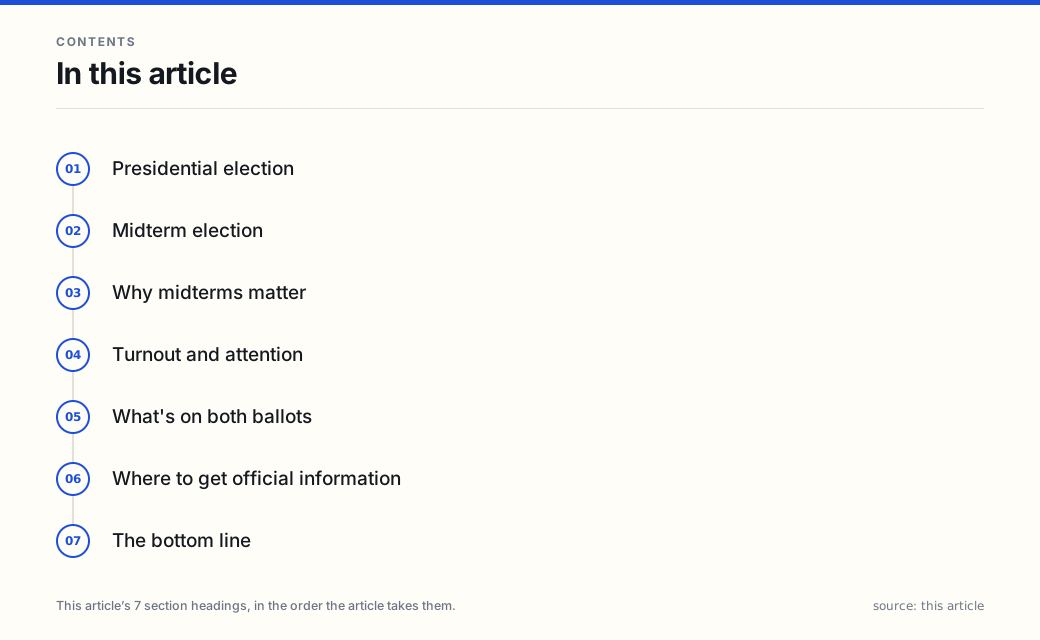
Presidential election
A presidential election is held every four years. Voters choose the President and Vice President, through the Electoral College, based on results in each state. The presidential race sits at the top of the ballot, but the same election also decides every House seat, about a third of the Senate, and a long list of state and local offices.
Midterm election
A midterm is held every two years, in the even-numbered year when there is no presidential race — the midpoint of a president’s term. Voters choose all 435 House seats, about a third of the Senate, and many governors, state legislators, and local officials. The presidency is simply not on the ballot.
The name “midterm” marks where the election falls in the four-year cycle. It is not a different kind of office — the same House and Senate seats are at stake; the White House is just absent.
Why midterms matter
Because they decide control of Congress, midterms can shift which party runs the House, the Senate, or both. That changes which party sets the legislative agenda for the president’s final two years. Many state offices are decided at the same time, so a midterm can reshape government well beyond Washington.
Turnout and attention
Turnout is generally higher in presidential years than in midterms, though midterm turnout has varied widely from cycle to cycle. The presence of a presidential contest and the national attention it draws tend to pull more people to the polls.
What’s on both ballots
Some offices appear on both:
- Every House seat is on the ballot every two years, including in presidential years.
- About a third of the Senate is on the ballot each cycle.
- Governors and state/local offices follow state-set schedules, which may or may not line up with the federal cycle.
The presidential race is the one that distinguishes the two.
Where to get official information
- Your state or local election office — the authority on exactly what is on your ballot in a given year. The EAC’s state lookup points to each office: eac.gov/vote.
- vote.gov — the official federal voting-information site, in place since 2016 and administered by the General Services Administration until the EAC assumed management of the site in 2025; the EAC now operates and hosts it — state-by-state paths.
- usa.gov/voting-and-elections — the federal front door that links to state and local election offices.
- The network’s Voting & Elections topic page collects these explainers, alongside Primary vs. General Election, How Midterm Elections Work, and Who Certifies U.S. Election Results?.
If what is on your ballot matters, the answer lives at your state or local election office — not in a general explainer.
The bottom line
A presidential election happens every four years and puts the presidency on the ballot; a midterm happens every two years and decides Congress but not the president. Both include House, Senate, and many state and local races, and both matter — but they sit at different points in the four-year cycle and put different stakes at the top of the ticket. To see exactly what is on your ballot, check with your state or local election office or at vote.gov.
Counsel is the law site of the Omni Mundi Compendium network. How federal agencies describe their own role in civic life is covered in What Is America.gov? The New Federal Front Door, Explained.
This article is general information about midterm and presidential elections in the U.S., not legal advice, and not official voting information. Which offices appear on a given ballot varies by state and can change. Confirm current details with your state or local election office or at vote.gov before relying on them. It is AI-written and independently AI-reviewed before publication; the review standard and this article’s findings are recorded in the network’s editorial review log.
Frequently asked questions
- What is a presidential election?
- A presidential election is the federal election held every four years in which voters choose the President and Vice President (through the Electoral College, based on state results). It also includes all the down-ballot races — every House seat, about a third of the Senate, governors, state legislatures, and local offices. The presidential race is at the top of the ballot.
- What is a midterm election?
- A midterm election is the federal election held halfway through a president's four-year term — every two years, in the even-numbered year when there is no presidential race. Voters choose all 435 House seats, about a third of the Senate, and many state and local offices. There is no presidential contest on the ballot.
- Why is it called a midterm?
- Because it falls at the midpoint of a president's four-year term. The name marks its place in the cycle, not a separate kind of office. The same House and Senate seats are up; the difference is simply that the presidency is not on the ballot.
- What is at stake in a midterm?
- Control of Congress. Because all House seats and a portion of the Senate are decided, a midterm can shift which party controls the House, the Senate, or both — which changes which party sets the legislative agenda for the president's remaining two years. Many state offices are decided at the same time.
- Is turnout different between the two?
- Typically, yes. Turnout is generally higher in presidential years than in midterms, though midterm turnout has varied widely. The races on the ballot and the public attention differ, which affects how many people vote. The exact rates vary by election.
- Do the same offices appear on both ballots?
- Some do. Every House seat is on the ballot every two years, including in presidential years. About a third of the Senate is on the ballot each cycle. The presidential race appears only in presidential years; governors and state and local offices follow their own state-set schedules, which may or may not align with the federal cycle.
Sources
Each source is a primary or official reference, checked before publication. Links open the original.
- U.S. Election Assistance Commission — 'Voter FAQs': explains the election cycle, that House seats are up every two years and a portion of the Senate each cycle, and that what is on the ballot varies by state — eac.gov/voters/voter-faqs
- National Conference of State Legislatures (NCSL) — state election cycles and what offices appear on the ballot vary by state — ncsl.org/elections-and-campaigns
- 2 U.S.C. § 2a — fixes the total number of Representatives in the House at 435 (Permanent Apportionment Act of 1929); the size of the House is set by federal statute — govinfo.gov
- U.S. General Services Administration, vote.gov / USA.gov 'Voting and Elections': the federal front door that links to state and local election offices, where each state's ballot is published — usa.gov/voting-and-elections