Open vs. closed primary: who can vote in a party's primary?
A closed primary limits voting to party members; an open primary lets any voter pick a party's ballot. Here is how each primary type works and why it matters.
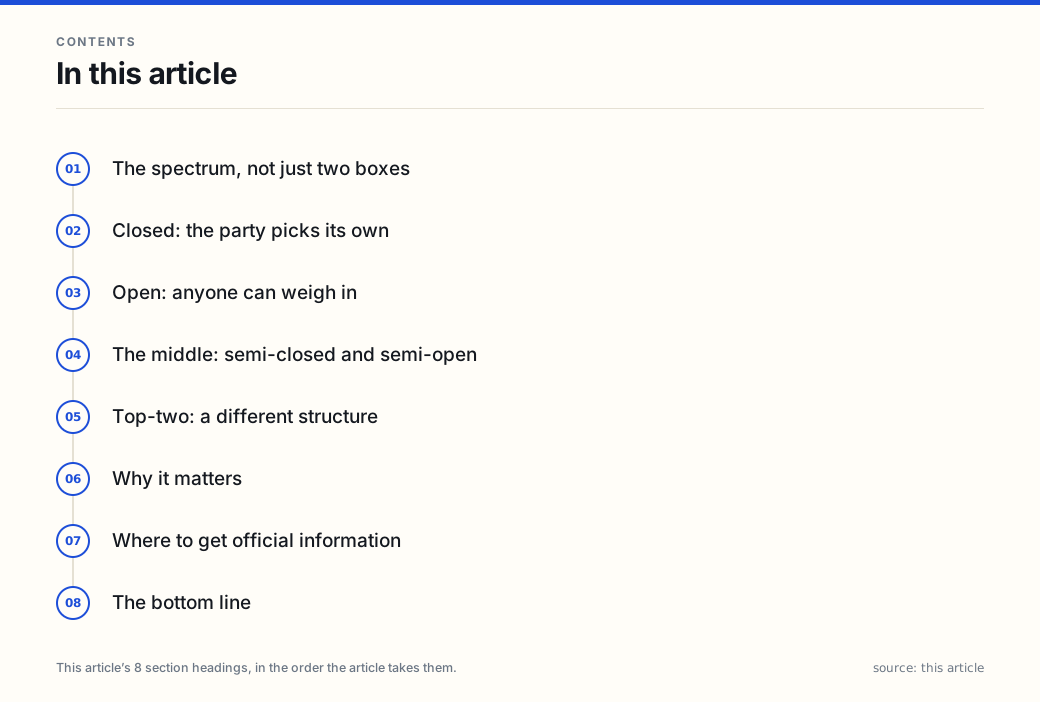
When people say “the primary,” they often mean very different elections. In one state, only registered Democrats can vote in the Democratic primary; in another, any voter can walk in and pick a Republican or Democratic ballot. That difference — open vs. closed — is one of the most consequential rules in American elections, because it decides who gets to choose a party’s nominee.
If you remember one thing: a closed primary limits voting to party members; an open primary lets any voter pick a party’s ballot. The type your state uses shapes turnout, candidate strategy, and sometimes the final winner.
The spectrum, not just two boxes
Primary types sit on a spectrum. The two ends are closed and open, but most of the action is in the middle.
- Closed primary — Only voters registered with a party may vote in that party’s primary. Independents and voters registered with another party generally cannot participate.
- Open primary — Any registered voter may participate, typically by choosing one party’s ballot at the polling place. Your choice usually does not change your own registration.
- Semi-closed primary — Party members, and often unaffiliated voters, may request a party’s ballot; voters registered with a different party generally may not.
- Semi-open primary — Similar, but the voter’s ballot choice is recorded while their registration stays unchanged.
- Top-two (jungle) primary — A different model entirely: all candidates appear on one ballot regardless of party, and the top two advance, even if from the same party.
Closed: the party picks its own
In a closed primary, the party controls who helps choose its nominee. The logic is that only people who have committed to the party should decide its candidate. The trade-off: independents — a large and growing share of voters in many states — are shut out of the nomination fight.
If you are an unaffiliated voter in a closed-primary state, you generally cannot vote in either party’s primary, though rules about same-day party affiliation changes vary by state.
Open: anyone can weigh in
In an open primary, any registered voter can participate by picking one party’s ballot. This tends to draw higher turnout and lets independents influence who appears on the general-election ballot. The concern critics raise is “raiding” — voters from one party crossing over to influence the other’s nomination — though the evidence on how often that decides outcomes is mixed.
Importantly, in most open-primary states, choosing a party’s ballot at the primary does not enroll you in that party.
The middle: semi-closed and semi-open
Most states do not sit cleanly at either end. Semi-closed and semi-open primaries let unaffiliated voters request a party’s ballot while keeping party members in control of their own nomination. The practical difference between “semi-closed” and “semi-open” is mostly about whether the voter’s choice is recorded and whether it can affect registration — details that vary by state.
Top-two: a different structure
A few states use a top-two (sometimes called jungle) primary. All candidates run on a single ballot, parties may or may not appear on it, and the two highest vote-getters advance to the general election. This can produce a general election between two candidates of the same party. It is a structural alternative to the closed/open question, not a point on that spectrum.
Why it matters
The primary type decides who gets to choose a party’s nominee — and in many districts, the primary is the decisive election. In a safe seat, the November outcome is predictable, so the real contest is the primary. A closed primary limits that choice to party members; an open one invites the broader electorate. That difference shapes which candidates run, who turns out, and sometimes who wins the office.
Where to get official information
- Your state or local election office — the authority on which primary type applies where you live, including any difference between presidential and other primaries. The EAC’s state lookup points to each one: eac.gov/vote.
- vote.gov — the official federal voting-information site, in place since 2016 and administered by the General Services Administration until the EAC assumed management of the site in 2025; the EAC now operates and hosts it — state-by-state paths.
- usa.gov/voting-and-elections — the federal front door that links to state and local election offices.
- The network’s Voting & Elections topic page collects these explainers, alongside Primary vs. General Election, How Midterm Elections Work, and How to Register to Vote in the U.S..
If who can vote in your primary matters, the answer lives at your state or local election office — not in a general explainer.
The bottom line
A closed primary limits voting to party members; an open primary lets any voter pick a party’s ballot, with semi-closed and semi-open models in between and top-two primaries as a separate structure. The type your state uses determines who chooses each party’s nominee and can shape the final outcome. To confirm which model applies where you live, check with your state or local election office or at vote.gov.
Counsel is the law site of the Omni Mundi Compendium network. How federal agencies describe their own role in civic life is covered in What Is America.gov? The New Federal Front Door, Explained.
This article is general information about primary types in U.S. elections, not legal advice, and not official voting information. Which primary type a state uses varies by state and can change. Confirm current details with your state or local election office or at vote.gov before relying on them. It is AI-written and independently AI-reviewed before publication; the review standard and this article’s findings are recorded in the network’s editorial review log.
Frequently asked questions
- What is a closed primary?
- In a closed primary, only voters registered with a party may vote in that party's primary. If you are an independent or unaffiliated voter, you generally cannot vote in either party's closed primary. The party controls who participates in choosing its nominee.
- What is an open primary?
- In an open primary, any registered voter may participate, typically by choosing one party's ballot at the polling place. Your choice of ballot usually does not change your own party registration. Open and closed are the two ends of a spectrum; several states use versions in between.
- What is a semi-closed or semi-open primary?
- These are the middle ground. In a semi-closed primary, party members and often unaffiliated voters may request a party's ballot, while voters already registered with another party generally may not. In a semi-open primary, the voter's pick is recorded but does not change their registration. The exact rules vary by state.
- What is a top-two (jungle) primary?
- In a top-two primary, all candidates — regardless of party — appear on one ballot, and the top two vote-getters advance to the general election, even if they are from the same party. A handful of states use this model. It is a different structure from closed and open primaries entirely.
- Does my state use closed or open primaries?
- It depends on the state, and the type can differ between partisan and presidential primaries. The National Conference of State Legislatures tracks each state's primary type; your state or local election office is the authority on which model applies where you live.
- Why does the primary type matter?
- It decides who gets to choose a party's nominee. Closed primaries limit that choice to party members; open and semi-open primaries let more voters weigh in. The type affects turnout, which candidates run, and sometimes who ultimately wins the general election.
Sources
Each source is a primary or official reference, checked before publication. Links open the original.
- National Conference of State Legislatures (NCSL) — 'Primary Types': states use closed, open, semi-closed, semi-open, and top-two (jungle) primaries, and the type determines who may vote in a party's primary — ncsl.org/elections-and-campaigns/primary-types
- U.S. Election Assistance Commission — 'Voter FAQs': explains that primary rules, including who may participate, vary by state — eac.gov/voters/voter-faqs
- U.S. General Services Administration, vote.gov / USA.gov 'Voting and Elections': the federal front door that links to state and local election offices, where each state's primary type is published — usa.gov/voting-and-elections