Your First Passport Is Going Online: What the State Department Announced
State Department pilot puts some first passport applications online from November 16, 2026 — narrower than the December and 2027 promises. Plus a 2028 redesign.
Getting a first passport has been one of the last stubbornly paper processes in federal life: print the form, get a photo taken, find an acceptance facility, wait in line, then wait some more. On September 29, 2026, at the launch of America.gov (see our overview, What Is America.gov?), Secretary of State Marco Rubio announced that the State Department intends to move the first-time application online — and, separately, to redesign the passport book itself. Here is what was actually announced, what is confirmed in writing, and what is still a goal rather than a feature.
The part that changes first: applying online
Today, an adult applying for a first passport must apply in person at an authorized acceptance facility — a post office, courthouse or library — with a printed paper application (Form DS-11) and a physical photo. Adults who are renewing can typically already renew online through the State Department’s Online Passport Renewal platform.
What Rubio announced changes the first-time case:
- Fully online first-time applications — a pilot from November 16, 2026, with the general rollout promised by the end of 2027. The stated goal is that by the end of 2027, “the vast majority of Americans” will be able to apply for a passport or a passport card on America.gov. The 2026 piece of that is narrow: two adult groups, described below.
- Sign-in through Login.gov. In the demonstration, information the government already holds filled itself in, rather than the applicant retyping name and address.
- The photo comes from your own device. You would take or upload a picture at home, preview how it looks in the document, and retake it until it meets the requirements. No photo counter, no white screen.
- Payment and tracking move online too. The demo showed paying inside the platform and then following the application’s status in real time, with an estimated delivery date. That was the demo: the November 16 notice describes no payment step and no tracking screen, and the only fee it addresses is the $35 execution fee, which still applies.
Three limits are worth stating plainly. First, this is a goal with a date, not a live feature for most people — as of November 2026 first-time applicants outside a narrow pilot still apply in person, and the roll-out schedule depends on execution that has not happened yet. Second, applicants under 18 will still need to apply in person. The pilot is limited to adults 18 and over, so 16- and 17-year-olds are outside it too. The State Department says applications for minors require additional safeguards; that rule is not changing as part of this announcement. Third, federal law requires a first-timer’s oath to be verified by a person authorized to administer it, so a website has to work around that. Under 22 U.S.C. §213, an applicant who has never held a U.S. passport must have the application “duly verified by his oath before a person authorized and empowered by the Secretary of State to administer oaths.” The Congressional Research Service, in a report updated November 2, 2026, records the department’s own position that first-time applicants “would still be required to verify their application in person, as required by law” — a reading that sat uneasily beside the “apply entirely online” phrasing used at the launch event and in the department’s October 26 article. CRS also notes that Congress could revisit whether the in-person requirement remains necessary as online services expand.
Status as of November 14, 2026: the pilot has not opened. A State Department notice scheduled for publication on November 16, 2026 (Public Notice 13173, FR Doc. 2026-23317) establishes a pilot effective November 16, 2026 through November 20, 2027 for adults 18 and over located in the United States who either (a) previously held a fully valid U.S. passport but cannot renew on Form DS-82, or (b) are first-time applicants using a USCIS Certificate of Naturalization. That notice also states the department’s position on the §213 question for the duration of the pilot: the applicant records the oath on camera, and a passport agent reviews and confirms the recording before adjudication, with several in-person regulations temporarily set aside. Whether a recording satisfies “before a person” is the department’s reading, not a court holding. The full terms — the eligibility table, the seven-step process and the $35 execution fee that still applies — are in The online first-passport pilot opens November 16. Anyone outside those two groups still applies on paper, and the portal’s own passport screen remains a preview: the arrival date printed on that sample, November 5, 2026, passed with no launch, and no route at /passport exists. No website other than travel.state.gov and, for pilot applicants, America.gov can take a first passport application from you today; anything else offering to is a private intermediary, not a government service.
A date, from the person building it
The launch announcement came with a year and no date. On October 9, 2026, the official the President put in charge of the federal government’s digital overhaul gave a date.
Joe Gebbia, the Airbnb co-founder the President put in charge of the federal government’s digital experience, told Politico’s Playbook that his team is “working around the clock to roll out new features” to America.gov, including letting first-time passport applicants complete the process entirely online. Playbook reports him saying that feature “will launch Dec. 1, with more capabilities coming in 2027.”
December 1 is a specific date, and it is worth setting beside the other official statements rather than replacing them, because they still disagree:
| Where it comes from | What it says about timing |
|---|---|
| Secretary of State Rubio, September 29 | Online first-time applications; the goal is the “vast majority of Americans” applying on the platform by the end of 2027 |
| America.gov’s about page | “Phase 2 begins in 2027” |
| America.gov’s coming-soon page | Additional services “Coming early 2027” |
| Joe Gebbia, October 9 | The first-time online feature “will launch Dec. 1,” with more capabilities in 2027 |
| State Department, October 26 | The online process “will launch for most first-time U.S. passport applicants in December” — a month, no day |
| The White House fact sheet, September 29 | Passport renewal and Medicare enrollment “later this year” |
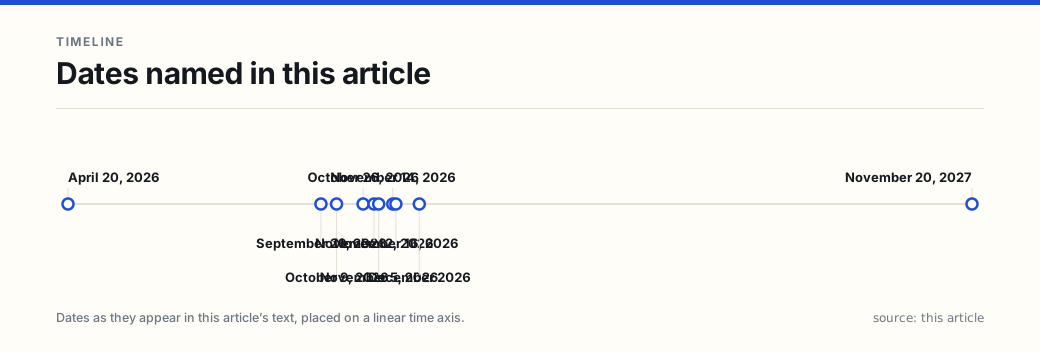
| State Department notice, November 16, 2026 | A pilot effective November 16, 2026 until November 20, 2027, limited to two adult groups, expanded “as the Department makes progress on testing and technological capability” |
Three of those statements place the transactional phase in 2027; four point at 2026 — the launch-day fact sheet, for a broader set of services; Gebbia, for one feature in particular; the department’s own public-affairs article, for the month; and now the notice, which is the only one of the seven with an effective date and an end date attached to it.
The notice narrows rather than converts the earlier promises. A pilot limited to first-time applicants using a Certificate of Naturalization, plus adults who cannot renew by mail, is a smaller population than “most first-time U.S. passport applicants in December,” and the notice does not name December at all. It also does not foreclose a December expansion: it describes a phased rollout and anticipates widening “as testing progresses.” Both readings are consistent with the document; only one of them is written down.
The October 26 row narrows what this article said in early October: the December window had reached readers through reporting on the launch event and through an interview, rather than through anything the department had published. On October 26, 2026 the department’s own site changed that. A ShareAmerica article states that the online process “will launch for most first-time U.S. passport applicants in December.” Two limits belong with it. It is a month, not a day, and it is scoped to most first-time applicants, not all of them. The same article is also not internally consistent: it says that “starting next year, most Americans will be able to apply entirely online,” which points at 2027 rather than the December 2026 launch it had just described. We are not choosing between these statements — the honest position is that the government’s own documents and its own officials still give different answers, and a launch date announced while the service is unbuilt is a target, not a settled schedule.
What does not change: first-time applicants outside the pilot still apply in person today. If you need a passport now and you are not in one of the pilot’s two groups, the current process is the one that works, and a December promise is not a reason to wait. Inside the pilot, the counter visit is gone but the oath is not: it is recorded on camera and confirmed by a passport agent (see the third limit above and the pilot article for the mechanics).
The part coming later: a redesigned passport book in 2028
Rubio also showed what he called the 2028 U.S. passport, developed with the National Design Studio:
- The cover keeps its blue, but “United States of America” moves to the top and the Great Seal becomes larger and more prominent.
- Inside, illustrated pages trace scenes of American history, and flipping the pages quickly creates an animation of an eagle in flight.
- Passports would arrive in upgraded packaging rather than the current envelope.
The redesign was also foreshadowed in writing months earlier: a Federal Register notice published April 20, 2026 (Public Notice 12997, docket DOS-2026-0496) says the next redesign, anticipated to roll out in 2028, moves U.S. passport books to a single 38-page size, replacing today’s 26-page and 50-page options. The Emergency Passport stays at 12 pages. The State Department’s own numbers: about 92 percent of applicants request the 26-page book, so most people get more visa pages than before — but frequent travelers, U.S. citizens living abroad, and special-issuance holders who use the 50-page book will need to renew more often once it disappears. The department pairs that with a planned upgrade to online renewal for overseas applicants.
One element of the preview drew more attention than the page count: the interior artwork shown included a portrait of the sitting president, the same image used on the limited-edition commemorative passport. Whether that artwork will be on the standard book when it ships has not been stated, and the department has published no such detail in writing. We take that question up — alongside the practical one, whether to renew before the new design arrives — in The 2028 passport redesign: what is confirmed, and what the State Department has not said.
If you already hold a passport, nothing changes: documents issued with older designs remain valid until their printed expiration date.
What this does not change
- Eligibility and evidence requirements are untouched. Who qualifies for a passport, what documents prove citizenship, and how minors’ applications work are set by statute and regulation, not by the website.
- Fees are unchanged by the announcement. Fee amounts are set by the State Department and published at travel.state.gov; the announcement is about the channel, not the price. The November 16 notice changes no fee, but it does keep the $35 execution fee for an online DS-11.
- This is a federal process. Eligibility and evidence rules are set by federal statute and regulation and are the same in every state. State lines appear at the edges: the ID you present must be issued by a U.S. state, D.C. or a territory — a mobile driver’s license is not accepted — and the later birth-certificate expansion depends on whether your state’s vital records authority elects to participate.
The scam angle: an industry built on the old friction
Rubio was explicit that part of the motivation is the ecosystem of paid middlemen — services that charge for forms and appointments that are free, and collect personal information along the way. That ecosystem will not vanish on announcement day; if anything, expect it to market harder while the transition creates confusion.
The durable rules: official passport forms and instructions are free at travel.state.gov; the only official place to renew a passport online is the State Department’s own platform there; nobody legitimate needs your payment to “release” or “expedite” an application you have not filed; and no government email or text asks for your Login.gov password. Our network’s scam checklist, Is That Really America.gov?, covers the verification steps in detail.
What to do right now
If you need a passport, do not wait for the online option — apply today through the current process: confirm the requirements at travel.state.gov, book an appointment at an acceptance facility, and file. If your travel is more than occasional and you prefer the larger book, renewing before the 50-page option disappears in 2028 is worth considering. And if you are a frequent traveler living overseas, watch for the promised upgrade to online renewal for overseas applicants — that is the piece most likely to save you real time.
More background on the portal this all runs through is in our overview of America.gov, and related guides are collected at the network’s resources page (omc.center/resources).
Sources
Each source is a primary or official reference, checked before publication. Links open the original.
- U.S. Department of State — official remarks by Secretary of State Marco Rubio at the America.gov launch event (September 29, 2026): state.gov/releases/office-of-the-spokesman/2026/09/secretary-of-state-marco-rubio-at-president-trumps-america-gov-event/
- Federal Register, 91 Fed. Reg. 21070 (April 20, 2026) — State Department Public Notice 12997, 'United States Passports Moving to Single-Sized Passport Book', FR Doc. 2026-07670 (docket DOS-2026-0496): govinfo.gov/content/pkg/FR-2026-04-20/pdf/2026-07670.pdf
- U.S. Department of State, Bureau of Consular Affairs — passport application, photo and renewal rules: travel.state.gov
- The New York Times, 'No More Drugstore Head Shots: Passport Applications Go Digital' (September 30, 2026)
- Politico Playbook, October 9, 2026 — Joe Gebbia, the official leading the federal digital overhaul, on America.gov's coming features, including that first-time online passport applications 'will launch Dec. 1,' with more capabilities in 2027, and his statements on the models behind the portal and on privacy: politico.com/newsletters/playbook/2026/10/09/the-battle-for-black-voters-01113316
- U.S. Department of State, ShareAmerica — 'New passport tells America's story', published October 26, 2026: the online process 'will launch for most first-time U.S. passport applicants in December', the 2028 redesign, and the figures of more than 27 million passport books and cards issued in 2025 and about half of Americans holding a valid passport, up from 5 percent in 1990 — share.america.gov/new-passport-tells-americas-story/
- Congressional Research Service, 'U.S. Passport Services' (In Focus IF12466), updated November 2, 2026, author Cory R. Gill — records the State Department's position that first-time applicants 'would still be required to verify their application in person, as required by law' (citing 22 U.S.C. §213), and notes Congress could revisit whether that requirement remains necessary: crsreports.congress.gov/product/details?prodcode=IF12466
- 22 U.S.C. §213, 'Application for passport; verification by oath of initial passport' — an applicant who has not previously been issued a U.S. passport must have the application 'duly verified by his oath before a person authorized and empowered by the Secretary of State to administer oaths': law.cornell.edu/uscode/text/22/213
- U.S. Department of State, 'Pilot for Online Version of Application for a U.S. Passport (Form DS-11)', Public Notice 13173, RIN 1400-ZA28, FR Doc. 2026-23317, published in the Federal Register on November 16, 2026 — the pilot's effective dates of November 16, 2026 through November 20, 2027, the two eligibility groups, the recorded-oath method and the regulations it temporarily alters, and the $35 execution fee that still applies: www.federalregister.gov/documents/2026/11/16/2026-23317/pilot-for-online-version-of-application-for-a-us-passport-form-ds-11