Your medical records are due in 15 days, not 30 — and the price list has to be posted
HHS finalized the HIPAA access rule: 15 calendar days for your records, no fee for portal access, and a posted fee schedule — with compliance by July 17, 2027.
The HHS Office for Civil Rights has finalized a rewrite of the HIPAA Privacy Rule’s access provisions. Its headline change: a covered entity must answer a request for your medical records as soon as practicable and no later than 15 calendar days after receiving it, down from the 30 days the rule allows today, with a single 30-day extension still available.
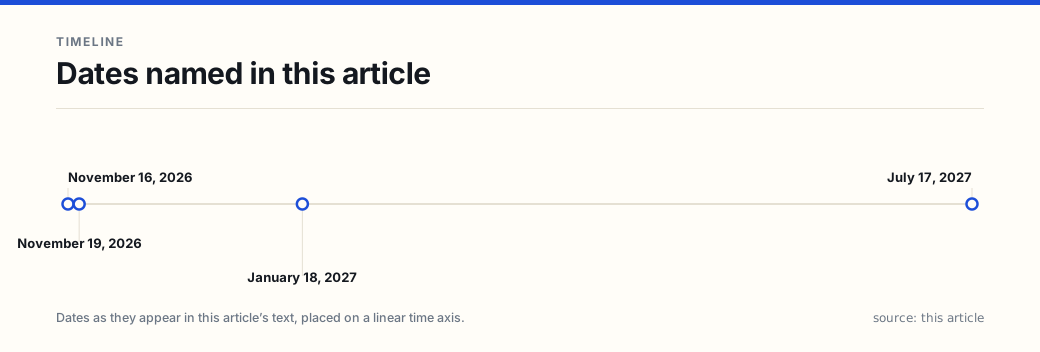
The rule is Document No. 2026-23429, amends 45 CFR Parts 160 and 164 under RIN 0945-AA00, runs 363 pages, and was announced on November 16, 2026. It was published in the Federal Register on November 19, 2026, which is the date every deadline in it is measured from.
| What it is | A final rule from the HHS Office for Civil Rights amending the HIPAA Privacy Rule |
| Announced | November 16, 2026 |
| Federal Register publication | November 19, 2026 (91 Fed. Reg. 74848) |
| Effective | January 18, 2027 — 60 days after publication |
| Compliance required | July 17, 2027 — 180 days after the effective date, which the rule expresses as 240 days after publication |
| Who it binds | HIPAA covered entities: health care providers that bill electronically, health plans, and clearinghouses |
| The one number to remember | 15 calendar days, not 30 — but not until July 2027 |
That last row is the part most coverage of this rule will skip. Between now and July 17, 2027, a provider or health insurer that takes 30 days to send your records is still complying, because the 15-day standard is not yet the one they are held to. The rule’s own date line sets compliance 240 days after publication — the same day the fact sheet describes as 180 days after the effective date, which is why the two documents look like they disagree and do not.
What actually changes for a patient
Six of the modifications in this rule are things a reader can use. The rest are housekeeping: the rule allows disclosures to telecommunications relay services assistants, adds the Public Health Service and NOAA Commissioned Corps to the military provision, and gives regulated entities extra time to amend business associate agreements.
1. Fifteen days, with one extension
The new standard is “as soon as practicable,” but no later than 15 calendar days after the request arrives, at 45 CFR 164.524(b)(2). The Department says it should be read as an outer limit, and points out that a patient portal or a health plan API can answer in minutes.
If the entity cannot finish in 15 days, it may take one extension of up to 30 calendar days — 45 days total. To use it, it must tell you within the first 15 days, in writing, why it needs more time and the date it will respond. There is no second extension. And a request cannot be parked while the two of you argue about format: the rule says negotiating with you about the form and format of the response does not extend the clock.
2. Two situations where the fee is zero
This is the change most likely to be felt at a hospital cashier’s window.
- Inspecting in person: no fee.
- Electronic records through an internet-based method: no fee. The rule names a patient portal, a health plan member portal, and a personal health app connected through a standards-based API.
“Internet-based method” means an automated transmission — not an employee emailing you a PDF, which involves labor. If your record exists as electronic protected health information and is readily producible in the format you asked for, sending it to you or to your app is free.
3. Copies can only be priced four ways
For a copy you take away, a covered entity may charge a reasonable, cost-based fee built from four components:
| Allowed charge | What it covers |
|---|---|
| Labor | Copying the requested records |
| Supplies | Creating a non-electronic copy, where you asked for one |
| Postage | Mailing a non-electronic copy or a summary |
| Summary | Preparing an explanation or summary, only if you agreed to it |
That list supersedes the 2016 guidance, which also allowed an average-cost method and a flat $6.50 per request. The Department describes the resulting charge as a ceiling, not a floor: an entity may charge less, and other law may require it to.
4. The price list has to be on the website
A new 45 CFR 164.525 kicks in if the covered entity charges for copies at all: a covered entity that imposes fees must post its estimated fee schedule on its website, if it has one, and make that schedule available at the point of service and on request. The posted schedule has to itemise the components that go into a total: labor for making a copy, supplies for a non-electronic copy, postage, and any charge for preparing a summary, added together. Labor may be shown as an hourly rate. The schedule must also say when copies are free.
Practical effect: before you pay a records invoice, you can compare it against the number the entity published itself.
5. You can direct a copy to someone else
The rule implements section 13405(e) of the HITECH Act, the 2009 statute that created this right and that the Department says it is now implementing through regulatory text. You may direct a covered entity to transmit an electronic copy of protected health information in your electronic health record to a person you designate.
Two limits are worth stating plainly, because they are narrower than the proposal:
- The right covers electronic records in an electronic health record, not paper charts. That scope follows the 2020 decision in Ciox Health, LLC v. Azar, which the Department says it is conforming to.
- A covered entity may not refuse because it disapproves of the recipient or the reason. The rule gives an example: it cannot turn down a request just because the person you named is a lawyer.
The request must be clear, conspicuous and specific — the person’s name and where to send the file. The Department proposed requiring entities to accept oral requests and dropped it: a verbal request may be accepted, and if it is, the entity must document it in writing, but it may also insist on receiving the request in writing as long as it tells you that.
6. Less paperwork at the front desk
The requirement to make a “good faith effort” to obtain your written acknowledgment of the notice of privacy practices — and to document the effort when you declined — is gone from 45 CFR 164.520(c)(2)(ii). So is the six-year retention duty that came with it.
In its place, the notice must tell you that you have a right to discuss it with a designated contact person or office, whose email address must appear in the notice, and the required header now has to say the notice covers how to access your information, how to file a HIPAA complaint, and what rights you have. The word “Medical” in the header becomes “Health.” The rule also removes the exception that kept inmates of correctional institutions from receiving a notice at all.
The trade: more sharing for care coordination
The same rule widens what can be shared without your authorization, and readers who care about privacy should know which direction that runs.
- The definition of health care operations is amended so health plans may use and disclose protected health information for population-based and individual-focused care coordination and case management.
- Covered entities are expressly permitted to disclose information for individual-level care coordination and case management to third parties that provide health-related services — social services agencies, community-based organizations, and home and community-based services providers.
Both are permissions, not obligations, and both sit inside existing treatment, payment and operations rules that never required your signature. But the boundary between “care coordination” and “marketing” is now doing more work in the regulation than it did before, and a reader who wants a copy of everything shared about them has to use the access right above to find out.
What the rule does not do
Four things that were proposed and did not survive, all confirmed in the final rule’s own responses to comments:
- No mandated oral requests. A covered entity may accept a verbal access request; it does not have to.
- No change to the right to inspect the record in person, beyond the fee bar.
- No duty to forward your request from one provider to another on your behalf.
- No mandated written policy on how staff verify identity. The rule instead prohibits an unreasonable identity verification requirement, and leaves what counts as reasonable to the circumstances rather than to a checklist in the text.
It also does not create a private right of action. HIPAA is enforced by the Office for Civil Rights through complaints under 45 CFR 160.306, which is why the rule’s announcement ends by pointing readers at the complaint form rather than at a court.
Where state law still decides
HIPAA sets a floor, not a ceiling, for access rights. A state law that gives you more access — a shorter deadline, a lower or zero fee, a wider definition of the record — is not preempted, and the rule says so explicitly when it addresses fees: it names state laws that “prohibit fees” or “allow only lesser fees” as examples of more stringent law that survives. States do differ on both points, and a number of them already impose a records deadline shorter than the federal one or cap copying charges below what HIPAA permits. Which rule controls your request depends on which state you are in, so check your state’s health-records statute before treating the federal numbers as the operative ones.
What to do now
- Ask in writing, and be specific. Use the portal message function or email rather than the phone. Name the date range, the record types (office notes, imaging reports, lab results, billing), and the format you want.
- Say who should receive it, if not you. A name plus an email address or upload destination is what makes a right-of-access-to-direct request “clear, conspicuous and specific.”
- Ask for the fee schedule before you pay. From July 17, 2027 the entity must have posted one; today, ask for it and compare the invoice against the four permitted components.
- Use the portal for anything you only need to read. Inspecting, and any access through an internet-based method, is free.
- If the deadline passes, ask in writing which deadline they are applying and, if they take an extension, for the written notice with a date. Keep the request date; that is the date the clock starts.
- Escalate to OCR, not to a lawsuit. The complaint route is the HHS filing page, and there is a 180-day window in the ordinary case.
If the bill for records is part of a larger dispute — a denied claim, a medical debt in collections — the access right is usually the cheapest way to get the evidence. Our walkthroughs of what to do when a claim is denied and of debt collector rights both assume you can get the file; this rule makes that faster and, in the portal case, free. For the underlying requirements that hospitals and insurers publish about their prices, see health price transparency rules. The primary documents behind federal programs like this one are collected in the network’s government resources directory.
One note on the dates in this piece: every deadline in the rule is written as a count of days from its Federal Register publication, which took place on November 19, 2026 as scheduled. The deadlines below are fixed.
Frequently asked questions
- Can I demand my records within 15 days right now?
- Not yet. The rule is effective January 18, 2027 — 60 days after its Federal Register publication on November 19, 2026 — but covered entities have 180 more days, until July 17, 2027, to comply. Until then the current 30-calendar-day deadline in 45 CFR 164.524(b)(2) is what a provider or health plan owes you, and a request that arrives before the compliance date is still measured against the old rule.
- Do I have to pay for copies of my medical records?
- Less than before, and nothing at all in two situations. The final rule bars any fee when you inspect your record in person or when you access electronic protected health information through an internet-based method — a patient portal, a health plan member portal, or a personal health app connected to a standards-based API. For copies you take away, a covered entity may charge only a reasonable, cost-based fee covering labor for copying, supplies for a non-electronic copy, postage, and preparing a summary if you agreed to one. That narrows the 2016 guidance, which also allowed an average-cost method and a flat $6.50.
- Can my hospital refuse to send my records to my lawyer or to a health app?
- Not because of who the recipient is. The rule implements the right of access to direct: you can tell a covered entity to transmit an electronic copy of protected health information in your electronic health record to a person you designate, and the entity may not deny the request based on its opinion of that person or of your purpose. The request does have to be clear, conspicuous and specific — the person's name and where to send it — and a covered entity may require it in writing as long as it tells you that.
- Can I make the request by phone?
- A covered entity is permitted, but not required, to accept a verbal request. The Department proposed requiring acceptance of oral requests and dropped that in the final rule after comments. If you dictate the recipient's email address to a receptionist the request can qualify, but the entity must document it in writing, and it may insist on receiving the request in writing instead.
- Does this change how my health plan shares information about me?
- Yes, in the other direction. The rule amends the definition of health care operations so health plans may use and disclose protected health information for population-based and individual-focused care coordination and case management, and it expressly permits disclosures for individual-level care coordination to social services agencies, community-based organizations and home and community-based services providers. Those disclosures do not require your authorization.
- Do I still have to sign something at the front desk?
- Not for the notice of privacy practices. The rule eliminates the requirement that a provider with a direct treatment relationship make a good faith effort to obtain your written acknowledgment of the notice, along with the paperwork that followed a refusal. In its place the notice must tell you that you can discuss it with a contact person or office the provider designates, and the required header now has to point to how you access your information and how you file a HIPAA complaint.
- What can I do if a provider misses the deadline or overcharges me?
- Ask for the written extension notice first: an entity that needs more time must tell you within the first 15 calendar days why, and the date it will respond, and only one 30-day extension is allowed. If that does not resolve it, a complaint goes to the HHS Office for Civil Rights, which is the enforcement route under 45 CFR 160.306. State law can be stricter than HIPAA — shorter deadlines and lower fees are common — and where a state rule gives you more access, HIPAA does not displace it.
Sources
Each source is a primary or official reference, checked before publication. Links open the original.
- HHS Office for Civil Rights — 'HIPAA Privacy Rule: Changes to Support Coordinated Care and Individual Engagement and Reduce Regulatory Burdens', final rule, 45 CFR Parts 160 and 164, RIN 0945-AA00, Document No. 2026-23429, 363 pages, published in the Federal Register on November 19, 2026, effective 60 days after publication, compliance required 240 days after publication. Read for: the SUMMARY list of modifications; the DATES line; the 15-calendar-day response standard and the single 30-day extension with its written-notice requirement at 45 CFR 164.524(b)(2); the fee components (labor for copying, supplies, postage, summary or explanation) and the bar on any fee for inspection or for ePHI accessed by an internet-based method, which supersedes the 2016 guidance's actual-cost, average-cost and $6.50 flat-fee methods; the new fee-schedule posting requirement at 45 CFR 164.525; the definitions added for 'electronic health record' and 'personal health application'; the 'clear, conspicuous, and specific' standard for the right of access to direct and the decision not to require acceptance of oral requests; the elimination of the written-acknowledgment requirement at 45 CFR 164.520(c)(2)(ii) and the new right to discuss the notice at 164.520(b)(1)(iv)(G); the amended health care operations definition; and the proposals the Department expressly did not finalize — www.federalregister.gov/documents/2026/11/19/2026-23429/hipaa-privacy-rule-changes-to-support-coordinated-care-and-individual-engagement-and-reduce
- HHS — press release, 'HHS Issues New Final Rule to Modernize the HIPAA Privacy Rule to Support Coordinated Care and Individual Engagement and Reduce Regulatory Burdens', published November 16, 2026, 4:30 p.m. Eastern. Read for: the announcement date, the statement that the rule 'is effective 60 days after publication', the Secretary's and the OCR Director's statements, and the complaint route the department points readers to — hhs.gov/press-room/hhs-issues-new-final-rule-modernize-hipaa-privacy-rule-support-coordinated-care-individual-engagement-reduce-regulatory-burdens.html
- HHS Office for Civil Rights — fact sheet for the final rule. Read for: the itemised list of modifications by heading (individual engagement, care coordination and case management, regulatory burdens); the statement that regulated entities must comply 'by 180 days after the effective date', which is the same day the rule states as 240 days after publication; the telecommunications relay services and Uniformed Services provisions; the additional time allowed for amending business associate agreements; and the removal of the correctional-institution exception to receiving a notice of privacy practices — hhs.gov/hipaa/for-professionals/privacy/changes-support-coordinated-care-individual-engagement-reduce-regulatory-burdens-final-rule.html
- 45 CFR 164.524 — Access of individuals to protected health information, as currently codified. Read for: the 30-calendar-day deadline and 30-day extension this rule replaces, and the existing fee limits the final rule amends — ecfr.gov/current/title-45/subtitle-A/subchapter-C/part-164/subpart-E/section-164.524
- 45 CFR 164.520 — Notice of privacy practices for protected health information, as currently codified. Read for: the written-acknowledgment and documentation requirements at paragraphs (c)(2)(ii) and (e) that the final rule eliminates — ecfr.gov/current/title-45/subtitle-A/subchapter-C/part-164/subpart-E/section-164.520
- 45 CFR 160.306 — Complaints to the Secretary. Read for: the 180-day filing window in paragraph (b), and the reason the HHS Office for Civil Rights is the enforcement route for a Privacy Rule violation rather than a court, since HIPAA does not give an individual a private right of action — ecfr.gov/current/title-45/subtitle-A/subchapter-C/part-160/subpart-C/section-160.306
- HHS Office for Civil Rights — 'Filing a Complaint', the intake page for a HIPAA complaint and the route the rule's own announcement points readers to — hhs.gov/hipaa/filing-a-complaint/index.html
- Office for Civil Rights — 'Proposed Modifications to the HIPAA Privacy Rule To Support, and Remove Barriers to, Coordinated Care and Individual Engagement', proposed rule published January 21, 2021, the proposal this final rule largely adopts five years later — federalregister.gov/documents/2021/01/21/2020-27157/proposed-modifications-to-the-hipaa-privacy-rule-to-support-and-remove-barriers-to-coordinated-care
- U.S. Government Accountability Office — 'Medical Records: Fees and Challenges Associated with Patients' Access', GAO-18-386, May 2018. Read for: the finding that high fees can deter patients from obtaining their records, and the account of patients cancelling requests once they learn the cost — the reason the fee provisions are in this rule at all — gao.gov/assets/gao-18-386.pdf