How midterm elections work: the House, the Senate, and who runs them
Midterm elections decide every House seat and about a third of the Senate. Here is how U.S. federal elections work, who runs them, and where to register.
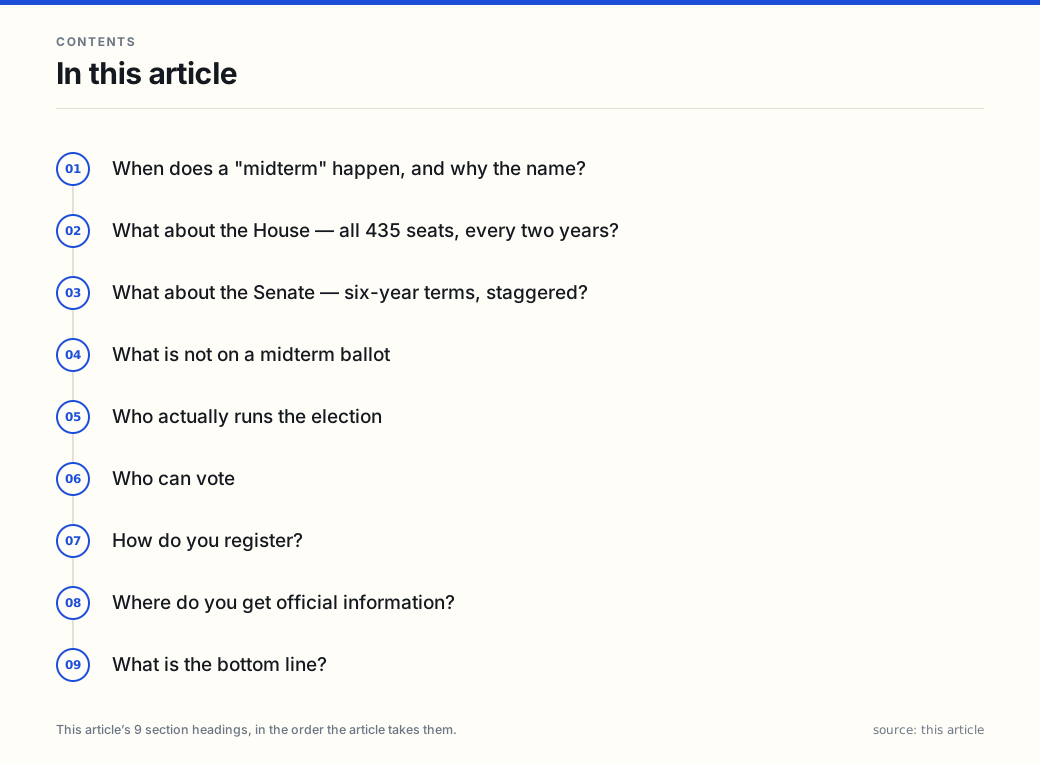
A midterm election is the federal election that falls in the middle of a president’s four-year term. The name describes timing, not a separate kind of government: the same offices that are always elected to Congress are on the ballot. The difference is simply that the presidency is not.
If you only remember one thing, remember this: every seat in the House of Representatives is elected every two years, and about one-third of the Senate is elected every two years, and the states — not Washington — run the election. Everything else is detail built on those three facts.
When does a “midterm” happen, and why the name?
Federal elections are held every two years, on the Tuesday after the first Monday in November, a date fixed by federal statute (2 U.S.C. § 7). The years fall into two patterns. In years divisible by four, voters also choose a president. In the even-numbered years in between — the midpoints of a presidential term — they do not. Those in-between years are the midterms.
So a midterm is not a special or lesser election. It is the regular federal election that happens to fall when no presidential race is on the ballot. Special elections to fill vacancies can occur at any time, in any year, but those are off-cycle fill-ins, not the scheduled midterm.
What about the House — all 435 seats, every two years?
The House of Representatives is built for short accountability. The Constitution requires that its members be chosen every second year, and today the House has 435 voting seats, each elected from a single congressional district. Every one of those 435 seats is contested in every federal election, midterm or not.
Districts are redrawn after each decennial census, because the 435 seats are divided among the states by population. That redrawing is a state responsibility, conducted under federal constitutional and statutory limits — which is why district lines differ so much from state to state and change only after a census year.
What about the Senate — six-year terms, staggered?
The Senate is built for the opposite purpose: continuity. Its 100 seats carry six-year terms, and those terms are staggered across three classes so that only about one-third of the Senate is elected in any given even-year federal election. The direct popular election of Senators comes from the Seventeenth Amendment; before it, state legislatures chose them.
This is the structural fact that confuses a lot of coverage. A midterm does not elect “the Senate” — it elects roughly a third of it. The other two-thirds are simply not up. That is why control of the Senate can turn on a small number of seats in a given cycle, while the House is decided all at once.
What is not on a midterm ballot
The presidency. Presidential elections run on a separate four-year clock and are decided by the Electoral College, a mechanism that applies only to the presidential race. Midterms have no presidential contest, and the Electoral College plays no part in them. Any explanation that mixes the two is describing two different systems.
States frequently put their own races — governors, state legislatures, statewide officers, ballot measures — on the same midterm ballot. Those are state and local matters, run under state law, even though they share the date.
Who actually runs the election
This is the most misunderstood part of the system, and the most worth getting right. There is no federal agency that runs U.S. elections. The Constitution assigns the “times, places, and manner” of federal elections to the states, while giving Congress the power to set or override those rules. In practice, that means thousands of state and local election offices — county clerks, boards of elections, secretaries of state — administer registration, polling places, ballots, and vote counting.
Two federal agencies sit beside this system without running it:
- The Federal Election Commission enforces federal campaign-finance law — disclosure, contribution limits, and the rules around who may spend on federal races. It does not run polls or count votes.
- The Election Assistance Commission, created by the Help America Vote Act of 2002, certifies voting-system standards and maintains the federal mail voter-registration form. It supports state and local offices; it does not administer elections. Vote.gov, the official federal voting-information site, is a separate operation: it has carried official federal voting information since 2016 and was administered by the General Services Administration until the EAC assumed management of the site in 2025; the EAC now operates and hosts it.
The division is deliberate. Election administration in the United States is decentralized by design, which is why the same federal election looks different in every state.
Who can vote
The Constitution originally left the franchise to the states, and the states spent decades restricting it. A series of constitutional amendments narrowed that power by guaranteeing the vote to citizens regardless of race (15th), sex (19th), poll taxes in federal elections (24th), and age — 18 and older (26th). The Voting Rights Act of 1965 separately prohibits racial discrimination in voting.
Two boundaries follow from this. First, federal elections are for U.S. citizens; the amendments expand citizens’ rights, they do not extend federal voting to noncitizens. Second, the details that remain — residency, registration, and how you prove identity at the polls — are set by each state, within those federal floors.
How do you register?
There is no single federal voter-registration form. Under the National Voter Registration Act of 1993, most states must offer registration at motor-vehicle offices and by mail and must let you update your registration when you renew a license. Beyond that baseline, states diverge: some allow same-day registration at the polls, and one state does not use voter registration at all. Military and overseas citizens vote under the Uniformed and Overseas Citizens Absentee Voting Act.
The reliable way to find your state’s specific rules and deadlines is vote.gov, the official federal voting-information site, which points to each state’s election office. For a step-by-step walkthrough, see How to Register to Vote in the U.S..
Where do you get official information?
- vote.gov — the official federal voting-information site, in place since 2016 and administered by the General Services Administration until the EAC assumed management of the site in 2025; the EAC now operates and hosts it — state-by-state registration paths.
- usa.gov/voting-and-elections — the federal front door for finding state and local election offices.
- fec.gov — the Federal Election Commission, for how campaign-finance rules apply to federal races.
- The network’s Voting & Elections topic page collects both election explainers in one place.
If a number, a deadline, or a “is this on my ballot” question matters to you, the answer lives at your state or local election office, not in a general explainer.
What is the bottom line?
A midterm election is the regular federal election at the midpoint of a presidential term. It decides the entire House and about a third of the Senate, never the presidency. The races are run by states and local officials, not a federal agency, under constitutional and statutory floors set in Washington. To act on any of it, register per your state’s rules — start at vote.gov — and confirm the specifics with your state election office.
Counsel is the law site of the Omni Mundi Compendium network. How federal agencies describe their own role in civic life is covered in What Is America.gov? The New Federal Front Door, Explained.
This article is general information about the structure of U.S. federal elections, not legal advice, and not official voting information. Election rules, registration, and ballots are set by each state and can change; confirm current details with your state or local election office or at vote.gov before relying on them. It is AI-written and independently AI-reviewed before publication; the review standard and this article’s findings are recorded in the network’s editorial review log.
Frequently asked questions
- What is a midterm election?
- A midterm election is the federal election held in the middle of a president's four-year term. Federal elections happen every two years, on the Tuesday after the first Monday in November; the ones in even-numbered years that are not presidential-election years are called midterms. Voters choose the full House of Representatives and about one-third of the Senate. The presidency is not on the ballot in a midterm.
- How often are House and Senate elections held?
- All 435 voting seats in the House of Representatives are elected every two years, because House terms are two years under the Constitution. The Senate is different: its 100 seats have six-year terms, staggered across three classes, so roughly one-third of the Senate is elected in each even-year federal election. That staggered clock is why a midterm reshapes part, not all, of the Senate.
- Who actually runs U.S. elections?
- States and local election officials run them. The Constitution gives state legislatures the power to set the time, place, and manner of federal elections, subject to Congress's power to alter those rules. There is no single federal agency that administers elections. The Federal Election Commission enforces campaign-finance law, and the Election Assistance Commission supports state and local offices, but neither runs the polls or counts the votes.
- How do I register to vote?
- It depends on your state, not a single federal form. Under the National Voter Registration Act, most states must offer registration at motor-vehicle offices and by mail, and must let you update your registration when you renew a license. Many states allow same-day registration, and one state does not use voter registration at all. The official starting point for finding your state's rules and deadlines is vote.gov.
- Is Election Day a federal holiday?
- No. Federal Election Day is not a federal public holiday. Some states designate it a state holiday or give state employees leave, and a few jurisdictions require employers to give workers time to vote, but those are state and local choices. The date itself is fixed by federal law: the Tuesday after the first Monday in November in even-numbered years.
- Can noncitizens vote in federal elections?
- No. Voting in federal elections is limited to U.S. citizens. The constitutional amendments that expanded the franchise — the 15th, 19th, 24th, and 26th — protect citizens' right to vote regardless of race, sex, poll taxes, or age (18 and older). They do not extend federal voting to noncitizens; eligibility beyond citizenship, such as residency and registration, is set by each state within federal floors.
Sources
Each source is a primary or official reference, checked before publication. Links open the original.
- U.S. Constitution, Article I, Section 2 (House chosen every second year) and Section 4 (states set the time, place, and manner of federal elections, subject to Congress's power to alter) — constitution.congress.gov
- Seventeenth Amendment (direct popular election of Senators, 1913) and the constitutional structure of six-year, staggered Senate terms — constitution.congress.gov
- 2 U.S.C. § 7 — 'Time of election,' fixing the federal election day as the Tuesday next after the first Monday in November in even-numbered years; 2 U.S.C. § 1 ties the Senate election to that same regular election day — govinfo.gov
- 5 U.S.C. § 6103 — the list of federal public holidays; Election Day is not among them — govinfo.gov
- Fifteenth, Nineteenth, Twenty-Fourth, and Twenty-Sixth Amendments — the constitutional expansion of the federal franchise to citizens regardless of race, sex, poll tax, and age 18+ — constitution.congress.gov
- National Voter Registration Act of 1993 (NVRA), 52 U.S.C. § 20501 et seq. — motor-vehicle-office and mail registration, and the obligation to offer and update registration — govinfo.gov
- Help America Vote Act of 2002 (HAVA), 52 U.S.C. § 20901 et seq. — the Election Assistance Commission, provisional ballots, and voting-system standards — govinfo.gov
- Uniformed and Overseas Citizens Absentee Voting Act (UOCAVA), 42 U.S.C. § 1973ff — absentee voting for military and overseas citizens — govinfo.gov
- Voting Rights Act of 1965, 52 U.S.C. § 10301 et seq. — prohibition on racial discrimination in voting — govinfo.gov
- Federal Election Commission — 'Congressional and presidential elections' and the agency's role enforcing federal campaign-finance law (the FEC does not administer elections) — fec.gov
- U.S. Election Assistance Commission — voting-system standards, guidance, and the Commission's supporting (non-administrative) role in state-run elections — eac.gov
- General Services Administration — 'Vote.gov makes it easier for voters to find trustworthy, official voting information': vote.gov has been a trusted source for accurate, official voting information from the U.S. government to the American public since 2016, and Executive Order 14019 (2021) tasked GSA with modernizing the site — gsa.gov/node/164993
- U.S. Election Assistance Commission, 2019 Annual Report — 'vote.gov, a federal government website administered by the General Services Administration (GSA)'; the December 2019 EAC–GSA memorandum of understanding on the NVRA form and vote.gov information (p. 39) — eac.gov
- U.S. Election Assistance Commission, Fiscal Year 2026 Congressional Budget Justification — 'In FYs 2024 and 2025, the EAC signed a memorandum of understanding with General Services Administration (GSA) to transfer Vote.gov to the EAC... In FY 2026, the EAC will fully maintain Vote.gov' (p. 4) — eac.gov
- U.S. Election Assistance Commission, 2025 Annual Report — 'in 2025, the EAC assumed management of the site' (vote.gov), following an EAC–GSA partnership that began in 2020 (p. 75) — eac.gov
- U.S. Election Assistance Commission, Fiscal Year 2027 Congressional Budget Justification — 'The EAC operates and hosts Vote.gov, a trusted source for accurate, unbiased, and official voting information' (p. 4) — eac.gov
- USA.gov — 'Voting and elections,' the federal front door for finding state election offices and official voting information — usa.gov/voting-and-elections