What is early voting, and how does it work?
Early voting lets you cast a ballot in person before Election Day. Here is how it works, where it is offered, and how it differs from mail voting.
You do not have to vote on Election Day. In most states, you can walk into a designated location days or weeks beforehand, cast a normal ballot, and be done. That option is called early voting.
If you remember one thing: early voting is in-person voting at a state-run location before Election Day. It is created by state law, not federal law, so the dates, locations, and rules are different in nearly every state — and it is a separate track from voting by mail.
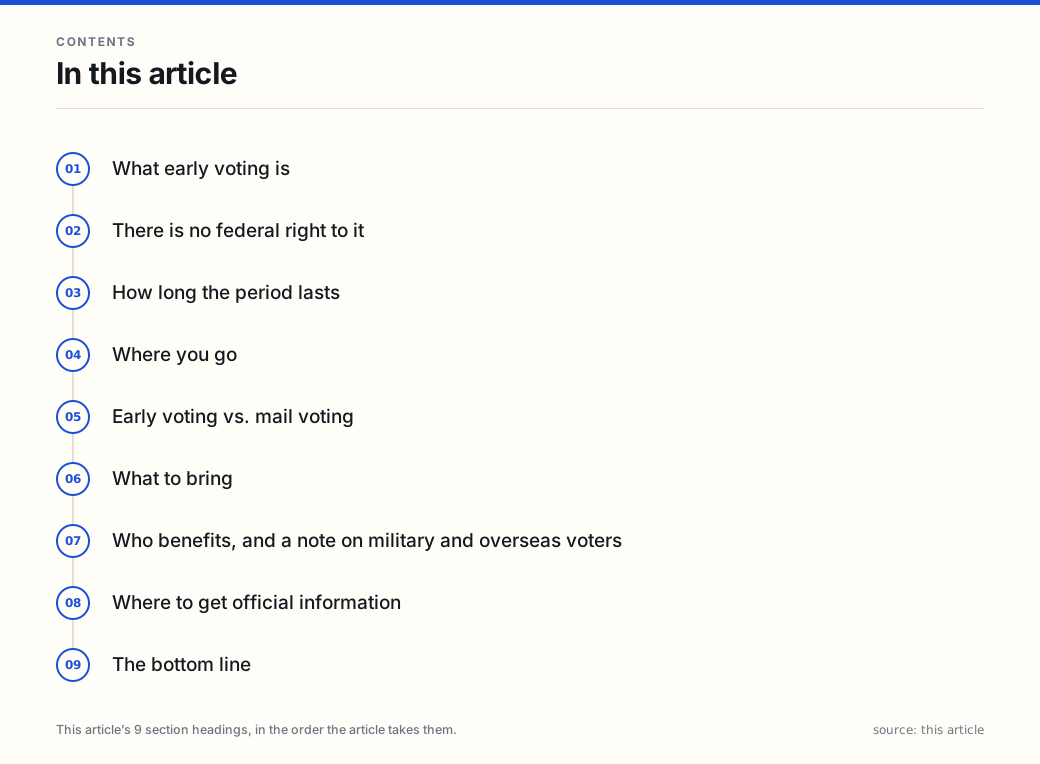
What early voting is
Early voting is casting your ballot in person at a designated site during a period set by your state, instead of at your regular precinct on Election Day. In states that offer it, you typically vote a regular ballot — not a provisional or absentee ballot — and it is counted together with the other Election Day votes once officials begin the post-election canvass.
The U.S. Election Assistance Commission frames it simply: many states let people vote in person before the official election day, and the specifics are set by each state.
There is no federal right to it
This is the single most important fact about early voting: it is a state-created convenience, not a federal entitlement. The U.S. Constitution and federal statutes do not guarantee a right to cast an in-person ballot before Election Day. Whether early voting exists, when it starts, how long it lasts, and where you go are all decided under state law.
That is why the answer to almost every “can I…?” question about early voting is “it depends on your state.” The National Conference of State Legislatures tracks which states offer it and for how long, and the variation is close to total.
How long the period lasts
There is no national standard. Some states open early voting only a few business days before Election Day. Others begin several weeks earlier — in a handful of cases, more than a month ahead. Two neighboring states can have wildly different windows.
The practical takeaway: do not assume your state’s schedule matches a friend’s in another state. Check your own state’s start and end dates.
Where you go
Early voting is usually not at your normal precinct polling place. States run it from a mix of sites:
- county or city election offices,
- satellite or branch election offices,
- and temporary locations such as libraries, community centers, or mobile units.
Because the location can change from election to election, confirm the address your state or local election office publishes before you go.
Early voting vs. mail voting
These are two different ways to vote before Election Day, and they are easy to confuse:
- Early voting is in person, at a location, during a state-set window. You mark and cast a ballot on site.
- Mail or absentee voting sends a ballot to you (or lets you request one); you return it by mail, drop box, or in person.
A few states conduct elections almost entirely by mail and automatically send every registered voter a ballot. In those states there may be little or no separate in-person early-voting period, because voting by mail is the early method. Our explainer on absentee vs. mail voting walks through that track.
What to bring
Bring what you would need on Election Day. If your state requires identification to vote, you generally must show it when voting early as well, and you should confirm your registration status first. Whether ID is required — and what kind — varies by state.
Who benefits, and a note on military and overseas voters
Early voting exists for convenience: shorter lines, more scheduling flexibility, and more time to decide. Separately, voters covered by the federal Uniformed and Overseas Citizens Absentee Voting Act (UOCAVA) — military members, their families, and citizens living abroad — receive their ballots earlier so they can return them in time. That is a distinct federal track, not the same as state early voting, but it serves the same goal of letting people vote before the day itself.
Where to get official information
- Your state or local election office — the only authority on whether early voting is offered where you live, the exact dates, the locations, and ID rules. The EAC’s state lookup points to each one: eac.gov/vote.
- vote.gov — the official federal voting-information site, in place since 2016 and administered by the General Services Administration until the EAC assumed management of the site in 2025; the EAC now operates and hosts it — state-by-state paths.
- usa.gov/voting-and-elections — the federal front door for finding state and local election offices.
- The network’s Voting & Elections topic page collects these explainers, alongside How Midterm Elections Work, How to Register to Vote in the U.S., and What Happens After Election Day.
If whether early voting is available to you matters, the answer lives at your state or local election office — not in a general explainer.
The bottom line
Early voting lets you cast a normal ballot in person before Election Day at a state-run location. It is a state-law option with no federal guarantee, so the dates, sites, and ID rules vary by state and can change. It is distinct from mail voting, which sends a ballot to you. To confirm what applies where you live, check with your state or local election office or at vote.gov.
Counsel is the law site of the Omni Mundi Compendium network. How federal agencies describe their own role in civic life is covered in What Is America.gov? The New Federal Front Door, Explained.
This article is general information about early voting in U.S. elections, not legal advice, and not official voting information. Whether early voting is offered, its dates, locations, and ID requirements vary by state and can change. Confirm current details with your state or local election office or at vote.gov before relying on them. It is AI-written and independently AI-reviewed before publication; the review standard and this article’s findings are recorded in the network’s editorial review log.
Frequently asked questions
- What is early voting?
- Early voting is casting your ballot in person at a designated location during a period before Election Day, instead of going to your regular polling place on the day itself. In most states that offer it, you vote a normal ballot — not a provisional or absentee ballot — and it is counted with the other Election Day votes once the canvass begins. The U.S. Election Assistance Commission describes early in-person voting as one of the ways states let people vote before the official election day.
- Is there a federal right to early voting?
- No. Early voting is created by state law, not by the U.S. Constitution or a federal statute. There is no federal right to cast an in-person ballot before Election Day, so whether, when, and for how long early voting is available is set state by state. The National Conference of State Legislatures tracks which states offer it and for how long; the rules differ in nearly every state.
- How long does the early voting period last?
- It varies widely by state. Some states open early voting only a few business days before Election Day; others begin several weeks — in a few cases more than a month — ahead. There is no national standard, which is why the single most important step is to check your own state's start and end dates rather than assume a neighbor's schedule applies.
- Where do I go to vote early?
- States run early voting from different kinds of sites: county election offices, satellite or branch offices, and temporary locations such as libraries, community centers, or mobile units. The location is often not your usual precinct polling place, so check the address your state or local election office publishes before you go.
- Does early voting mean the same thing as mail voting?
- No, they are distinct tracks. Early voting is in person, at a location, during a state-set window. Mail or absentee voting sends a ballot to you (or lets you request one) that you return by mail, drop box, or in person. A few states conduct elections almost entirely by mail and send every voter a ballot; in those states there may be little or no separate in-person early-voting period. Our explainer on [absentee vs. mail voting](https://law.omc.center/absentee-vs-mail-voting/) covers that track.
- What do I need to bring to vote early?
- Bring the same thing you would need on Election Day: if your state requires identification to vote, you generally must show it when voting early too, and you should confirm your registration status beforehand. The rules — including whether ID is required and what kind — vary by state; your state or local election office is the authority on what to bring.
Sources
Each source is a primary or official reference, checked before publication. Links open the original.
- U.S. Election Assistance Commission — 'Voter FAQs': many states offer early in-person voting at designated locations before Election Day, and early voting rules differ by state; the EAC points voters to state-specific information — eac.gov/voters/voter-faqs
- National Conference of State Legislatures (NCSL) — 'Early Voting': early voting is a state-created option, the states that offer it and the length of the period vary widely, and there is no uniform national rule — ncsl.org/elections-and-campaigns/early-voting
- National Conference of State Legislatures (NCSL) — 'All-Mail Elections': a small number of states conduct elections largely by mail, automatically sending every registered voter a ballot, a distinct model from in-person early voting — ncsl.org/elections-and-campaigns/all-mail-elections
- U.S. General Services Administration, vote.gov / USA.gov 'Voting and Elections': the federal front door for finding your state or local election office and each state's voting rules, including early voting availability — usa.gov/voting-and-elections